
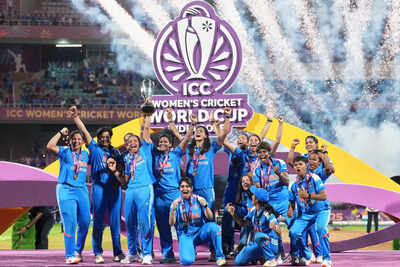
India’s players pose with the winning trophy after their win over South Africa in the Women’s World Cup. This iconic moment captures their historic achievement.
WV Raman, a former India opener and the coach who led the Indian women’s team to the 2020 T20 World Cup final (where they faced a crushing defeat against Australia in front of a massive 80,000-strong crowd at the MCG), recently shared his thoughts with TOI on the team’s incredible journey during the ODI 2025 World Cup. Here are excerpts from our conversation:
Question: There is a perception the team you coached was overwhelmed playing in front of such huge crowds in 2020. What has changed since then?
WV Raman: It’s not fair to directly link those events. The simple truth is, this team has played a tremendous amount of cricket since 2020. They’ve accumulated invaluable experience by consistently competing against top-tier teams. What’s truly beneficial is that about 70-80% of the squad from the 2020 T20 World Cup final is still actively playing. This continuity is crucial; it helps them understand each other’s game, making things smoother for captain Harmanpreet Kaur. This consistent squad selection is precisely what makes the Australian women’s team so formidable – they maintain a core group of players for at least four to five years.
Question: This team faced fierce criticism when they lost three matches on the trot…
WV Raman: This highlights the real essence of their campaign. There’s a tendency in India to focus on the negatives. Even after losing three consecutive matches, they still had a strong possibility of reaching the semifinals, yet many were quick to dismiss them. Their incredible comeback proved they are far from pushovers. I’ve always believed that India is the only team capable of truly challenging the dominant Australians. In the past, it felt like they were “so close, yet so far,” but this time, they completely flipped the script.
Question: Where and when did women’s cricket start changing for the better?
WV Raman: Before I took on the coaching role for the women’s team, I was at the National Cricket Academy (NCA) during Rahul Dravid’s tenure. That period saw the launch of numerous comprehensive programs. U-19 cricket gained significant importance, as did ‘A’ tours for women. The NCA opened its doors to women cricketers nationwide. The introduction of the U-19 World Cup, followed by the Women’s Premier League (WPL), dramatically increased exposure for these young athletes. This expanded the player pool and, crucially, taught the girls how to effectively manage high-pressure situations.
Question: How has the approach changed?
WV Raman: Previously, they were held back by a lack of access to high-performance training and facilities. Now, they regularly compete against formidable teams like Australia and England, which has effectively closed that gap. I recall, when I first became coach, the team didn’t fully believe in their T20 cricket capabilities. However, after a year of intensive high-performance training and participating in a significant tri-series in Australia leading up to the T20 World Cup, they ultimately reached the final.
Question: You had given Jemimah Rodrigues a long rope before she was dropped last year. A word on how she turned it around…
WV Raman: Often, the most profound lessons come from the toughest challenges. True experience is forged by navigating diverse and difficult situations. Jemimah is a perfect illustration of someone who refused to give up, leveraging her experiences to completely transform her game. She was already a recognized talent when she first played for India, but her performance in the semifinal truly elevated her to superstar status.
Question: Harmanpreet’s 171* vs Australia in the 2017 World Cup semifinal changed a lot of things. How much will this campaign impact the women’s game?
WV Raman: The debate around pay parity shouldn’t even exist. It’s a fundamental right, regardless of whether it directly guarantees performance. However, Harmanpreet’s phenomenal 171* against Australia in the 2017 World Cup semifinal truly shifted the landscape. It brought significant financial investment into women’s cricket. Coupled with pay parity and the Women’s Premier League (WPL), these changes have empowered more young girls to pursue cricket as a viable career. This recent campaign will only amplify that impact, leading to more international matches and further global growth for women’s cricket, which I believe is the ideal pathway for the sport’s expansion worldwide.