
The first One-Day International in Perth saw Australia clinch a decisive seven-wicket victory over India in a match significantly impacted by rain. Despite India setting a total of 136/9 from their 26 overs, the Duckworth-Lewis-Stern (DLS) method revised Australia’s target to a more manageable 131 runs. Australia comfortably chased this down with almost five overs to spare, largely thanks to an unbeaten 46 from Mitch Marsh. This defeat unfortunately brings an end to India’s impressive eight-match ODI winning streak in 2025.
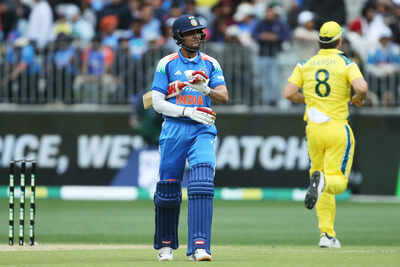
In a curious turn of events during the Perth ODI, Australia found themselves needing to chase 131 runs, even though India had managed to score 136/9. This revised target was a direct consequence of multiple rain interruptions that plagued the match.
The highly anticipated match at Perth Stadium, marking the international return of star players Rohit Sharma and Virat Kohli, was repeatedly disrupted by rain. What began as a 50-over contest was first cut to 49, then to 35, subsequently to 32, and finally settled at a mere 26 overs per side after a frustrating fourth rain delay.
Despite the challenging stop-start nature of the game, KL Rahul played a crucial knock, scoring 38 off 31 balls, while Nitish Kumar Reddy’s quickfire unbeaten 19 from 11 deliveries bolstered India’s total. However, the much-anticipated returns of Rohit Sharma (8 runs) and Virat Kohli (duck) were short-lived. Axar Patel added a valuable 31, and Shubman Gill and Washington Sundar each contributed 10 runs. The intermittent rain clearly hindered the Indian batsmen’s ability to build sustained momentum.
The application of the Duckworth-Lewis-Stern (DLS) method resulted in Australia’s target being adjusted downwards to 131. This calculation took into account the initial, more favorable batting conditions India experienced with a dry outfield and a longer powerplay before the rain interruptions. Crucially, Australia then had the distinct advantage of knowing their precise target and could plan their chase accordingly, without the uncertainty that plagued India’s innings.
Australia’s chase was spearheaded by Mitch Marsh, who played a commanding unbeaten innings of 46 runs. His efforts, combined with solid partnerships – 34 with Matthew Short, 55 with Josh Philippe (who scored 37), and an unbroken 32 with debutant Matt Renshaw (21 not out) – ensured Australia comfortably reached their revised target of 131 with almost five overs to spare, securing a seven-wicket win.
Earlier, KL Rahul was the backbone of the Indian innings, steadying the ship after a flurry of early wickets. He formed a 39-run partnership with Axar Patel and later added 31 runs with Washington Sundar. However, a rapid collapse followed Rahul’s dismissal, with India losing three wickets for just three runs. It was Nitish Reddy’s spirited unbeaten 19, featuring two towering sixes, that ultimately pushed India to their final total.
India’s top order endured a torrid start, with Rohit Sharma, Shubman Gill, and Virat Kohli collectively contributing a mere 18 runs. This marked India’s lowest top-three aggregate in men’s ODIs since 2019. Josh Hazlewood drew first blood, having Sharma caught at second slip by Renshaw in the fourth over. Mitchell Starc then stunned India by dismissing Kohli for a duck, thanks to a spectacular diving catch at gully by Cooper Connolly. Nathan Ellis joined the wicket-taking spree, getting Gill caught behind down the leg side, and Hazlewood further deepened India’s woes by removing Shreyas Iyer for 11 runs.
The bilateral series is set to continue with remaining One-Day Internationals in Adelaide and Sydney, leading into a five-game Twenty20 International series commencing on October 29th.
Reflecting on the match, India’s captain Shubman Gill acknowledged the uphill battle: “When you lose three wickets in the powerplay, you’re always trying to play a catch-up game. There are many learnings and positives for us from this game. We were defending 130 and managed to take the game quite deep, which was satisfying. We are truly fortunate for the immense fan support, and we hope they’ll continue to cheer us on in Adelaide.”
This result signifies India’s first ODI defeat of 2025, bringing an end to their impressive streak of eight consecutive victories. Furthermore, the loss means Shubman Gill now joins a select list of Indian captains, including Virat Kohli, who have started their captaincy tenure across all three formats with a defeat.