
India delivered a masterful performance, achieving a decisive 2-0 Test series sweep against West Indies with a dominant seven-wicket victory in the second match held in New Delhi. This triumph also marked Shubman Gill’s inaugural series win as Test captain. The Indian squad, requiring just 58 runs to chase down the 121-run target, sealed the victory within approximately an hour. KL Rahul was instrumental, scoring an unbeaten 58 runs and contributing significantly as India claimed all 40 opposition wickets throughout the two Tests.
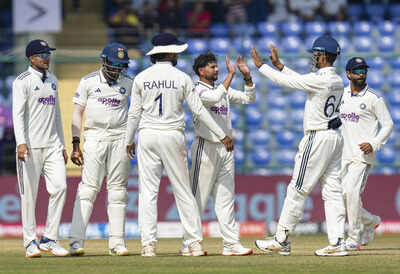
On the final day, KL Rahul, alongside Dhruv Jurel (6 not out), steered India comfortably to the target in 35.2 overs. Rahul’s stellar innings, featuring six fours and two sixes, was highlighted by a pivotal 79-run second-wicket partnership with Sai Sudharsan (39).
Despite the final outcome, the second Test stretched into the fifth morning thanks to resilient centuries from West Indies batsmen John Campbell (115) and Shai Hope (103), complemented by a stubborn tenth-wicket stand. The Feroz Shah Kotla pitch presented a consistent challenge, remaining low and slow and providing very little assistance to the spinners throughout the match.
The Indian bowling unit showcased its formidable skill across both Tests. Their pacers excelled even on uncooperative surfaces, while the spinners demonstrated remarkable patience, adapting effectively when conditions at the Kotla weren’t in their favor.
India’s batting lineup also shone brightly, with their top six batsmen collectively amassing five centuries and one score just shy of 90 runs across the two matches, underlining their comprehensive dominance.
During the presentation ceremony, captain Shubman Gill commented on his leadership, stating, “I am getting used to managing this side. Sometimes you have to take bold decisions.”
Kuldeep Yadav’s exceptional eight-wicket haul, highlighted by a five-wicket performance in the first innings, earned him the Player of the Match award. Ravindra Jadeja was deservingly named Player of the Series for his superb all-round contributions.
While India’s series victory was undoubtedly comprehensive, it is important to note the inexperience of the West Indies squad. Their top-order batsmen currently average below 35 in Test cricket, and with the exception of Jayden Seales, their bowling attack largely lacked significant first-class experience.
This loss marked a difficult record for Roston Chase, who became only the second West Indies captain, after Kraigg Brathwaite, to lose all of his first five Tests at the helm.
Reflecting on the series, Chase remained optimistic at the presentation ceremony: “I think the guys we have here are some of the best players in the Caribbean. So it’s just for us to use this last Test match as a stepping stone…We just have to keep improving as much as we can from here.”
Looking ahead, India’s next major challenge will be a two-Test series against South Africa scheduled for next month. Preliminary insights from the ongoing South Africa-Pakistan series suggest that pitch conditions featuring turn and variable bounce could play a pivotal role, as evidenced by spinners accounting for 15 out of 16 wickets in the first two days of that series.
The South African batting contingent, boasting talents such as Aiden Markram, Ryan Rickelton, and Dewald Brevis, is anticipated to pose a much sterner challenge than what the West Indies offered.
Despite being relatively young overall, India’s batting lineup, anchored by seasoned players like KL Rahul and Ravindra Jadeja, also features promising talents such as Yashasvi Jaiswal and Shubman Gill, who have proven capable of performing on demanding pitches.
The effectiveness of India’s spin attack often depends on the pitch. While Ravindra Jadeja and Washington Sundar tend to be less impactful on unhelpful surfaces, Kuldeep Yadav’s wrist spin offers a distinct and more potent advantage in such conditions.
Choosing the right venues for the upcoming South Africa series will be critical. Eden Gardens, for instance, is known to assist seam bowlers during the early and late sessions of play, while generally remaining a strong batting surface.
Adding to the anticipation, Barsapara Stadium in Guwahati is set to host its inaugural Test match, introducing an intriguing element of unpredictability concerning pitch behavior and overall match dynamics.
This South Africa series holds considerable importance as it will be India’s final red-ball cricket engagement before their away series in Sri Lanka, which is scheduled for eight months later.