
NEW DELHI: Harjas Singh, Australia U-19’s star performer who notched a crucial 55 against India U-19 in last year’s World Cup final, leading Australia to their first U-19 title in 14 years, is once again making headlines. While some of his teammates like Sam Konstas have already debuted in Test cricket for Australia, and others like Oliver Peake and Harry Dixon have swiftly advanced to Australia A, Harjas has been on a relentless journey to carve his own niche.
“Most of my teammates are playing for Australia A or are in the Australia squad. It makes no difference. Everyone has their own journeys, their own paths, their own timeframe,” the 20-year-old reflects, emphasizing that success comes at different ages. “You could still go pro at 25, or at 27, or you could go pro at 16, like some of the greats such as Sachin (Tendulkar).”
Just last week, Harjas became the newest sensation in Australian cricket, featuring on podcasts with legendary captains Michael Clarke and Brad Haddin, and earning a coveted maiden call-up to the New South Wales Second XI.
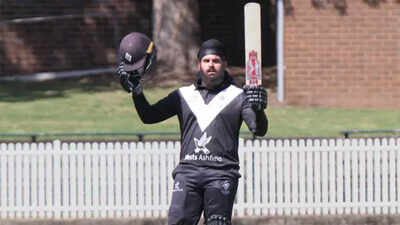
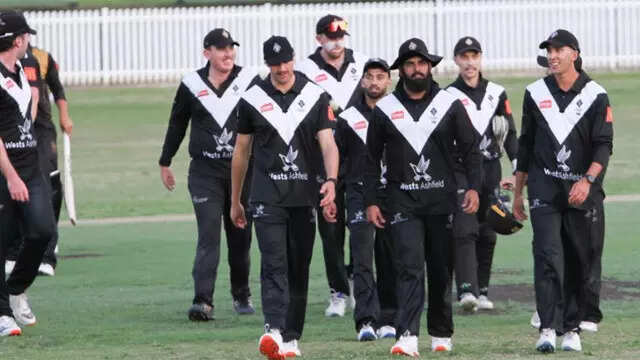
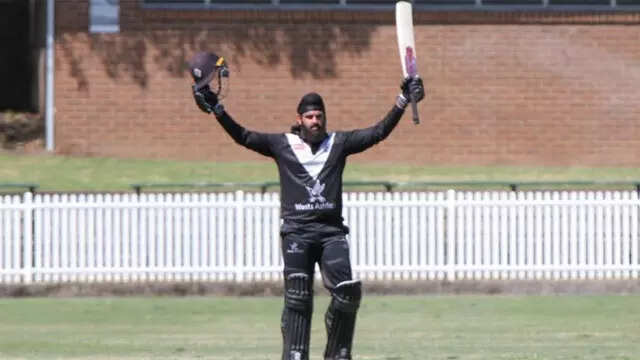
This whirlwind of recognition followed an extraordinary innings where he smashed an unbeaten 314 runs off just 141 balls. This monumental knock, featuring an incredible 35 sixes, propelled his club, Western Suburbs, to a colossal 483 for 5 against Sydney Cricket Club. The next highest score in his team was a mere 37, highlighting the sheer dominance of Harjas’s batting. Western Suburbs ultimately won by 186 runs.
Coming in at No. 3 in the 11th over, Harjas raced to his century in just 74 balls. He then unleashed a stunning assault, adding an astonishing 214 runs off his next 67 deliveries. This breathtaking performance became the third-highest individual score in NSW Premier first-grade history and shattered a 120-year-old record for the most sixes in an innings, surpassing Victor Trumper’s 22 sixes from the 1902/03 season.
The impact of his power-hitting was so profound that approximately $2000 worth of cricket balls went missing during his rampage. “It was fun,” he chuckles. “Honestly, I have no idea how I hit those runs and sixes. After 100, my intention was just to hit every ball for six. And yeah, they just kept going, so I just kept swinging.”
Harjas emphasizes the competitive nature of Australian Premier First Grade cricket, noting it’s where players earn contracts for Sheffield Shield teams and capture the attention of Big Bash League (BBL) franchises. “It’s one level below where you become a professional cricketer. All the professional cricketers from Australia who play state cricket are chosen from New South Wales first grade,” explains Singh, who honed his skills under the guidance of renowned coach Neil D’Costa, known for coaching stars like Michael Clarke, Phil Hughes, and Marnus Labuschagne.
Family’s Sacrifice
Harjas hails from a family with a strong sporting background. His father was a state boxing champion in Punjab, and his mother was a long jumper. They immigrated from Chandigarh to Australia in 2000.
As an Indian-origin immigrant, the 20-year-old witnessed his parents, Inderjit Singh and Avinder Kaur, dedicate themselves to supporting his cricketing aspirations. “My parents are bus drivers, both of them,” he shares. “For every parent who has a son who is a cricketer, sacrifices always have to be made — straight after work, taking them to training, late nights, early mornings, making sure their clothes are ready when they were younger. Financially, it’s a big thing too — buying pads, bats, all that stuff.”
Harjas maintains strong ties to his roots, frequently visiting Chandigarh, where his uncle and other family members reside. “I went to Chandigarh two years ago. We live in Sector 44-D. I still have family back in Chandigarh and Amritsar.”
A few years prior, in a podcast with SBS Punjabi, Harjas candidly discussed the additional effort required due to his identity. “If you look different from others, you have to do something different and much more to maintain that identity and your place in the field,” he had stated.
Recounting his parents’ emotional reaction to his record-breaking knock, Harjas says: “My family’s reaction was priceless. During the innings break, I spoke to my mom. She said, ‘I checked your score when you were on 260 and couldn’t believe it — my legs started shaking.’ And my dad, when I spoke to him, was in tears. It was quite emotional and special.”
The Change in Technique
Harjas readily admits that recent technical adjustments have played a crucial role in his ability to hit those enormous sixes. “I’ve definitely worked on it. It’s something I’ve focused on throughout the off-season. I’ve been doing that with my coach Darius (Visser) at Hype Cricket. It’s been in the works for about three or four months,” he explains.
Interestingly, this isn’t his first major technical shift. While he’s right-handed in most activities, he bats left-handed. This switch happened by chance in his childhood; to avoid breaking glass windows while batting right-handed in the backyard, he simply started batting left-handed and stuck with it. He still bowls right-arm medium pace and throws with his right hand.
Throughout his young career, Harjas has also adapted to various roles in the batting order. “I move around in different formats. For my club currently in Tier II, I open the batting. In one-day matches, I bat at number three, and in two-day games, I bat at number four,” he says.
More Eyeballs
Despite his youth, Harjas possesses a mature outlook and remains unfazed by the sudden surge of attention. “After 35 sixes, there will be more eyeballs for sure. I’m not going to let that distract me from doing my job, which is scoring runs,” he states calmly.
“I don’t think it’s overwhelming,” he reasons. “I mean, it’s definitely something I’ll look out for in the future, which thankfully I’m ready for now. It has caught me a little off guard, but that’s all part of it, and it’s something I have to manage.”
He acknowledges the dual nature of social media attention. “When you’re on social media, you get all sorts of attention — good and bad. It’s a different skill to not let it affect you and to stay focused on what you need to do. Again, my main aim is to perform in the next match.”
When asked about his remarkable maturity, the youngster smiles: “I think it’s something I’ve ingrained into my speech and my actions. It hasn’t been easy, but it’s definitely been a journey.”
The Future
Former Australia captain Michael Clarke has already predicted that Harjas will soon secure contracts from IPL and BBL teams. However, Harjas remains grounded, understanding that consistency is paramount. “There’s a long way to go. One innings doesn’t define your career. You need consistency and back-to-back performances,” he wisely notes.
“Honestly, I couldn’t tell you about my future or where I’ll be in a few years. My aim is to perform in the next match I play. I like to take things day by day and not look too far ahead,” he concludes.
A true Gen Z spirit, Harjas is unburdened by distant future concerns. For now, he finds joy grooving to Karan Aujla’s hit song “Gabhru,” relishing homemade Shahi Paneer, and has one more promise to make: he’s coming for his own record again. “I’ll go for it again for sure,” he signs off with a confident grin.