
The second day of the opening Test in Ahmedabad saw an exceptional performance from India’s batting lineup, leaving the West Indies reeling. KL Rahul led the charge with his eleventh Test century, marking an end to his long wait for a home hundred. He was brilliantly supported by Dhruv Jurel and Ravindra Jadeja, who also scored aggressive and elegant centuries. By the close of play, India had amassed a formidable 448 for 5, holding a significant lead of 286 runs, and are now in a dominant position to clinch the match as early as day three.
Each of the centurions—Rahul (100 off 197 balls), Jurel (125 off 210 balls), and Jadeja (104* off 176 balls)—showcased their unique batting styles. Rahul’s innings was a masterclass in controlled elegance, Jurel impressed with his confident and free-flowing strokes, while Jadeja unleashed his characteristic aggressive flair. Their collective efforts cemented India’s commanding position. The celebrations were equally memorable: Rahul paid tribute to his infant daughter with a helmet kiss, Jurel offered a poignant gun-salute to the Indian Army, and Jadeja delighted the crowd at the Narendra Modi Stadium with his signature sword celebration.
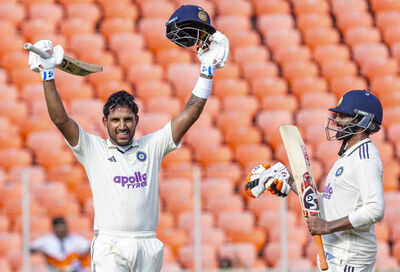
India’s Dhruv Jurel (left) celebrates his century with Ravindra Jadeja. (PTI Photo)
Resuming the day at 121 for 2, Rahul partnered with Indian captain Shubman Gill, contributing 98 runs for the third wicket. Gill’s innings ended at 50 when he was caught attempting a reverse sweep off Roston Chase. Rahul then meticulously built his 11th Test century, displaying impeccable timing and control, and finally breaking his nine-year drought for a home Test hundred, a feat last achieved against England in December 2016. Though he had an early scare with an edge off Jayden Seales, Rahul continued to dominate until he was dismissed post-lunch, caught sharply by Justin Greaves at extra cover. His monumental innings provided a solid platform for India’s formidable total and paved the way for the middle-order to launch their assault.
After Rahul’s departure, Dhruv Jurel and Ravindra Jadeja took over, significantly boosting the scoring rate. Jurel achieved his first-ever Test century in only his sixth match, scoring an impressive 125 runs, including 15 fours and three sixes, before being dismissed by debutant Khary Pierre. Not to be outdone, Jadeja unleashed a powerful innings, smashing 104 runs with six fours and five sixes, and in doing so, he surpassed MS Dhoni’s record for the most sixes by an Indian batter in Test cricket. Their brilliant 206-run fifth-wicket partnership was just shy of the 214-run record held by VVS Laxman and Sachin Tendulkar against West Indies in 2002.
The duo played aggressively, capitalizing on every loose delivery and exploiting the wear and tear on the pitch. Jadeja was particularly potent against spin, stepping out to clear the ropes with ease, while Jurel demonstrated a perfect blend of careful defense and aggressive strokeplay to maintain momentum. Their persistent attack left the West Indies bowlers disheartened and unable to apply sustained pressure on a pitch that was offering increasing assistance to the spinners.
As Day 2 concluded, India stood in an unassailable position, having reached 448 for 5 after 128 overs. Despite the West Indies spinners finding significant turn and bounce from the deteriorating pitch, India’s strategic partnerships and aggressive counter-attacking strategy nullified their threats. With such a substantial lead, India is highly favored to secure a victory on the third day, thereby strengthening their standing in the World Test Championship.