
In a thrilling, rain-affected One Day International in Perth, Australia found themselves chasing a revised target of 131 runs, not the original 136, after multiple interruptions plagued India’s innings. India had managed to post 136/9 in their allotted 26 overs.
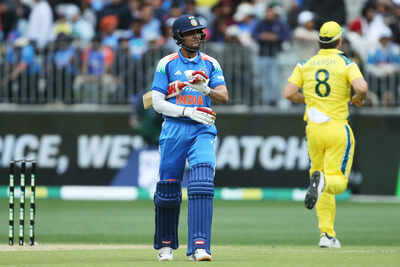
India’s Shubman Gill departs after being dismissed by Australia’s Nathan Ellis. (AP Photo)
The match at Perth Stadium marked the highly anticipated return of star players Rohit Sharma and Virat Kohli to international cricket. However, the weather had other plans, with rain halting play four times throughout India’s batting. Initially, the match was curtailed to 49 overs, then further reduced to 35 overs after the second break. More rain meant a further reduction to 32 overs, before officials finally settled on a 26-over contest after the fourth delay.
For India, KL Rahul was a standout performer, scoring 38 off 31 balls. Nitish Kumar Reddy also contributed significantly with an unbeaten 19 from just 11 deliveries, helping India reach their final total. In contrast, Rohit Sharma managed only eight runs, and Virat Kohli was unfortunately dismissed for a duck. Axar Patel added 31 runs, while Shubman Gill and Washington Sundar each scored 10. The constant rain breaks clearly hindered the Indian batters from building momentum.
The crucial adjustment in Australia’s target to 131 was made using the Duckworth-Lewis-Stern (DLS) method. This calculation factored in India’s more favorable initial batting conditions, including a dry outfield and an extended powerplay. This DLS revision gave Australia a distinct advantage, as they knew their exact target and could plan their chase accordingly, assuming no further rain delays.
Mitch Marsh spearheaded Australia’s successful chase, guiding them to a decisive seven-wicket victory with an unbeaten 46 runs. Australia comfortably reached their revised target of 131 with nearly five overs to spare. Marsh built solid partnerships: 34 runs with Matthew Short, an impressive 55 with Josh Philippe (who scored 37), and an unbeaten 32 with Matt Renshaw, who remained 21 not out on his ODI debut.
Earlier, KL Rahul had valiantly anchored India’s innings after early wickets threatened to derail their score. He forged a 39-run partnership with Axar Patel and later added 31 runs with Sundar before his dismissal. Following Rahul’s exit, India suffered a quick collapse, losing three wickets for just three runs. It was Nitish Reddy’s quickfire 19, including two sixes, that pushed India to their eventual total. India’s top order struggled significantly, with Rohit Sharma, Shubman Gill, and Virat Kohli collectively managing only 18 runs, marking India’s lowest top-three aggregate in men’s ODIs since 2019.
Australian bowlers capitalized on India’s struggles. Josh Hazlewood dismissed Sharma in the fourth over, caught by Renshaw at second slip. Mitchell Starc then claimed Kohli’s wicket with a spectacular catch at gully by Cooper Connolly. Nathan Ellis removed Gill, caught behind down the leg side, before Hazlewood picked up his second wicket, sending Shreyas Iyer back for 11 runs.
The series is set to continue with further ODIs in Adelaide and Sydney, followed by a five-game T20 series commencing on October 29.
Reflecting on the match, India Captain Shubman Gill stated, “When you lose three wickets in the powerplay, you’re always trying to play a catch-up game. A lot of learnings for us from this game and a lot of positives for us as well. We were defending 130 and we took the game, not till the very end, but pretty deep. We were very satisfied with that. We are very fortunate. The fans turned up in huge numbers and hopefully they’ll be able to cheer us on at Adelaide as well.”
This defeat marks India’s first ODI loss in 2025, bringing an end to their impressive streak of eight consecutive victories. Additionally, Shubman Gill joins Virat Kohli as one of the Indian captains to lose his inaugural match in charge across all three formats.