
In Delhi, as the second Test approaches, the stark contrast between India’s cricketing prowess and the West Indies’ struggles is once again a major talking point. Following India’s dominant innings-and-140-run victory in Ahmedabad, it’s clear the gulf in standards remains vast. Yet, both nations, in their unique ways, confront a shared challenge: the absence of truly iconic megastars in their current lineups.
For years, Indian cricket celebrated individual heroics and nurtured a ‘superstar culture’. However, Team India is now consciously shifting away from this, aiming to build a more inclusive and cohesive unit focused on sustained success across all formats. This strategic pivot, aimed at reducing reliance on individual brilliance, has largely been well-received.
Meanwhile, the West Indies, a team yearning for the return of its past legends, finds itself in a dramatically different predicament. Their head coach, Darren Sammy, candidly described the sport’s deep-rooted decline in the Caribbean as a ‘cancer in the system,’ a stark contrast to India’s ‘problem of plenty.’
Sammy elaborated on the severity of the situation, stating, ‘We’re open to criticism, but the root of this problem didn’t start two years ago. It’s a deeply embedded cancer within our system, not just a surface-level issue.’ He humorously highlighted the team’s long struggle, noting, ‘The last time we won a Test series was in 1983 – my mother had just had me!’
For Sammy, the absence of charismatic, influential players that young fans admire and aspire to emulate represents an existential threat. He believes the West Indies must rekindle its star power to remain relevant. Strikingly, Sammy revealed a profound challenge: convincing young cricketers to commit to a unified ‘West Indies’ team – a problem unheard of during their golden age in the 1970s, ’80s, and early ’90s. ‘Now, when I call a player to inform them they’ve been selected for the West Indies,’ Sammy lamented, ‘I just hope they accept.’
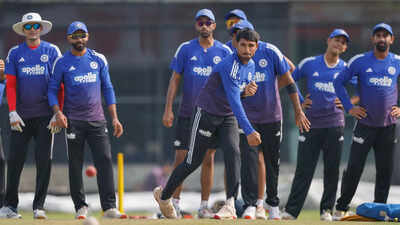
This stark reality is a world away from India’s current cricketing landscape, where a wealth of talent creates intense competition for squad spots – a dynamic the younger Indian players, training at the Kotla, would barely comprehend. However, even with this abundance, the team’s ambitious new direction under head coach Gautam Gambhir and chief selector Ajit Agarkar is still very much a work in progress.
As cricket legend Brian Lara recently noted, ‘Smaller nations, with their inability to draw huge crowds or secure major sponsorships, are truly straining their financial resources.’ This challenge, he suggested, extends beyond just the struggling teams.
Paradoxically, even as the luminous appeal of Virat Kohli and Rohit Sharma seems to be downplayed in favor of team unity, Indian cricket appears to be centralizing power in a new way: through the elevation of Shubman Gill as Test and ODI captain and T20I vice-captain. Gill’s rise signifies an implicit recognition that Indian cricket still requires fresh megastars to captivate audiences, not just efficient winning machines. A sport thrives on its stars, and the noticeably empty stands in Ahmedabad served as a stark reminder of Indian cricket’s transitional phase – hopefully a temporary one. While India exerts significant structural and financial influence over global cricket, this dominance ultimately relies on the iconic personalities who define it. The challenge is clear: Indian cricket must evolve beyond ‘star privilege’ but absolutely needs ‘star impact.’ If the West Indies face a systemic crisis, India’s ascendancy risks feeling somewhat detached. The second Test at Kotla is unlikely to alter this narrative or fill the stadium.