
On March 30, 2025, Prime Minister Narendra Modi, himself a former RSS pracharak (full-time volunteer), made a historic visit to the Rashtriya Swayamsevak Sangh (RSS) headquarters in Nagpur, hailing it as “India’s banyan tree of immortal culture and modernization.” This significant visit coincided with the RSS’s centenary year. Founded on Vijaya Dashami in 1925 by Keshav Baliram Hedgewar, a physician from Nagpur, the RSS emerged with a powerful vision: to transform India into a ‘Hindu Rashtra’ through cultural and religious rejuvenation. What began as a single shakha (a local branch or theological school for volunteers, known as swayamsevaks) has blossomed into a vast network of over 127,367 shakhas across 51,570 locations in India. Despite its controversial past, including being banned thrice in independent India, the RSS today exerts substantial ideological, political, and social influence nationwide. This multi-part series delves into the Sangh’s genesis, core beliefs, organizational framework, and its journey from pre-Independence India to its contemporary standing.
The Early Days
Roughly forty years after the Indian National Congress (INC) was established in 1885, a growing demand emerged for an alternative political voice. Certain leaders within the Congress began to champion a more assertive brand of nationalism. Parallelly, organizations like the Hindu Mahasabha and the Muslim League actively promoted their distinct religious agendas, though united by the overarching goal of liberating India from British rule, as detailed by author Dinesh Narayanan in ‘The RSS and the making of The Deep Nation’. Both these groups drew inspiration from contemporary ideological currents in Europe.
K.B. Hedgewar, a prominent figure in the Hindu Mahasabha, found profound inspiration in Bal Gangadhar Tilak, a pioneer in challenging the moderate approaches of the Congress. Hedgewar observed that Hindu society was fractured by divisions of caste, region, and sect. To counter this, he initiated the creation of shakhas—local gatherings designed to foster unity within the community. His vision was for these spaces to instill discipline and a strong sense of belonging among young Hindu men. As the shakhas gained popularity and attracted more participants, their meeting locations frequently changed.
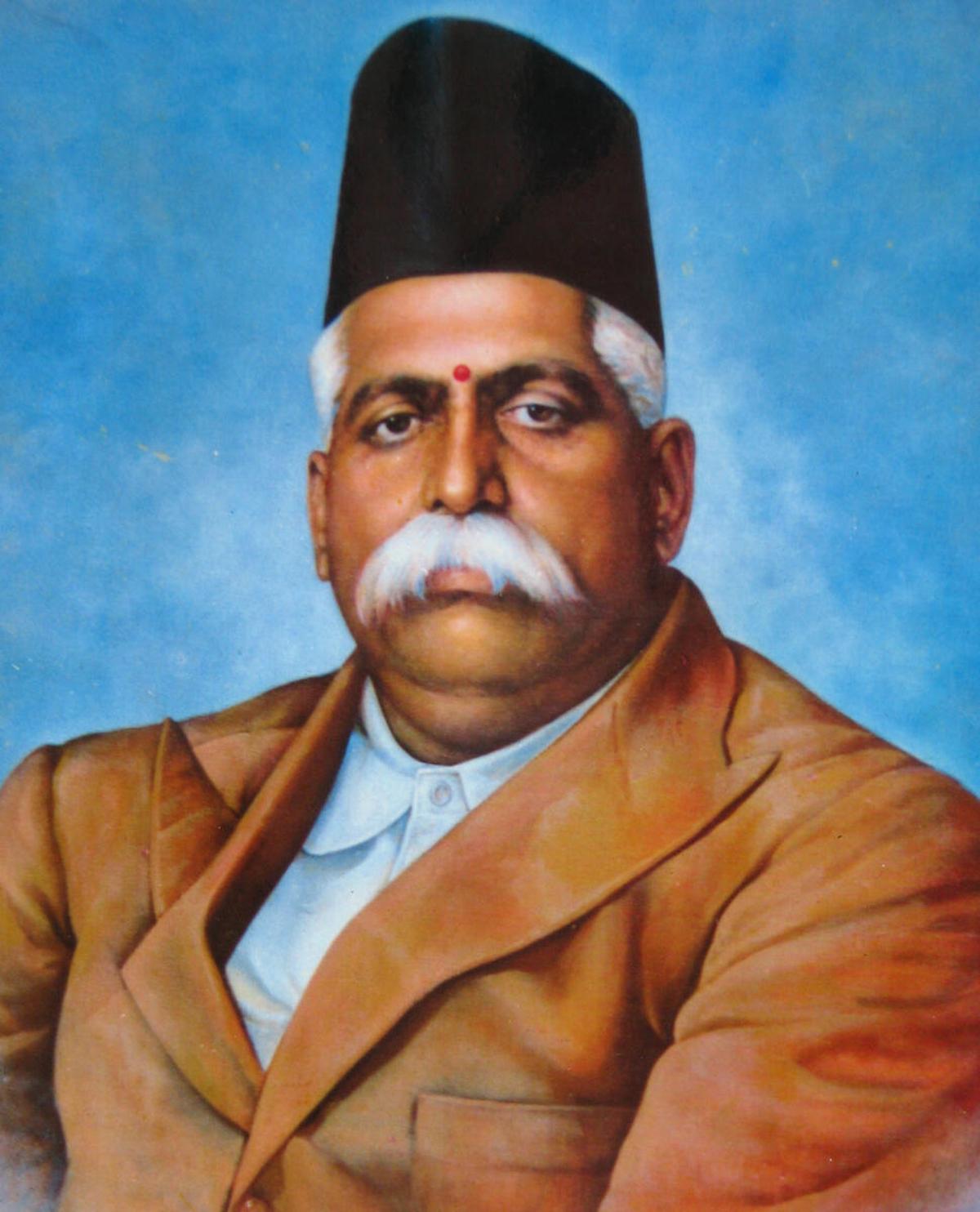
RSS founder Keshav Baliram Hedgewar. File
In 1926, at a pivotal meeting, twenty-six swayamsevaks, including foundational figures like Balaji Huddar, Bhauji Kawre, Bapurao Bhedi, Anna Sohni, and Vishwanathrao Kelkar, deliberated on a name for their burgeoning cultural initiative. Several suggestions emerged, such as Jari Patka Mandal, Bharat Udharak Mandal, and Hindu Sevak Sangh. Despite debates over whether an organization dedicated to Hindu unity could truly be ‘rashtriya’ (national), Hedgewar’s vision ultimately prevailed, leading to the adoption of the name Rashtriya Swayamsevak Sangh (RSS).
Although Hedgewar had been an active participant in the Congress, even joining the Non-Cooperation Movement, he gradually distanced himself from the party. He became increasingly disillusioned with the Congress’s perspectives, especially its inclusive approach to nationalism, which sharply contrasted with his own concept of Hindu nationalism and Mahatma Gandhi’s support for the Khilafat movement.
Nevertheless, in 1928, Hedgewar attended the Calcutta Session of the Congress, where he encountered prominent figures such as Subhas Chandra Bose, G.D. Savarkar, and V.D. Savarkar. Narayan recounts that “Dr. Hedgewar was annoyed that Bose would not give up on Hindu-Muslim unity even though he tried to impress upon him that the idea was meaningless and found himself more in agreement with Savarkar.” The significant influence of the Savarkar brothers on the Sangh is undeniable, with the RSS’s foundational tenets drawing directly from V.D. Savarkar’s seminal work on Hindutva, ‘Essentials of Hindutva’.
A 2023 publication by the RSS, titled ‘About RSS’, articulates the Sangh’s core ambition: “to make our country, Bharat, a pioneer in science and knowledge, economically self-reliant and prosperous.”
Beyond these objectives, the RSS adheres to Savarkar’s philosophy of Hindutva, which posits that “India or Bharat (as the RSS refers to it) is a Hindu nation. While anyone can be its citizen, only Hindus possess a civilizational claim to it.” The organization also aspires to restore ‘Akhand Bharat,’ an undivided India encompassing a vast geographical area from ‘Gandhar’ (Kandahar, Afghanistan) to Pakistan, Trivishtap (Tibet), ‘Bramhadesh’ (Myanmar), Bangladesh, Bhutan, Nepal, and Sri Lanka. This envisioned ‘Bharat’ is believed to become a ‘Vishwa Guru,’ or a global leader, with Indian culture and lifestyle guiding the world.
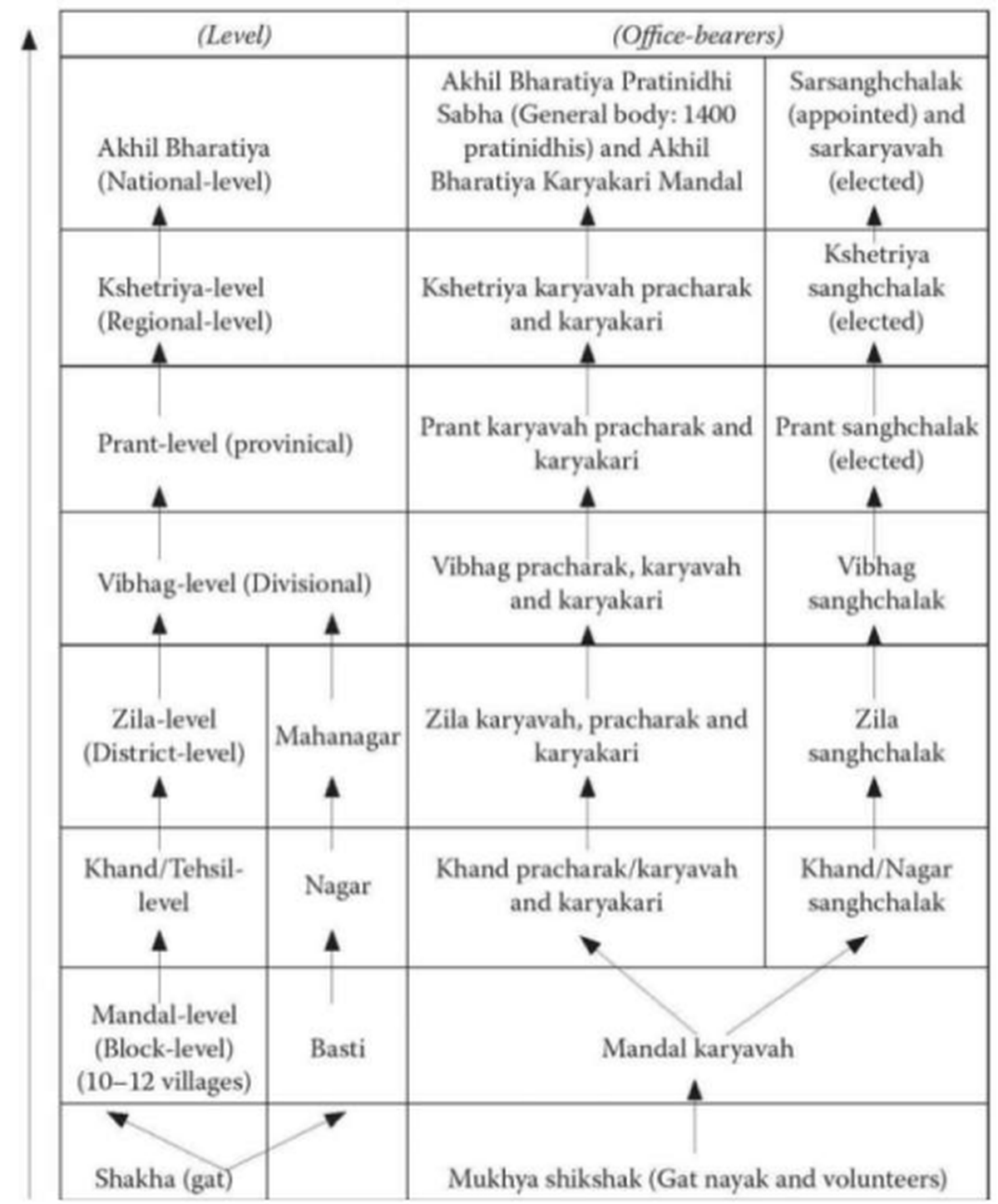
With the formalization of its leadership, Hedgewar was appointed as the Sarsanghachalak (chief) of the RSS. Balaji Huddar assumed the role of Sarkaryavah (general secretary), and Matandrao Jog became Sarsenapati (chief trainer). By this juncture, Hedgewar had formally severed ties with the Congress. Under his guidance, the RSS established 18 shakhas throughout Nagpur, and in 1928, the inaugural cohort of 99 swayamsevaks was initiated into the Sangh at Mohitewada.
The organization also drew inspiration from fascist ideologies. On March 19, 1931, founding member B.S. Moonje held a meeting with Italian dictator Benito Mussolini at the fascist government’s headquarters in Palazzo Venezia. Italian scholar Marzia Casolari’s research reveals that Moonje documented his visits to military schools and youth party wings responsible for indoctrinating children under the regime. During his discussion with Mussolini, Moonje remarked, “Every aspiring and growing nation needs such organisations. I have already started an organisation of my own, conceived independently with similar objectives. I shall have no hesitation to raise my voice from the public platform both in India and England when occasion may arise in praise of your Balilla and Fascist organisations.” Upon his return to India, Moonje systematically shaped the RSS’s organizational framework along similar lines.
In 1930, in response to the Congress’s declaration of ‘Poorna Swaraj’ (complete independence from British rule), all RSS shakhas observed January 26 as India’s independence day. Notably, unlike the Congress, the RSS chose to hoist the saffron flag rather than the national tricolour.
During the 1930s, the Jungle Satyagraha, a significant part of the Civil Disobedience Movement, took place. This protest targeted restrictive British forest laws that denied Indians, particularly tribal and rural populations, their traditional rights to forest access. Although Hedgewar and a number of swayamsevaks personally joined the Jungle Satyagraha, Hedgewar explicitly prohibited the RSS from official involvement.
The British Raj soon viewed the Sangh with suspicion. Between 1932 and 1934, a series of circulars were issued, prohibiting government employees from joining the RSS, on the grounds that they “were taking part in communal activities.” On March 3, 1934, the British government officially labeled the Sangh a ‘Nazi’ organization. This controversial classification was challenged by Councillor V.D. Kolte of Bhandaras, who moved a one-rupee cut motion in the Central Province Legislative Assembly’s Budget session. Kolte argued that this classification unfairly targeted the Hindu community, noting that similar Muslim, Depressed Class, and other communal organizations were not included. In a surprising display of solidarity, the Assembly passed a resolution condemning the British government’s directive. Although the British never formally revoked the order, they also refrained from enforcing it.

On June 21, 1940, Keshav Baliram Hedgewar passed away, and the leadership of the RSS transitioned to Madhav Sadasiva Golwalkar. A former teacher and lawyer who had embraced monastic life within the Ramakrishna order, Golwalkar took the helm of an RSS that, while not yet a political entity, was already making significant cultural inroads, particularly in central India.
The Era of Golwalkar
Madhav Sadasiva Golwalkar, a teacher at Banaras Hindu University (BHU), first met Hedgewar during the RSS founder’s visit to the institution in 1931. Deeply affected by the Hindutva philosophy espoused by Madan Mohan Malaviya, Golwalkar soon joined the RSS. Though he later became part of the Ramakrishna Mission, he returned to the RSS after the death of his mentor, Swami Akhandananda, in 1937, eventually becoming its Sarsanghachalak.
As Narayan points out, “Unlike RSS leaders who were weaned on Savarkar’s ideas and known atheists, Golwalkar was a monk.” His powerful oratorical skills in both Hindi and English were instrumental in shaping the Sangh’s foundational text, ‘We or Our Nationhood Defined’. Under Golwalkar’s leadership, the RSS expanded its reach across both northern and southern India, gradually diverging from Savarkar’s more militant Hindu Mahasabha.
Golwalkar’s pivotal book, ‘We’, published in 1939, introduced his concept of a ‘Hindu Rashtra’. Drawing inspiration from G.D. Savarkar’s 1934 work, ‘Rashtra Mimansa’, Golwalkar’s treatise described a nation as “a people who considered a land their mother and themselves its sons. These people should have a common system of conduct, same dreams, tradition, heroes and carry the same historical burdens and glory. They should consider other communities that gave them joy as friends and those that invaded them and gave them pain as enemies.”
Geographically, Golwalkar’s vision for the Hindu Rashtra extended from the Himalayas in the north to the Indian Ocean in the south. He famously declared, “We have to establish that in this land Hindu means nation and nation means Hindu. That is why the Sangh is called the Rashtriya Swayamsevak Sangh.”
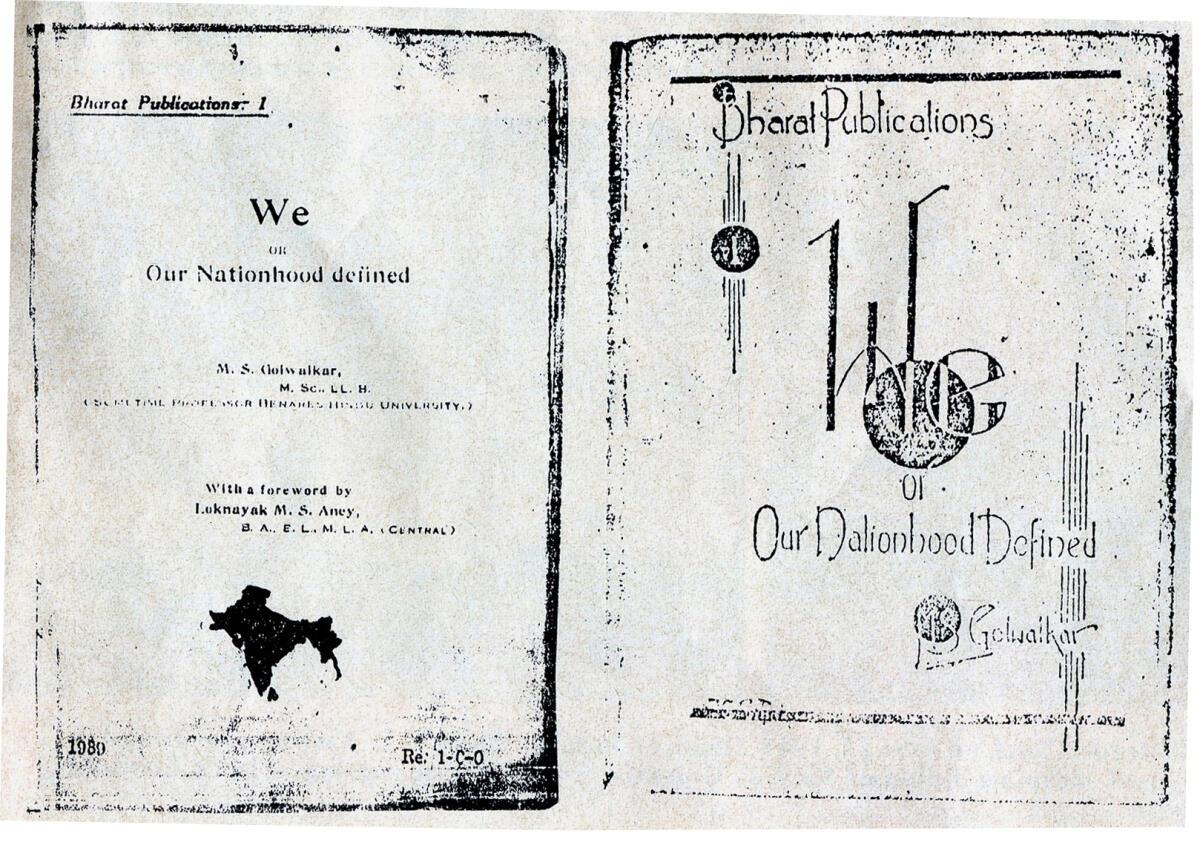
A reproduction of the covers of the 1939 and 1947 editions of Golwalkar’s We or our Nationhood Defined. Later, the RSS denied that Golwalkar had written this treatise, claiming that it was only a translation.
Disturbingly, Golwalkar also drew comparisons to Nazi Germany, writing, “Germany has shown how impossible it is for Races and cultures, having differences going to the root, to be assimilated into one united whole, a good lesson for us in Hindustan to learn and profit by.”
The publication of ‘We’ ignited considerable controversy. Numerous scholars studying the Savarkars asserted that the parallels drawn to the Holocaust, which saw the extermination of millions of Jews, were Golwalkar’s additions and not present in Savarkar’s original text. As the RSS later disavowed ‘We’, an edited compilation of Golwalkar’s speeches titled ‘A Bunch of Thoughts’ became the Sangh’s new foundational text and a guiding resource for all volunteers. This subsequent publication notably softened Golwalkar’s original rhetoric, for instance, by rephrasing references to Muslims and Christians into ‘Islamic fundamentalism’ and ‘missionary evangelism’ to mitigate backlash.
Throughout the 1940s, the RSS increasingly troubled the British, with its volunteer count surging from 37,362 in 1941 to a remarkable 100,402 by 1946, as documented by Narayan. For both ideological and strategic reasons, the RSS deliberately opted out of the Quit India movement and prohibited its swayamsevaks from participating.
However, the RSS mobilized significantly during the tumultuous period of Partition. On August 16, 1946, the Muslim League declared ‘Direct Action Day,’ demanding independent Muslim-majority states in India’s northwest and eastern regions during the transfer of power from the British to India’s Constituent Assembly. In the week leading up to this, Bengal’s then-Chief Minister Huseyn Suhrawardy publicly stated that he had taken steps to “restrain” the police, which many interpreted as an implicit endorsement for groups to engage in violence. As businesses across the state shut down, Muslim League members took to the streets, coercing Hindu shopkeepers to close their establishments. This provocative action provoked a strong reaction from Hindus, who actively obstructed the League’s processions.

1946: The observance of a Direct Action Day on August 16th by the Muslim League was attended by communal disturbances in Calcutta.
The ensuing clashes engulfed the city, resulting in over 5,000 deaths and 15,000 injuries, igniting a year of intense protests surrounding Partition. This escalating religious animosity allowed the RSS to expand its presence in northern India, establish relief camps for Hindus impacted by the communal violence, and advocate for the mass emigration of Muslims from India.
Amidst the widespread violence in Punjab, Delhi, and Bengal, which saw hundreds of thousands of Muslims fleeing to Pakistan following Partition, Mahatma Gandhi sought to engage with the RSS to de-escalate communal tensions. Addressing a gathering of swayamsevaks in Delhi’s Bhangi (Harijan) colony on September 16, 1947, Gandhi lauded the Sangh’s “rigorous discipline, complete absence of untouchability, simplicity, service, and self-sacrifice.” Yet, he critically challenged the Sangh’s claim that India exclusively belonged to Hindus, stating, “The Sangh’s strength could be used in the interest of India or against it and it should show by their good conduct that these allegations (forcing Muslims to leave India via violence) are baseless.”
However, Gandhi’s appeals went unheeded. On December 8, 1947, during a rally in Rohtak, Golwalkar declared, “The Sangh will not rest content until it had finished Pakistan. If anyone stood in our way we will have to finish him too.” He openly criticized Gandhi’s perceived ‘appeasement’ of Muslims, attributing it to vote-bank politics.
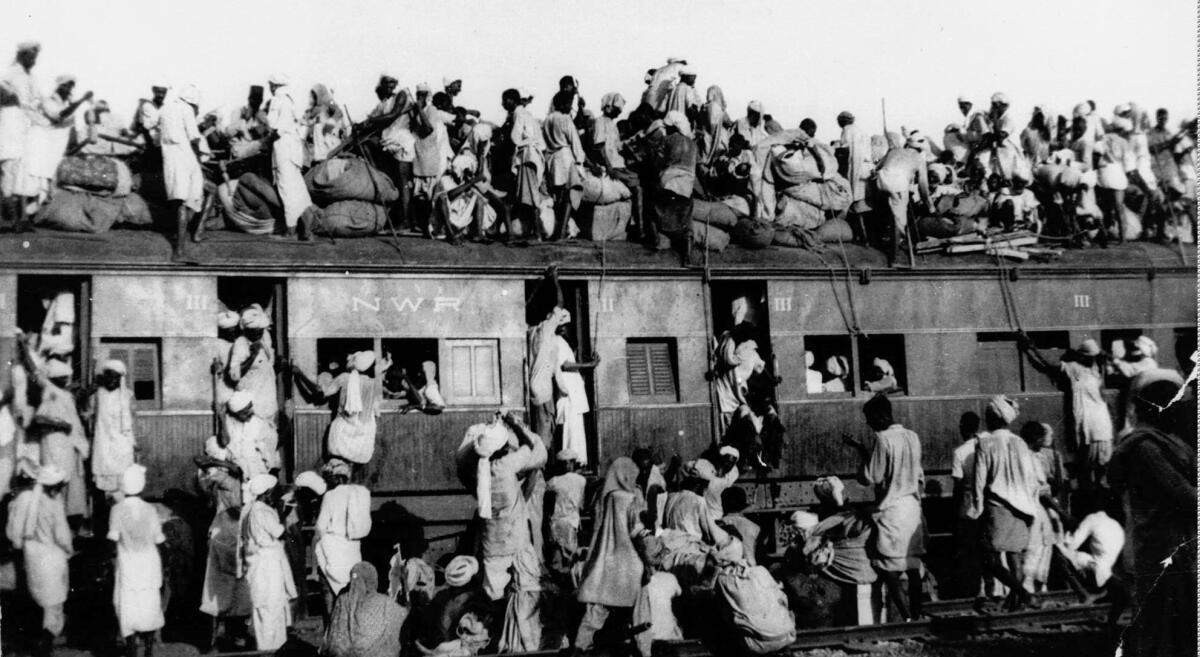
In this September 1947, file photo hundreds of Muslim refugees crowd on top a train leaving New Delhi for Pakistan. After Britain ended its colonial rule over the Indian subcontinent, two independent nations were created in its place _ the secular, Hindu-majority nation of India, and the Islamic republic of Pakistan. The division, widely referred to as Partition, sparked massive rioting that killed up to 1 million, while another 15 million fled their homes in one of the worlds largest ever human migrations.
Gandhi’s Assassination and its Repercussions
Just a month later, Mahatma Gandhi was tragically assassinated in New Delhi’s Birla House as he walked to lead evening prayers. His killer was Nathuram Godse, an RSS pracharak and Hindu Mahasabha leader known for his close ties to Savarkar.
Gandhi’s assassination ignited nationwide fury, prompting the Nehru government to swiftly suppress the RSS, the Hindu Mahasabha, Savarkar, and Golwalkar. Within a week, the RSS was outlawed, and Godse was arrested alongside N.D. Apte and Karkare. Raids were conducted on RSS premises across Mumbai and its environs, leading to the arrests of key RSS and Hindu Mahasabha figures, including Golwalkar and Savarkar. The RSS claims that at least 17,000 swayamsevaks were apprehended following the ban, pushing the organization into severe financial distress.
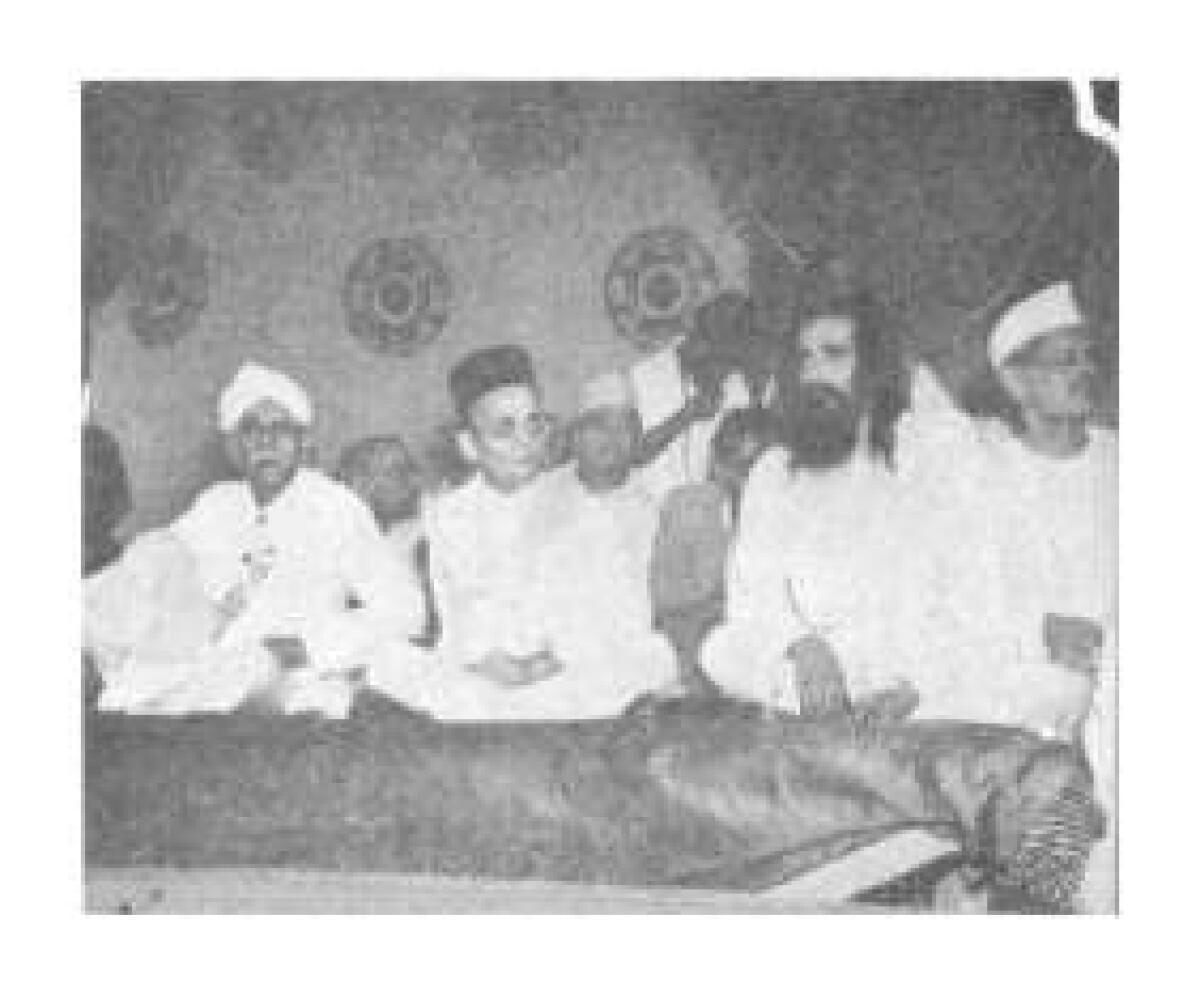
At the Red Fort (Gandhiji Murder) Trial, on June 22, 1948, Hindu Mahasabha leader V, D. Savarkar (wearing a cap, right) among the accused, including Nathuram Vinayak Godse (far left); at a Pune meeting in 1952, Golwalkar and Savarkar among others.
In February 1949, T.R.V. Sastri, a close confidant of Golwalkar and former Advocate-General, visited him in Seoni jail. Their discussions covered critical issues such as the RSS’s position on India’s national flag, its commitment to a ‘secular democracy,’ the drafting of the RSS Constitution, and strategies to address the organization’s financial woes—all with the aim of lifting the ban. Within weeks, the Sangh’s Constitution was formalized, and a draft was submitted to the Central government, stipulating that the Sangh would abstain from politics and dedicate itself solely to ‘purely cultural work.’ The RSS also consented to respect the Indian tricolour while maintaining its own saffron flag, and to adopt a democratic organizational structure led by a Sarsanghachalak nominated by the Sangh’s executive council. Furthermore, RSS members were granted the freedom to join any political party. Consequently, on July 12, 1949, the ban was revoked, and Golwalkar was released from jail.
To integrate RSS members harbouring political aspirations, the Congress Working Committee passed a resolution on November 17, 1949, permitting them to join the Congress, provided they relinquished their RSS membership.
Following his release from prison, Golwalkar strategically steered the RSS towards a more insulated stance, intentionally distancing it from direct political involvement. Throughout his remaining years as Sarsanghachalak, Golwalkar significantly broadened the RSS’s societal influence and consolidated the Hindutva movement. It was during his leadership that the extensive ‘Sangh Parivar’ network was established, through the formation of numerous RSS affiliates: the student union Akhil Bharatiya Vidyarthi Parishad (1948), the disaster relief organization Rashtriya Sewa Bharati (1950), the religious council Vishwa Hindu Parishad (1964), the tribal welfare organization Vanvasi Kalyan Asharam (1951), and the workers’ union Bharatiya Mazdoor Sangh (1955).
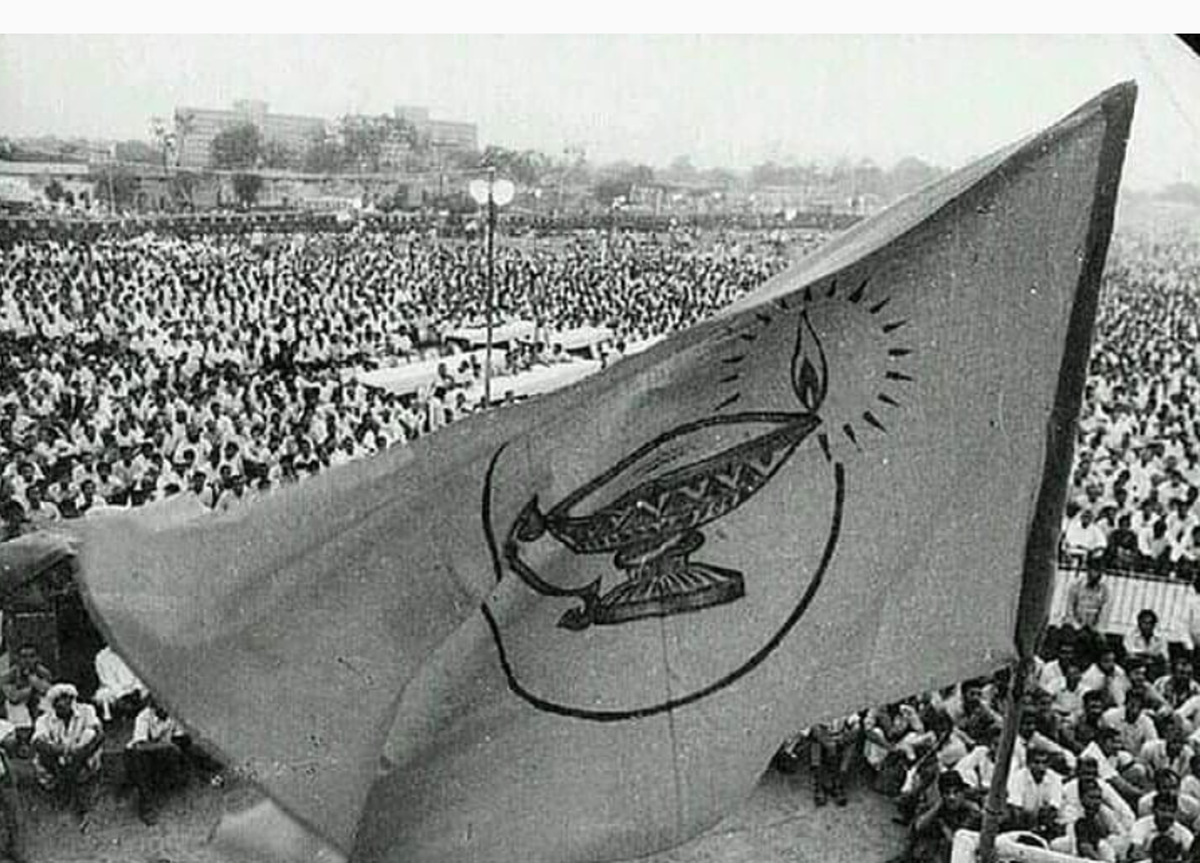
Jan Sangh foundation flag.
In 1949, Dr. Syama Prasad Mookerjee, a former president of the Hindu Mahasabha, resigned from the organization because it declined to “abandon its communalist composition and open its doors to every citizen, regardless of religion who was ready to accept its economic and political programme,” as explained by eminent Supreme Court lawyer A.G. Noorani in his book ‘RSS: A Menace to India’. Mookerjee, who had previously served in Nehru’s first cabinet, also resigned following the Nehru-Liaquat pact between India and Pakistan, accusing Nehru of neglecting the interests of Bengali Hindus in East Pakistan. Despite the RSS’s commitment to abstain from political activities, several senior RSS leaders, including V.R. Oak, B. Madhok, and Bhai Mahavir, harbored political aspirations. Mookerjee and Golwalkar ultimately forged an agreement to establish the Bharatiya Jana Sangh in 1951, which saw a significant influx of RSS workers.
The Rise of the Jana Sangh
The early years of the Jana Sangh were marked by considerable turbulence. According to Noorani, RSS cadres and political leaders struggled to align with the formal ‘democratic Constitution of a political party,’ even though they shared a common ideology. Prominent founding members, including Mauli Chandra Sharma, B. Madhok, and Guru Dutt, resigned from the Jana Sangh, alleging that the RSS wielded excessive influence within the party. Nevertheless, both the Jana Sangh and the RSS continued to expand. As former princely states and Portuguese colonies integrated into the Indian Union, RSS workers notably participated in the liberation movements of Goa, Dadra and Nagar Haveli.
Golwalkar held the cow in high reverence, viewing it as a powerful ‘Hindu symbol.’ Leveraging cow protection as a galvanizing cause, he directed RSS cadres to organize one of independent India’s largest demonstrations on November 7, 1966, along Parliament Street in Delhi.
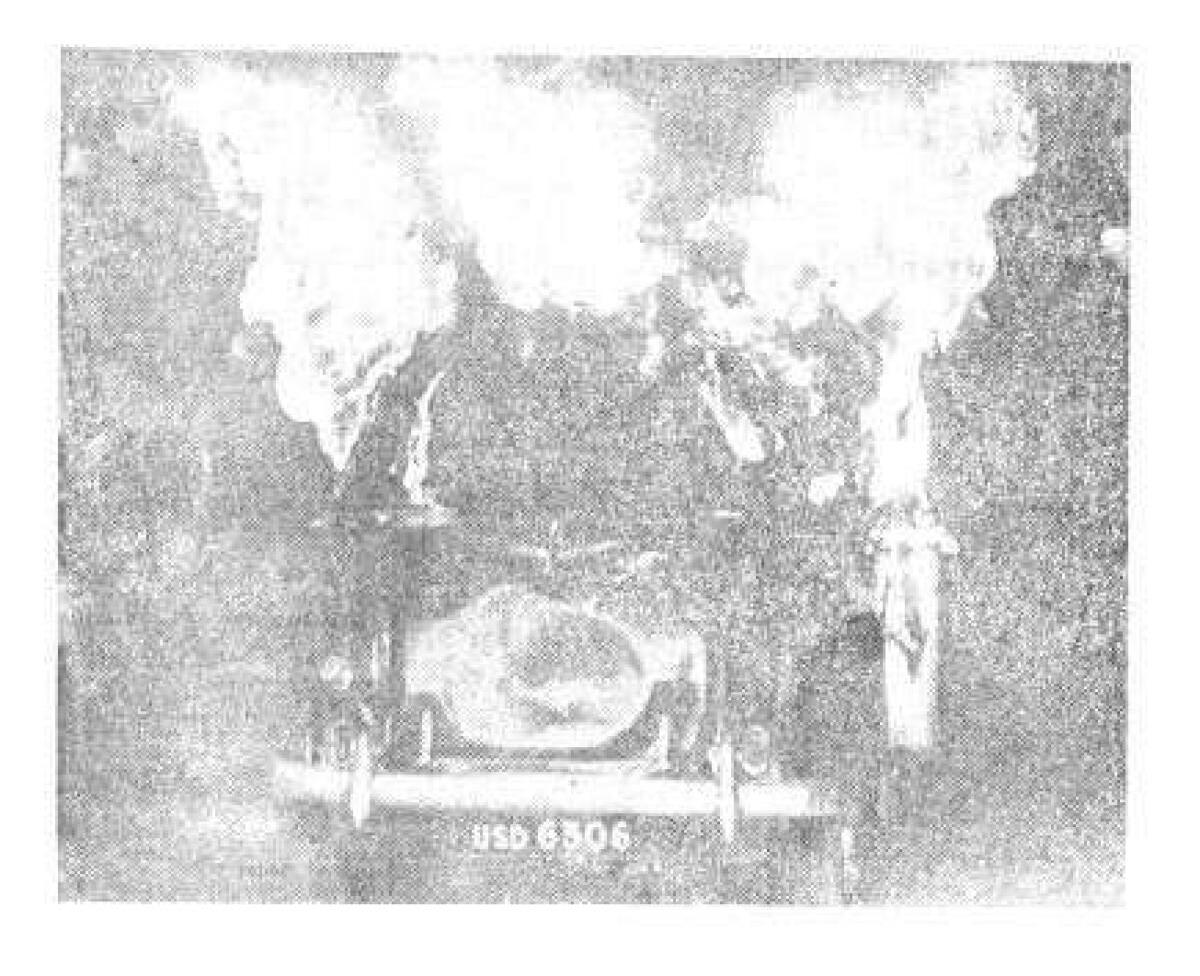
Anti-cow slaughter demonstrators stormed Parliament House in New Delhi in 1966 and indulged in violent acts. One of the cars set on fire by demonstrators going up in flames.
Narayan recounts, “The crowd fronted by hundreds of naked, ash-smeared Naga mendicants was agitating to abolish cow slaughter. In the late afternoon, the crowd got violent and went on a rampage in the city, setting fires, destroying vehicles, and raiding ministers’ homes. Seven people, including demonstrating Naga sadhus, were killed in police firing near Parliament. Police arrested hundreds of people including top RSS leaders Vasant Rao Oak, V.P. Joshi and O.P. Tyagi.” Ever since this event, the RSS has consistently organized protests, meetings, and advocated for legislation to protect cows by prohibiting cow slaughter.