
A significant milestone has been achieved for India’s ambitious Mumbai-Ahmedabad bullet train project. On Saturday morning, September 20, 2025, a crucial ‘breakthrough’ was successfully executed for a 4.88 km-long tunnel section located between Shilphata and Ghansoli. Union Railway Minister Ashwini Vaishnaw was present to oversee this momentous occasion.
Minister Vaishnaw hailed the completion of the tunnel section as a “landmark achievement.” He confirmed that the initial phase of this high-speed corridor, specifically the Surat-Bilimora section, is firmly scheduled to commence operations by December 2027.
Speaking to reporters in Ghansoli, near Mumbai, the Minister emphasized that the bullet train is envisioned as a “transport for the middle class,” assuring that its fares would be “reasonable” and accessible.
Highlighting the project’s transformative potential, he pointed out that while Google Maps currently estimates the journey between Mumbai and Ahmedabad at nine hours, the bullet train will dramatically reduce this travel time to just two hours and seven minutes.
Outlining the phased rollout, Mr. Vaishnaw reiterated that after the Surat-Bilimora section’s launch in 2027, the project will extend to Thane in 2028, culminating with connectivity to the Bandra Kurla Complex by 2029.
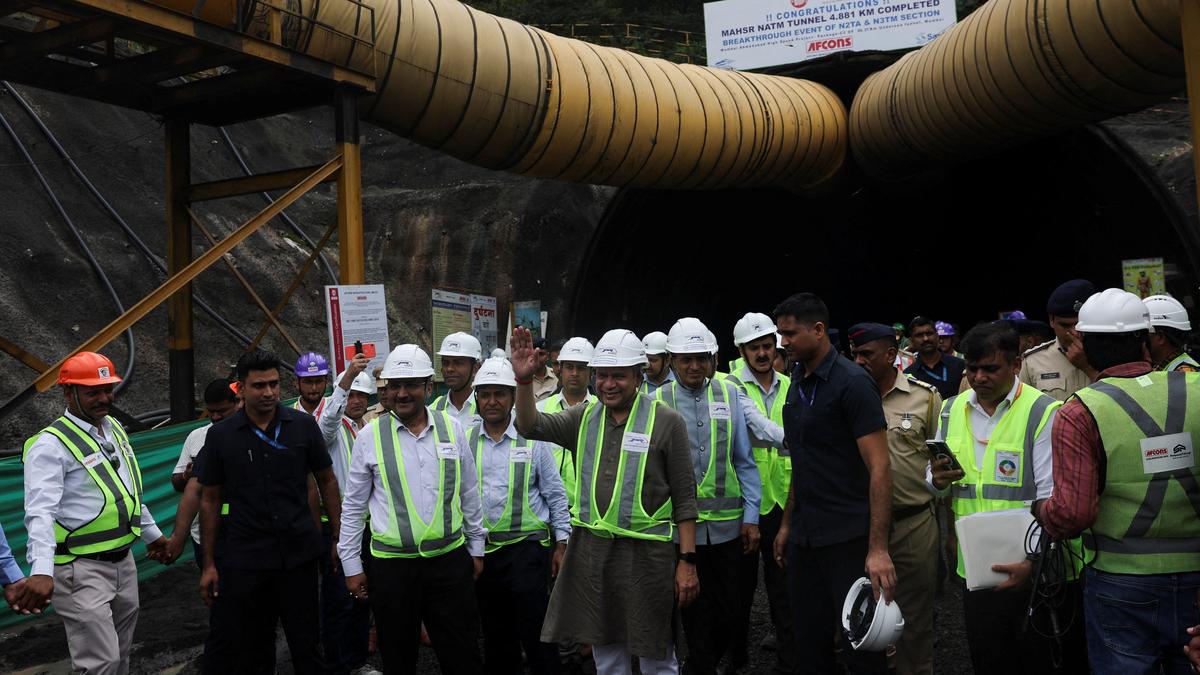
Union Railway Minister Ashwini Vaishnaw greeted the media outside the newly completed bullet train tunnel in Navi Mumbai on September 20, 2025, marking a significant step forward for the project. (Photo Credit: Reuters)
He detailed the service frequency, stating that trains would depart every half hour during morning and evening peak hours. Once the full network is stable, this frequency is expected to increase to a train every ten minutes during peak times.
In a move to enhance passenger convenience, the Minister announced that ticket reservations would not be necessary for travel between Mumbai and Ahmedabad, allowing passengers the flexibility to simply arrive at the station and board.
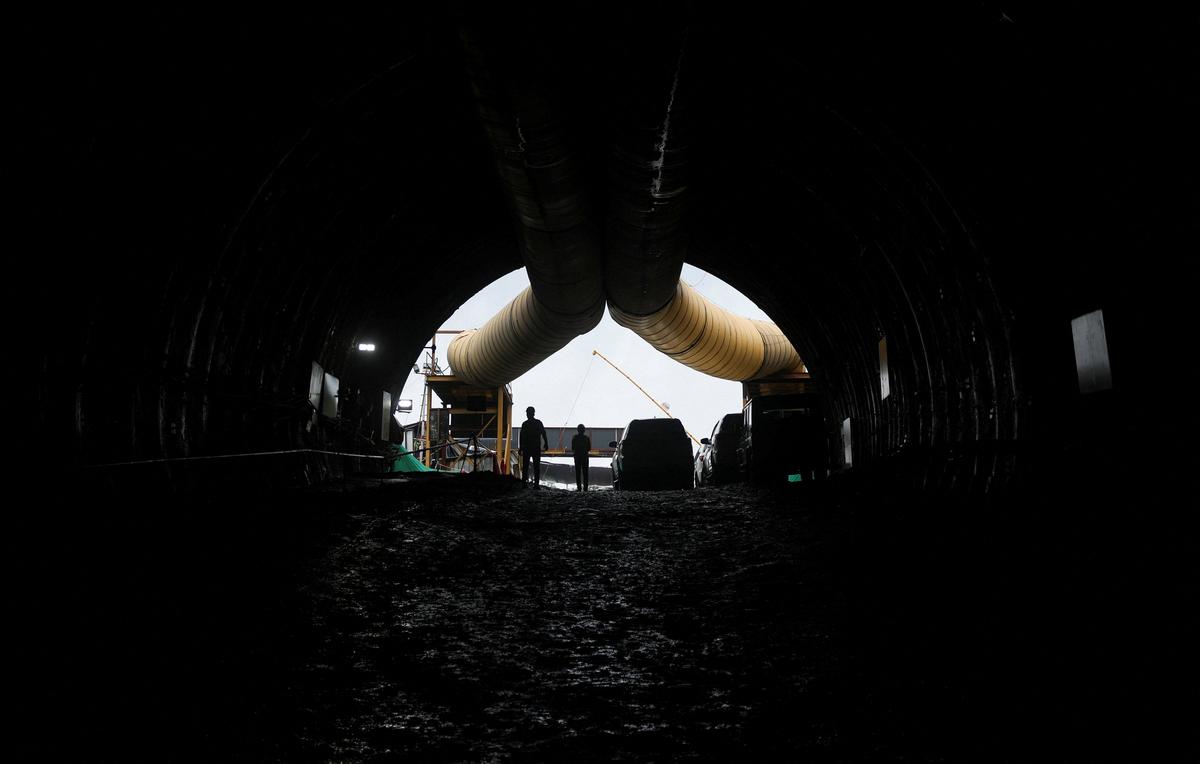
A view of individuals standing at the entrance of the recently completed tunnel section for the Mumbai-Ahmedabad bullet train project in Navi Mumbai, September 20, 2025. (Photo Credit: Reuters)
The Minister personally initiated the final breakthrough, triggering a controlled dynamite blast from one of the tunnel openings. This marked the completion of five kilometers of intricate excavation work for the tunnel.
According to the National High Speed Rail Corporation Limited (NHSRCL), this tunnel, constructed using the advanced New Austrian Tunnel Method (NATM), is an integral part of a larger 21 km underground section. This critical stretch runs between the Bandra-Kurla Complex (BKC) and Shilphata, notably encompassing a challenging 7 km segment beneath Thane Creek.
In an official release, NHSRCL confirmed that with this latest breakthrough, the tunnel now successfully connects the Savali shaft to the tunnel portal at Shilphata. This connection forms a vital link to the viaduct portion of the broader Mumbai-Ahmedabad High Speed Rail (MAHSR) project.
NHSRCL elaborated on the construction process, noting that excavation commenced in May 2024 and was executed in three distinct phases. The initial breakthrough for a 2.7 km continuous section occurred on July 9. To expedite progress, an Additional Intermediate Tunnel (ADIT) was strategically built, facilitating simultaneous excavation efforts from both the Ghansoli and Shilphata ends.
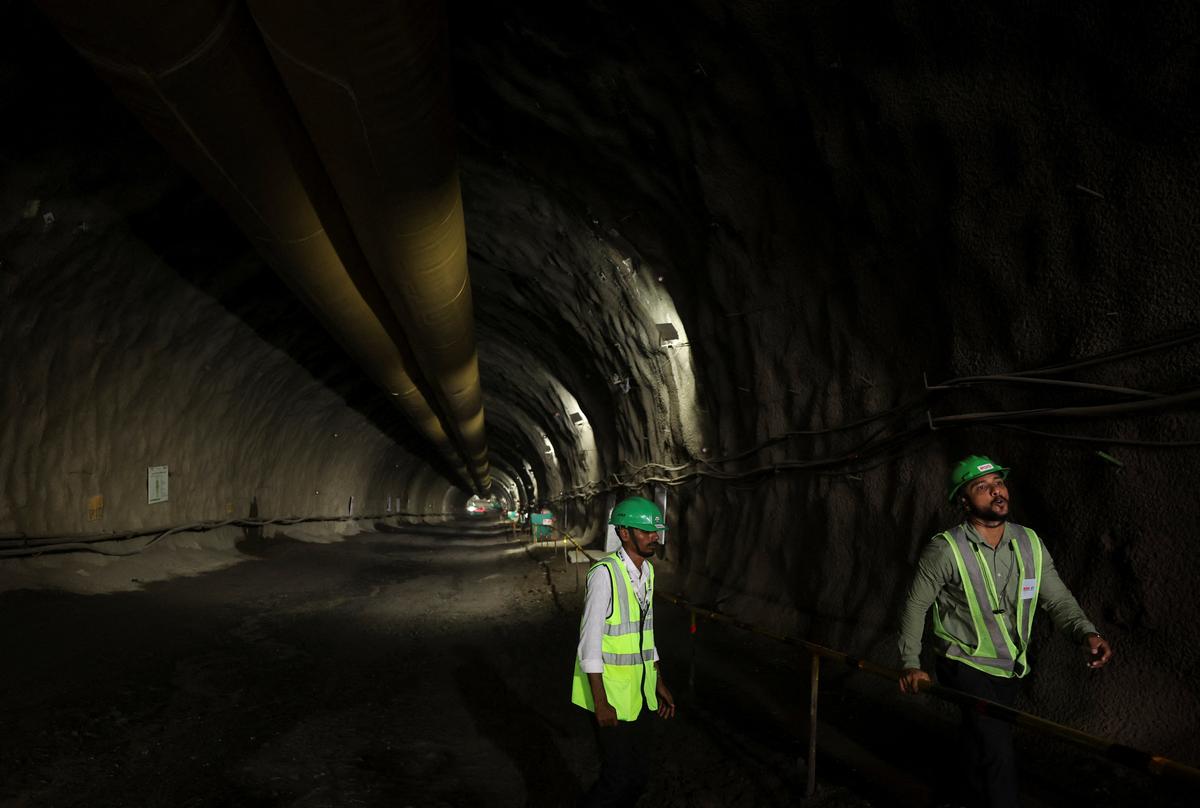
Workers seen inside a section of the completed tunnel for the Mumbai-Ahmedabad bullet train project in Navi Mumbai, September 20, 2025. (Photo Credit: Reuters)
The NATM tunnel boasts an internal width of 12.6 meters. Its construction involved extensive drilling, precise blasting, meticulous survey works, and robust support systems, all executed under demanding geological conditions, as per NHSRCL.
The corporation detailed the upcoming phases, which will include critical waterproofing, lining, finishing, and the installation of necessary equipment. The remaining 16 km of tunnelling will be carried out using advanced Tunnel Boring Machines (TBMs).
Upon completion, the entire tunnel will feature a single-tube, 13.1-meter diameter design, specifically engineered to accommodate twin tracks for both up and down lines, ensuring efficient two-way high-speed traffic.
NHSRCL emphasized the comprehensive safety protocols implemented throughout the project. These include the deployment of settlement markers, piezometers, inclinometers, and strain gauges for continuous monitoring, along with strict restricted site access. Furthermore, provisions for pumping fresh air ensure a safe working environment for personnel inside the tunnel.
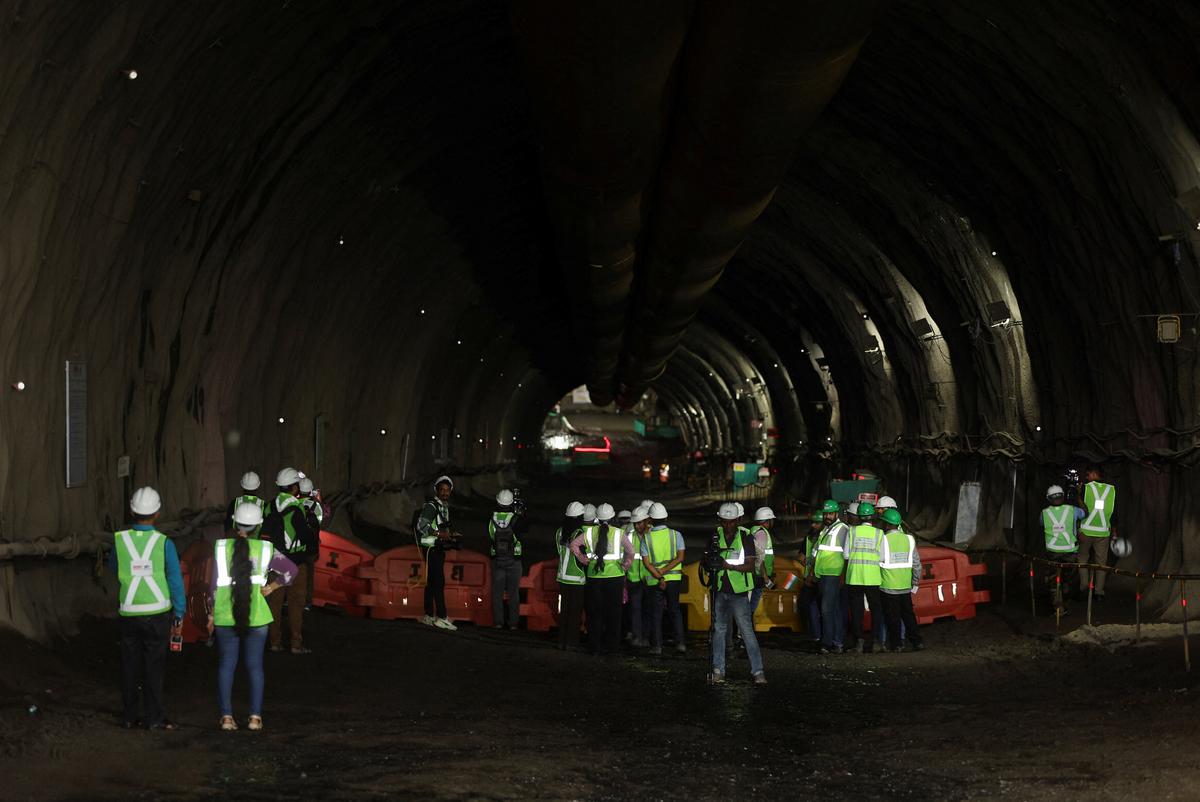
Media personnel observe the interior of the newly completed tunnel section for the Mumbai-Ahmedabad bullet train project in Navi Mumbai, September 20, 2025. (Photo Credit: Reuters)
This 508 km-long Mumbai-Ahmedabad high-speed rail corridor represents a monumental achievement as India’s inaugural bullet train project.
The NHSRCL also provided an update on overall project progress, confirming that 321 km of viaduct and 398 km of pier work have been completed. This also includes the construction of 17 river bridges and nine steel bridges, alongside the installation of over 400,000 noise barriers across 206 km of the route.
Further progress includes the completion of track bed construction across 206 km and the installation of over 2,000 overhead equipment masts spanning 48 km of the mainline viaduct.