
Just five years ago, as the COVID-19 pandemic swept across the globe, it exposed the critical vulnerabilities within public health systems worldwide. Hyderabad felt this acutely, relying almost entirely on a single government facility, Gandhi Hospital, to manage the overwhelming crisis. Its corridors and wards were stretched beyond capacity, and medical professionals tirelessly fought exhaustion and fear. This dire situation served as a powerful wake-up call, highlighting an urgent need for more robust, advanced public hospitals capable of withstanding future health emergencies. It was from this pressing necessity that the Telangana Institute of Medical Sciences (TIMS) emerged, envisioned as a new breed of government hospitals that could rival private institutions in both size and sophistication.
Today, this ambitious vision, born amidst a global health crisis, is rapidly becoming a reality in Sanathnagar, a bustling industrial and residential area of Hyderabad. The 1,000-bed super-specialty TIMS hospital is now in its final construction phase, with an anticipated inauguration date of December 9th.
This impressive ₹1,070-crore project received administrative approval on April 21, 2022, and its foundation stone was laid just five days thereafter, signaling a swift commitment to its development.
According to a top Health Department official, the new institute will feature 37 specialized departments and is poised to become a leading center for cardiothoracic, cardiac, and transplant sciences. Designed after the esteemed Nizam’s Institute of Medical Sciences, TIMS will enjoy an autonomous operational model, allowing for distinct management of both medical and non-medical services. Notably, about 200 of its beds will be reserved for patients who opt for paid services.
Spanning 22.6 acres within the grounds of the existing Government Chest Hospital, this expansive facility boasts a total built-up area of 11.68 lakh square feet. The project is being brought to life by Megha Engineering and Infrastructures Ltd. (MEIL) through a design-build approach, with M/s OCI Architects overseeing project management.
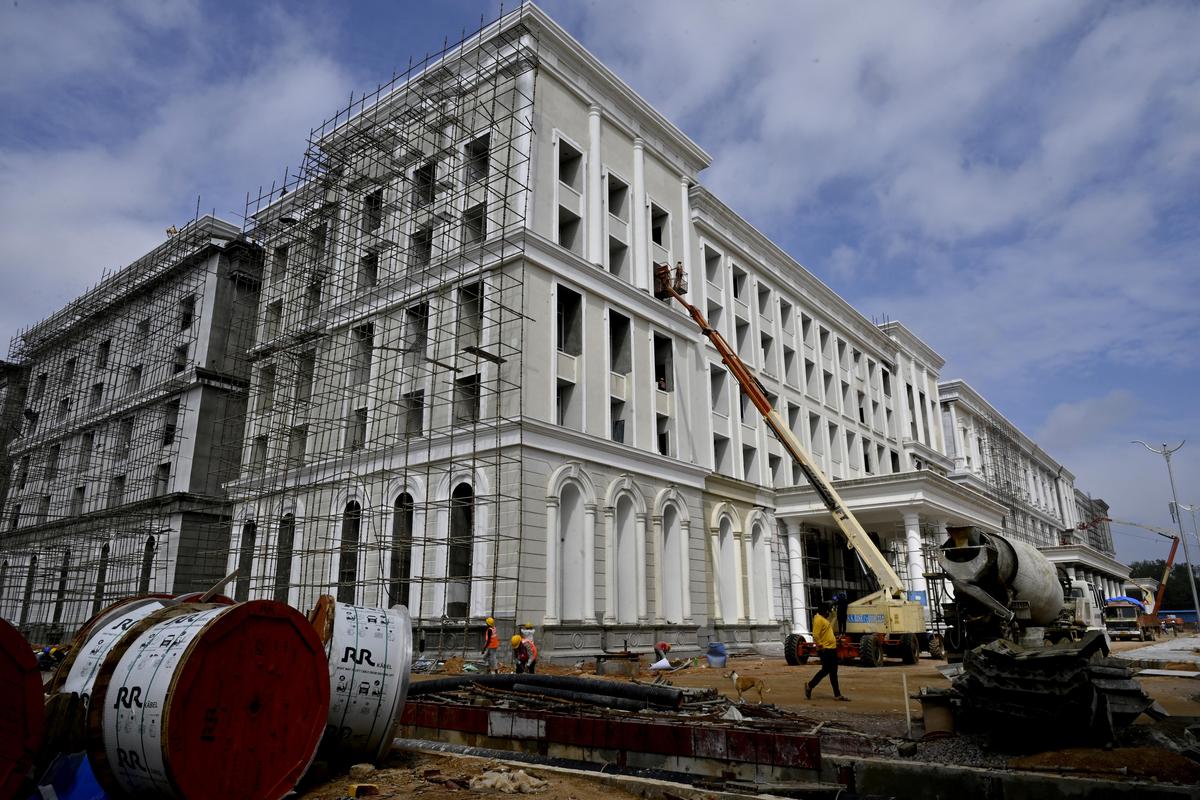
On a recent weekday afternoon, the Sanathnagar construction site buzzed with continuous activity. Towering cranes gracefully maneuvered overhead, cement mixers whirred a steady rhythm, and workers in protective white helmets moved purposefully among the rising structures. A temporary, muddy access road, lined with parked trucks caked in red soil and still resonating with the sounds of drilling and hammering, will soon be transformed into the hospital’s dedicated parking facility.
At the farthest point of this access route, a newly erected G+5 ‘dharamshala’ — a guesthouse for visitors — stands prominently. This grey block, designed to comfortably house up to 200 people, primarily patient attendants, is almost complete, awaiting only the installation of its furnishings. Presently, it serves as a temporary meeting area for Telangana government officials monitoring the project’s development.
Rising next to the dharamshala are three identical G+5 towers—Blocks A, B, and C—forming the core of the medical complex. Near Block A, Ramesh, an electrician, briefly stops to wipe his brow. “I’ve been on this site for six months,” he shares. “Our contractor manages this part, and we receive our pay monthly. I commute daily from Yousufguda.” His words reflect the quiet pride shared by thousands of dedicated workers who have been instrumental in transforming this ambitious blueprint into a tangible reality.
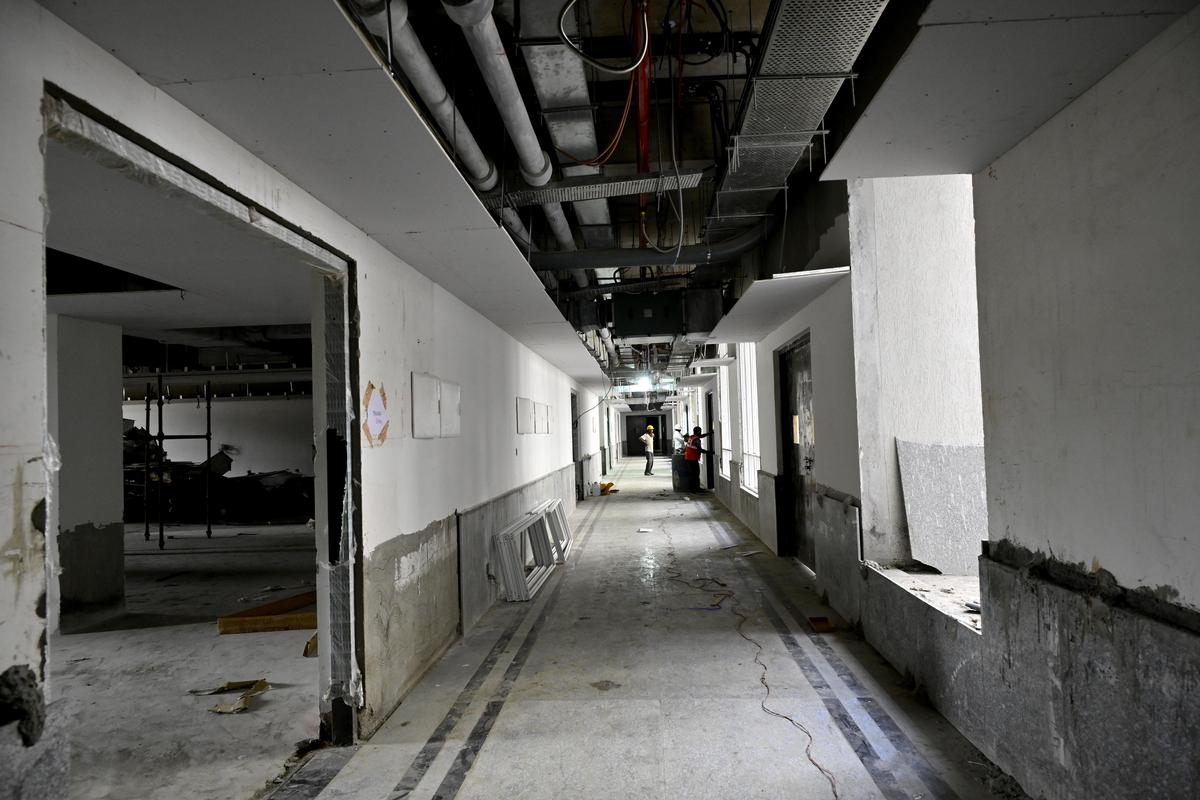
Traversing the expansive premises feels like an unending journey, with every corner revealing more concrete surfaces shimmering under the afternoon sun. Upon reaching Block A, the sheer magnitude of the project becomes truly apparent. Inside, the sound of finishing touches reverberates through the rooms, though several areas, especially the operation theaters, already sparkle with readiness. Walls are adorned with stainless steel fixtures, and large LED screens are mounted beside the operating tables. Amidst the clean scent of fresh paint and gleaming metal, the profound potential of TIMS is palpable: a government hospital designed to offer the appearance and feel of a premium corporate medical facility.
Despite the ongoing construction dust and noise, Govardhan Reddy, MEIL President of Projects, remains steadfast regarding the timeline. “We’ve been informed that December 9th is the inauguration date,” he states. “Before then, everything—from furniture to medical equipment—will be fully installed and operational. Our medical team is already on-site, meticulously inspecting rooms to confirm the precise placement for each piece of equipment.”
He confirms that 99% of the civil construction is complete, with only the final finishing touches, electrical installations, and mechanical, electrical, and plumbing (MEP) work remaining. “Civil work constitutes approximately 70% of the entire project, and that phase is virtually finished,” he explains. “Our current priority is the installation of advanced medical imaging equipment, including MRI, CT scanners, and X-ray units, with most already on-site or en route.”
Reddy acknowledges that the undertaking hasn’t been without its difficulties. “Initially, we faced a significant challenge in clearing a large plantation area and working with the Forest Department to safely relocate trees,” he recalls. “That was one of the major obstacles. However, everything is now successfully resolved,” he adds, a note of relief in his voice.
Sustainability and Grand Scale
Sustainability is a core principle integrated into the hospital’s design. Reddy highlights, “We are in the process of installing solar panels on the terrace, which will be operational soon. Even the hospital’s hot water system will be entirely solar-powered.” This thoughtful design aims to significantly reduce long-term energy expenses.
Designed as a comprehensive multi-block complex, TIMS Sanathnagar consolidates all critical functions of a super-specialty hospital within a single campus. Block A is dedicated to emergency services, featuring 15 operation theatres and 30 Intensive Care Units. Block B will host the primary Outpatient (OP) registration, a centralized pharmacy, a specialized cardiac operation theatre, and a LINAC-based nuclear medicine ward to enhance oncology and cardiac care, along with advanced cath labs.
Block C is designated for radiology and pathology laboratories, general and private wards, and even exclusive VIP suites. Meanwhile, Block D will serve administrative and academic functions, including an auditorium with a seating capacity for 200.
The hospital is slated to feature an impressive 16 major and six minor operation theatres. Its diagnostic capabilities will be robust, with 17 pathology labs, 12 microbiology labs, 10 biochemistry labs, and five specialized laboratories, collectively providing an unparalleled level of infrastructure in government healthcare.
The institute will also boast cutting-edge imaging technology, including a 3.0 Tesla MRI machine, a 128-slice CT scanner, a mammography unit, and five advanced X-ray machines.
Ensuring holistic patient and attendant support, the complex further integrates a centralized kitchen and laundry facility, alongside a mortuary capable of accommodating 30 bodies.
A senior official from the Health Department detailed TIMS’s innovative dual administrative structure: “A Chief Operating Officer will manage the hospital’s day-to-day operations, while the Medical Director will supervise all clinical services. These two branches will operate autonomously yet in close coordination.” The official added that critical support services like security, sanitation, biomedical waste management, dietary provisions, laundry, general patient care, and pest control will be entirely outsourced.
Regarding staffing, the official explained that existing personnel from other government hospitals would be temporarily reassigned to ensure the hospital’s immediate operational readiness, pending the finalization of detailed recruitment rules and regulations.
“Initially, highly respected doctors and surgeons from renowned institutions like Gandhi Hospital and Osmania General Hospital will be brought in,” the official clarified. “Once the hospital is stable, a phased recruitment process will commence for all positions.” They estimated that a facility of this size would need around 350 doctors, emphasizing the objective: “To establish a professionally managed system that marries corporate hospital-level efficiency and accountability within a public sector framework.”
Beyond the Blueprints: The Real Test Ahead
With the physical structure rapidly nearing completion, the Health Department now faces a more formidable challenge: ensuring the institution’s sustainable operation long after the construction dust settles. Telangana’s recent history with newly established government medical colleges—plagued by staff shortages, recruitment delays, and inadequate equipment—serves as a stark reminder, especially with the National Medical Commission having issued warnings.
However, TIMS distinguishes itself not just through its impressive infrastructure, but critically, through its foundational legislation. The Telangana Institute of Medical Sciences (TIMS) Act, 2024, meticulously crafted to ensure enhanced autonomy and accountability, is poised to be the decisive factor in how effectively these new institutions will operate.
A seasoned doctor from a local government hospital, speaking anonymously, clarified: “TIMS is governed by its own distinct Act, which grants these institutions a fundamentally different operational framework compared to conventional government hospitals or medical colleges. Similar to NIMS, which enjoys autonomous status and independent recruitment authority for all positions, from assistant professors to full professors, TIMS will possess comparable autonomy. This differs significantly from the current government hospital system, where doctors typically begin as assistant professors and advance through promotions over time.”
He further elaborated that this autonomy could effectively bypass the common administrative bottlenecks that frequently impede staffing and procurement in public healthcare, assuming the State commits to prompt appointments and allocates sufficient operational budgets.
The Legal Framework for a New Healthcare Era
The TIMS Act, 2024, serves as the critical legal foundation for the establishment and governance of the burgeoning super-specialty hospitals under the TIMS initiative throughout Telangana. Enacted as Act No. 9 of 2024, this legislation empowers the government to establish autonomous medical institutions with a dual mandate: to deliver advanced healthcare services and to provide comprehensive medical education.
According to the Act, which received gubernatorial assent in July 2024, each TIMS institution will operate as an independent corporate entity. It will be governed by its own council and executive body, with powers to award academic degrees, conduct pioneering research, and offer specialized postgraduate and paramedical training programs.
The governing council will comprise 12 members, including the Chief Minister as chairman, the Health Minister as vice-chairman, and the institute director as member secretary. Additionally, nine ex-officio members will be part of the council: the Health Secretary, Finance Secretary, Director of NIMS, Director of Medical Education, Vice-Chancellor of Kaloji Narayana Rao University of Health Sciences, managing director of Telangana Housing Corporation Limited, dean of ESI Hospital-Sanathnagar, managing director of Telangana Medical Services and Infrastructure Development Corporation, and the CEO of Rajiv Aarogyasri Health Care Trust.
These institutes are structured around a hybrid operational model. Roughly half of the hospital beds will remain dedicated to the government’s free-care system, while the other half will operate on a cost-recovery basis, a strategy aimed at ensuring long-term financial sustainability.
The legislation’s primary goal is to establish TIMS facilities as preeminent centers for super-specialty care, encompassing advanced services in cardiology, nephrology, neurology, oncology, and organ transplantation. Furthermore, the Act delineates clear provisions for funding, staffing, rigorous audits, and institutional autonomy, facilitating more agile decision-making than is typical in conventional government hospitals.
From Crisis Response to Lasting Cure
The genesis of TIMS Sanathnagar can be traced to its precursor in Gachibowli, which was hastily established in 2020 at the peak of the pandemic. In April of that year, the State government swiftly transformed the Sports Hostel building into a specialized COVID-19 hospital under the then-nascent TIMS initiative. By June, a subsequent Finance Department order authorized the hiring of 662 personnel for a year, kickstarting the hospital’s operations.
The Gachibowli facility welcomed its first patient on July 12th. Over the ensuing year, it played a pivotal role in Telangana’s pandemic efforts, providing care to over 12,000 outpatients and 9,500 inpatients.
However, maintaining that initial momentum proved challenging. Today, the Gachibowli facility operates as a mere echo of its former capacity, with only a limited number of doctors on duty and a sparse flow of patients.
Kiran Madala, General Secretary of the Telangana Teaching Government Doctors Association, remarked, “While the TIMS Sanathnagar hospital undeniably boasts the scale and design of a corporate facility, the true test will commence post-inauguration. For such a massive institution to truly thrive, three critical elements are indispensable: consistent infrastructure maintenance, sufficient and sustained staffing, and crucial initial financial backing from the government for a minimum of five years.”
Soon, the industrial symphony of drilling machines at the Sanathnagar site will be replaced by the gentle hum of air-conditioning and the quiet footsteps of patients. This transition will signify more than just the opening of a new hospital; it will be a pivotal moment, testing Telangana’s unwavering commitment to making world-class healthcare universally accessible.