
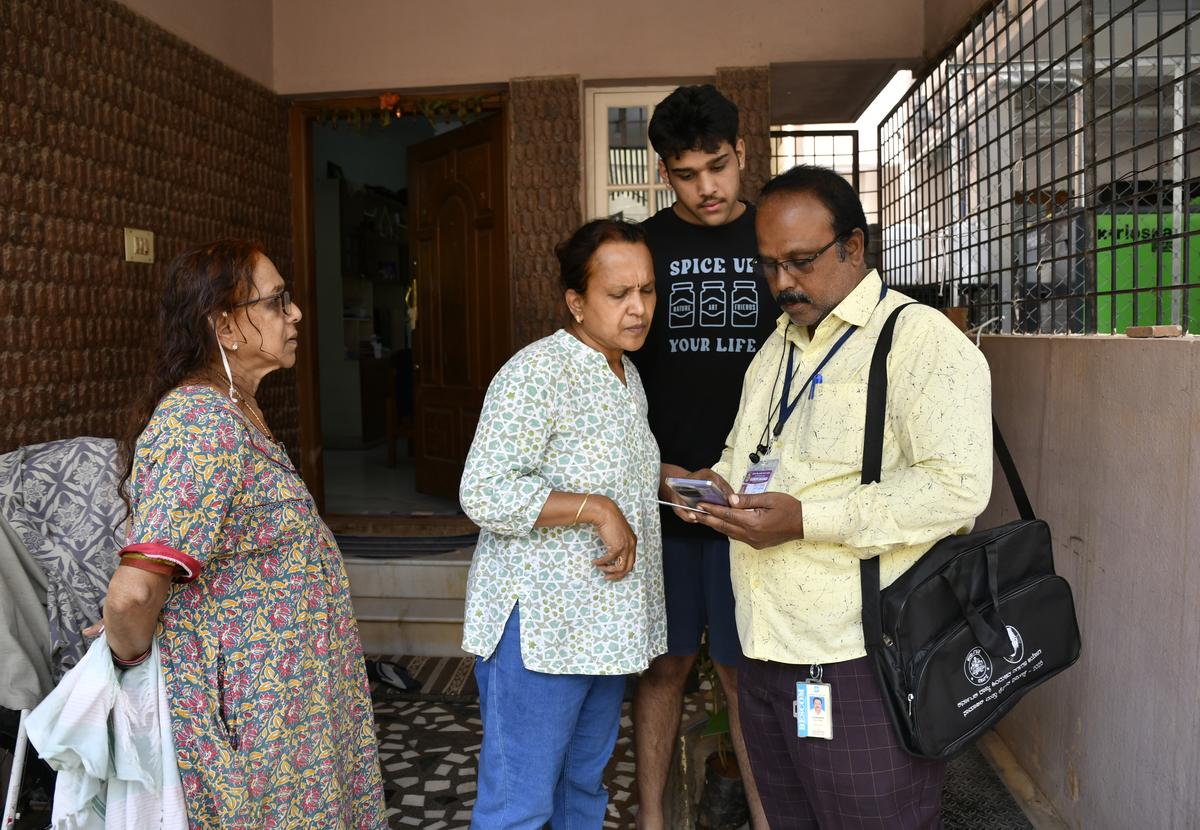
An enumerator interacting with residents during the ongoing Social and Educational Survey at Bhuvaneswari Nagar in Bengaluru on Sunday. | Photo Credit: ALLEN EGENUSE J.
On a recent Sunday morning, Manappa P. (name changed), a Bescom meter reader assigned as an enumerator, began his door-to-door duties for the Social and Educational Survey in Bhuvaneshwari Nagar, Dasarahalli. After more than 90 frustrating minutes on the streets, he finally found one household willing to cooperate, and that single survey alone took nearly an hour to complete.
Manappa’s struggles are far from unique. Across Bengaluru’s five corporation limits, this vital survey, which kicked off on October 4 within the Greater Bengaluru Authority (GBA) areas, is progressing at a snail’s pace. The primary culprits? Public hesitation, outright reluctance, and a slew of technical glitches plaguing the process.
According to enumerators, while no strict daily target has been officially announced, they were informally instructed to aim for around 15 surveys per day. “People are simply refusing to cooperate. Some won’t even open their doors when they see us. With this level of resistance, completing just three or four surveys feels like a monumental achievement,” Manappa lamented.
Lack of Training and Essential Resources
The state government enlisted personnel from various departments for this survey, many of whom claim they received less than half an hour of training before being sent into the field. This left them largely to their own devices, attempting to navigate the complex process on the fly.
Hemanth K., another enumerator, recounted an instance where an option for a resident’s district was missing from the app. A similar issue arose when trying to enter caste details. Information had to be tediously scrolled through rather than being directly searchable.
“We were supposed to receive a booklet with caste, sub-caste, and district codes, but it never materialized. We ended up scribbling down codes as we found them, hoping to speed up entries for subsequent households,” Hemanth shared with frustration.
In some cases, residents themselves resorted to searching YouTube tutorials or consulting old newspapers that had published caste codes, attempting to assist the struggling enumerators.
Adding to the difficulties, the survey application frequently crashed, sometimes even causing the enumerators’ devices to malfunction. Each household required multiple verification steps, including inputting Aadhaar numbers and generating one-time passwords (OTPs) for every family member. Even when the app seemed functional, forms often failed to save, forcing enumerators to re-enter all the data.
Public’s Hesitation and Lack of Trust
A widespread lack of public cooperation was observed, particularly in apartment complexes. Many tenants expressed unwillingness to provide information, insisting that the property owner should be the one to furnish the details. Others cited concerns from social media, fearing that enumerators might ask for sensitive bank or Aadhaar-linked personal financial information, making them wary of sharing any data.
“There are no questions that would grant access to anyone’s personal or financial details. We only inquire about bank accounts and Aadhaar numbers to verify other demographic data,” clarified Manappa, dispelling public fears.
A Lengthy and Questionable Process
Even participating residents raised questions about the relevance of certain survey queries, such as whether a household member knew how to use a computer or had internet access. “Why do they need to know this? It feels unnecessary and generic,” remarked one surveyed individual. Many felt these kinds of questions only prolonged the process, testing their patience and willingness to cooperate.
Conversely, some residents argued for the importance of these details in building an accurate demographic profile. “Understanding technology access and similar metrics is crucial for planning effective educational and social programs. If the survey aims to drive progress, these details are indispensable,” stated Pawan Swamy, a Vasanth Nagar resident, emphasizing that over-simplifying the survey would undermine its core purpose.
Residents also suggested that the government should have provided advance notice about when enumerators would arrive. They believed this would save time for both parties, allowing households to have all necessary documents ready. Frequent scenarios involved a family member being absent, leading to repeated calls for Aadhaar OTPs, making the entire exercise cumbersome. Many felt that bulk SMS alerts with schedules or allowing residents to book convenient time slots would have significantly streamlined the survey process.
Disputes Over Assigned Locations
Officials revealed that some enumerators, particularly from the Education Department, voiced concerns regarding their assigned locations that proved difficult to resolve. One teacher, whose school is in Hegde Nagar, requested a transfer to a nearby area instead of her allotted ward in Dasarahalli, a mere five kilometers away.
Authorities deemed such requests impractical, explaining that survey zones are strictly mapped and cannot be altered. However, the teacher found the allocation process unfair, arguing that it failed to consider enumerators’ familiarity with the local area, which only added to the difficulty of their task.