
For seven remarkable years, Rudra, a majestic tiger with a fiery orange coat, commanded the dense forest territories of the Wayanad Wildlife Sanctuary. His reign, however, met a brutal end in a fierce territorial clash with another powerful big cat, leaving him without his crucial canine teeth. This injury stripped him of his ability to hunt and defend himself in the wild.

Ostriches at the Zululand Zone of Thrissur Zoological Park. | Photo Credit: NAJEEB KK
Weakened by hunger, Rudra began to venture beyond the forest’s edge, seeking easier prey like cattle in human settlements around Surabhikkavala, Thanni Theruvu, and Vadanakkavala in Wayanad district. The presence of such a formidable predator in populated areas inevitably sparked fear, leading to demands for his capture.

A leopard at Thrissur Zoological Park. | Photo Credit: NAJEEB KK
In February 2024, Rudra was successfully trapped in a cage by forest officials, ending his solitary existence. Releasing him back into the wild was not a viable option; wildlife managers feared he wouldn’t survive and might pose a threat by returning to human settlements. The decision was made to relocate him to the Thrissur Zoological Park at Puthur, one of Asia’s largest zoological parks. This move was widely celebrated, offering Rudra the chance to roam freely in a spacious, near-natural environment rather than being confined to a small cage.
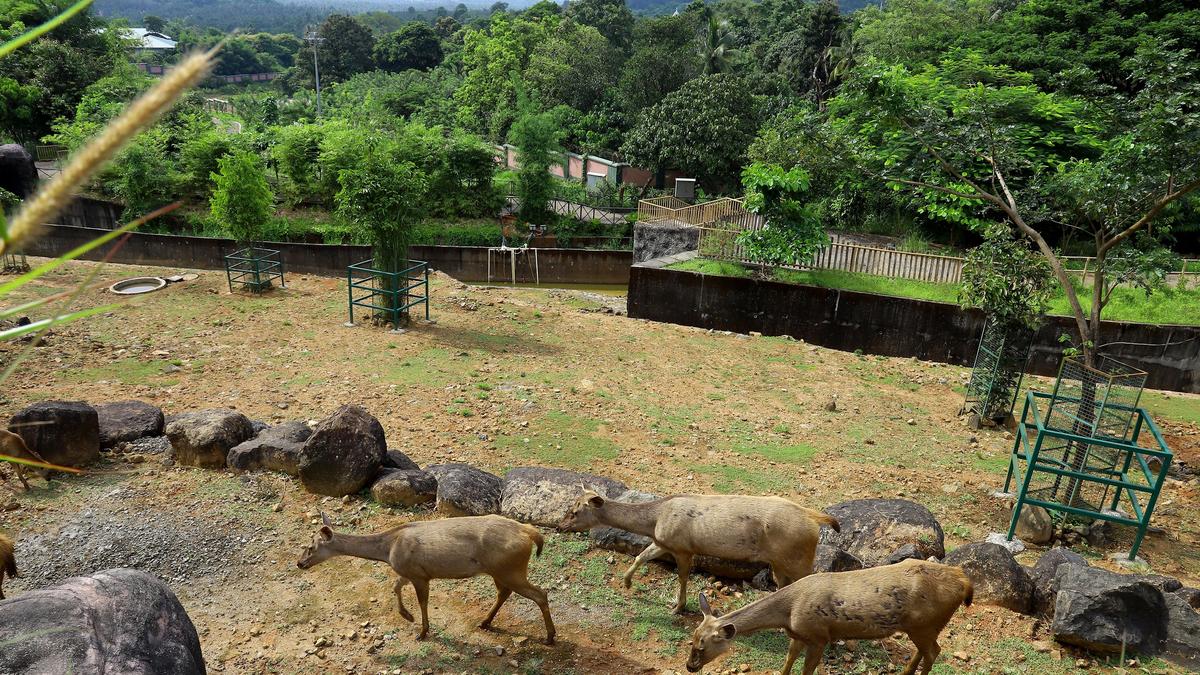
A panoramic view of the Thrissur Zoological Park at Puthur. | Photo Credit: NAJEEB KK
“The park is not a space to lock up animals but to give them a dignified, near-natural life and help people understand their place in the ecosystem,” explains Revenue Minister K. Rajan, articulating the core philosophy behind the project.
On October 28, Chief Minister Pinarayi Vijayan is set to inaugurate the park, ushering in a new era for Kerala’s wildlife care, conservation, and educational initiatives.
For nearly three decades, the vision of a larger, more modern zoo in Thrissur had been discussed. The existing century-old zoo, spread over a mere 13.5 acres in the city center, was overcrowded, housing over 450 animals in outdated enclosures.

A panoramic view of Thrissur Zoological Park, Puthur. | Photo Credit: NAJEEB KK
A turning point arrived in 2012 when renowned Australian zoo architect Jon Coe, who has contributed to over 85 zoological projects globally, visited the proposed site at Puthur. “Jon found the terrain and the ecosystem perfect for a new-generation zoo,” recalls M. Peethambaran, secretary of Friends of Zoo, an organization that actively campaigned for the project. “Our dream was to give animals space to live, not just survive.”
The park’s development gained momentum when the State government included it among projects to be funded by the Kerala Infrastructure Investment Fund Board. “A dream that began 30 years ago is finally taking shape,” states Rajan, who represents the Ollur Assembly constituency of Thrissur. “This isn’t just another zoo — it’s a statement of how Kerala treats its wildlife. We have invested over ₹370 crore to make this a world-class conservation space.”

Chimbu, the wild gaur at the Puthur zoo | Photo Credit: NAJEEB KK
A sanctuary re-imagined
Designed by Jon Coe, the Thrissur Zoological Park reimagines the traditional zoo. It functions not as a spectacle of confinement, but as a sanctuary promoting coexistence. Built as a ‘zoo without bars,’ the park meticulously replicates wildlife habitats found across India and internationally, offering animals and visitors an experience far closer to the wilderness than to a conventional urban enclosure, according to park managers.
“My principal responsibility was to see that the facility came up as conceived by Jon,” says K.J. Varghese, the special officer of the park.

Entrance to Thrissur Zoological Park. | Photo Credit: NAJEEB KK
The park is intelligently divided into nine distinct zones, each featuring a dedicated conservation area that echoes a specific ecological region. From the arid Zululand Zone to the misty Shola Grassland Zone, every segment narrates a tale of adaptation and harmonious living. “Each zone here is a miniature version of its parent ecosystem. We recreated the landscapes, soil texture, microclimate, and even the vegetation has been brought in,” Varghese emphasizes.
Nine worlds, one wilderness
In the expansive Kanha Zone, visitors can observe India’s magnificent big cats—tigers, leopards, and Asiatic lions—roaming freely amidst stretches of sal and teak forest. Elevated viewing decks and immersive tunnels provide unparalleled opportunities to watch these animals in their natural settings. “The idea is to let people see wildlife in action—climbing, stalking, playing,” explains B.N. Nagaraj, the park’s Director. “It’s not just about display. It’s about animal behavior, ecology, and emotions.”
A slice of Africa
A short stroll away, the landscape transforms dramatically. Red soil replaces lush green, the air feels drier, and the architecture shifts to traditional thatched, conical huts—a warm welcome to the Zululand Zone. Here, every element, from the terrain to the buildings, captures the essence of the African Savannah. Visitors will encounter giraffes, zebras, elands, ostriches, and hippos. Boardwalks extend over hippo swamps, with claybanks meticulously designed to mimic the eroded edges of African rivers. For a captivating moment, Thrissur feels a world away.
Whisper of the sholas

A view of Thrissur Zoological Park. | Photo Credit: NAJEEB KK
Entering the Shola Grassland Zone, the air cools, and the scenery turns to vibrant emerald. Nilgiri tahrs, raptors, and various grassland birds soar and move through the open spaces, enveloped by native plants that perfectly replicate the Western Ghats ecosystem. “The shola forests are fragile, unique, and stunning. We’ve recreated the microclimate — mist, moss, and meadow — so that even the birds feel at home,” notes Varghese.
Nearby, a dedicated Bear Zone provides shelter for sloth bears and Himalayan black bears within shaded woodlands, while the Grassland Zone hosts wild dogs—dhole, jackal, and hyena—in extensive, open plains that encourage their natural pack behaviors.
The park also boasts innovative hologram tunnels, where visitors can witness stunning 3D projections of extinct or rare animals. Guests can walk through immersive environments, experiencing holographic animals flying around them or appearing to be alive within fenced enclosures. These captivating experiences transport visitors to different locations and time periods, allowing them to feel truly connected to the wildlife. Another highlight is the Petting Zone, offering children a safe and enriching opportunity to interact with small and young animals, fostering empathy and ecological awareness.
“Our goal is to make learning irresistible,” the curators affirm. “When a child can see, touch, and understand an animal, they grow up wanting to protect it.”
A nocturnal house is currently being prepared to showcase owls and reptiles under soft, ambient lighting. Additionally, interpretive trails will guide visitors, explaining animal behavior, forest ecology, and the critical challenges of conservation.
Conservation comes alive
Beyond the public visitor trails, the park features a comprehensive conservation and research complex, fully equipped for breeding endangered species, providing advanced veterinary care, and facilitating wildlife rehabilitation. The zoo plans to forge collaborations with universities and various conservation agencies to further research into animal behavior and effective ecosystem management.
Sustainability is deeply ingrained in every aspect of the project. “We’ve planted thousands of trees — bamboo, palms, and various forest species, alongside innumerable garden plants — to cultivate a self-sustaining ecosystem,” adds Varghese.
The park’s water needs are met through two rainwater ponds and two abandoned quarries, collectively holding an impressive 645 million liters of water, supplemented by the Manali river. Solar panels power the administrative units, while natural reed beds efficiently treat wastewater. Moreover, natural drainage channels ensure optimal rainwater harvesting across the entire site.
Electric buses will transport visitors along the 6.5-km-long, ring-shaped path, offering a comfortable and eco-friendly tour. Thoughtfully placed cafeterias, restrooms, and resting spaces are available throughout the park. The Kerala State Road Transport Corporation will also launch a double-decker bus service, providing a scenic tour that connects the city with the park.
Visitors won’t merely walk through the park; they will embark on a journey through diverse biomes. Interpretation centers, interactive exhibits, and shaded walkways replace cluttered signages and confining cages. Every sense is engaged, from the gentle rustle of bamboo to the echoing calls of birds across the lake.
Currently, workers are diligently applying the finishing touches to the project. Landscaping teams are planting saplings, engineers are testing the electric buses, and curators are fine-tuning enclosures for the park’s initial residents. “My responsibility was to make sure the project stayed true to Jon’s vision,” states Varghese. “Animal enrichment isn’t a one-time job. It has to evolve — the animals must stay curious and active.”
The government anticipates an annual footfall of 20 to 25 lakh visitors by the fifth year of operation. Presently, only one-third of the total project area has been developed into the zoological park. “The park will grow and evolve with time. It also proves that development and compassion can coexist,” Rajan affirms.
Although scheduled to open on October 28, public entry to the park will be restricted for a few months to allow the animals to adapt smoothly to their new habitat, according to park authorities.
The Thrissur Zoological Park seamlessly integrates education, research, and tourism to foster greater awareness about wildlife and nature among its visitors. For Rudra, the tiger, life at the new park promises a relaxed existence, free from challenges and well-fed, a serene outcome perfectly suited for the once embattled predator.