
The PUNCH Space Mission, recently launched by NASA, is successfully achieving its goal of “making the invisible, visible” by observing the ‘young solar wind,’ according to Craig Edward DeForest, the mission’s Principal Investigator.
“We are making the solar wind visible,” Dr. DeForest stated during a public lecture titled ‘Imaging Almost Nothing At All…With the PUNCH Space Mission of NASA’ in Thiruvananthapuram. The event was a collaborative effort between the Indian Institute of Space Science and Technology (IIST), the Christ University Nodal Office, and the local chapter of the Breakthrough Science Society.
PUNCH, an acronym for ‘Polarimeter to Unify the Corona and Heliosphere,’ is designed to study the sun’s corona and solar wind as a unified system, explained Dr. DeForest, who also serves as Director of the Department of Solar and Heliospheric Physics at the Southwest Research Institute (SwRI) in Boulder, Colorado. He anticipates that within the coming year, scientists will download and analyze the mission’s data, allowing them to visualize the material constantly flowing across our cosmic neighborhood.
Crucial Scientific Objective
SwRI, the leading institution for the PUNCH mission, emphasizes its core scientific objective: “To determine the processes that unify the solar corona and heliosphere.” Launched in March, the mission utilizes four compact satellites orbiting in a sun-synchronous low-Earth orbit (LEO). Together, these satellites capture continuous 3D images of the solar corona as it transitions into the solar wind.
Dr. DeForest highlighted the immense importance of understanding and predicting space weather for human protection. He stressed that events like solar wind and coronal mass ejections (CMEs) can profoundly affect our entire solar system.
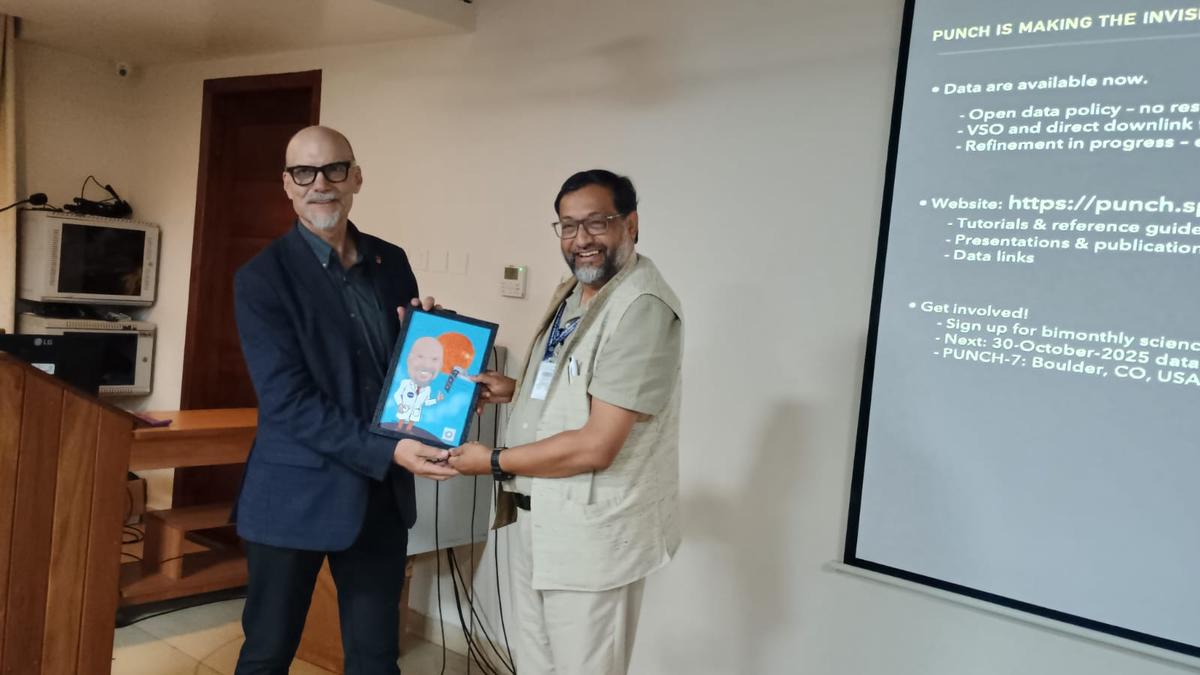
IIST Vice-Chancellor Dipankar Banerjee presenting a memento to Craig Edward DeForest, Principal Investigator of PUNCH mission in Thiruvananthapuram on Wednesday.
He explained that while the sun continuously emits “streams of material, this riotous torrent of clouds and turbulence,” these are minor compared to CMEs, which occur when active regions on the sun’s surface become unstable and violently eject vast amounts of material. Such intense solar phenomena can have significant repercussions for humans and our technology, ranging from intensified auroras to disruptions of satellites and even widespread power grid failures. “As humans, we ought to be interested in this, because we live here. We want to understand our environment,” he asserted.
Peak Solar Activity
Currently, the sun is experiencing a period of solar maximum, characterized by heightened activity, which will likely quiet down in about five years. While predicting the exact timing of individual ejections remains challenging, Dr. DeForest likened it to tracking hurricanes: “You cannot tell when an individual hurricane will happen, but we can track them.”
The lecture also featured remarks from IIST Vice-Chancellor Dipankar Banerjee and Breakthrough Science Society (Thiruvananthapuram) president Kurian Isaac.