
Just beyond the bustling Shivamogga bypass, a cluster of makeshift homes, crafted from wooden poles and plastic sheets, reveals a poignant story. These are the decades-old dwellings of microscopic nomadic communities, where approximately 150 individuals from the Sindhollu, Sudagadu Sidda, and Shillekyatha communities reside. Their daily lives are marked by a stark absence of basic necessities: no electricity and no proper sanitation facilities.
Each morning, as children prepare for school, their parents and elders embark on their daily quest for survival. Many women collect plastic waste from public spaces, while others peddle stationery, ornaments, and household items. A dwindling few still maintain their traditional practice of seeking alms in customary attire. Despite these efforts, economic stability remains elusive; only two individuals from this settlement have managed to enroll in degree colleges, and none currently hold a job with a consistent income.
For the aspiring students of the camp, education literally takes place under external light sources. Lacking electricity at home, they rely on the streetlights of a nearby locality to complete their homework. After dark, their studies continue by the dim glow of small lamps or battery-powered lights. Even charging their essential mobile phones and other devices requires a trip to a nearby shopkeeper, who levies a modest fee of ₹5 for the service.
No Access to Toilets
“The lack of toilets is our most pressing issue,” stated Saritha, a camp resident. “Everyone, especially the women, faces immense hardship. We have been pleading for proper sanitation facilities for years, but our pleas remain unanswered.”
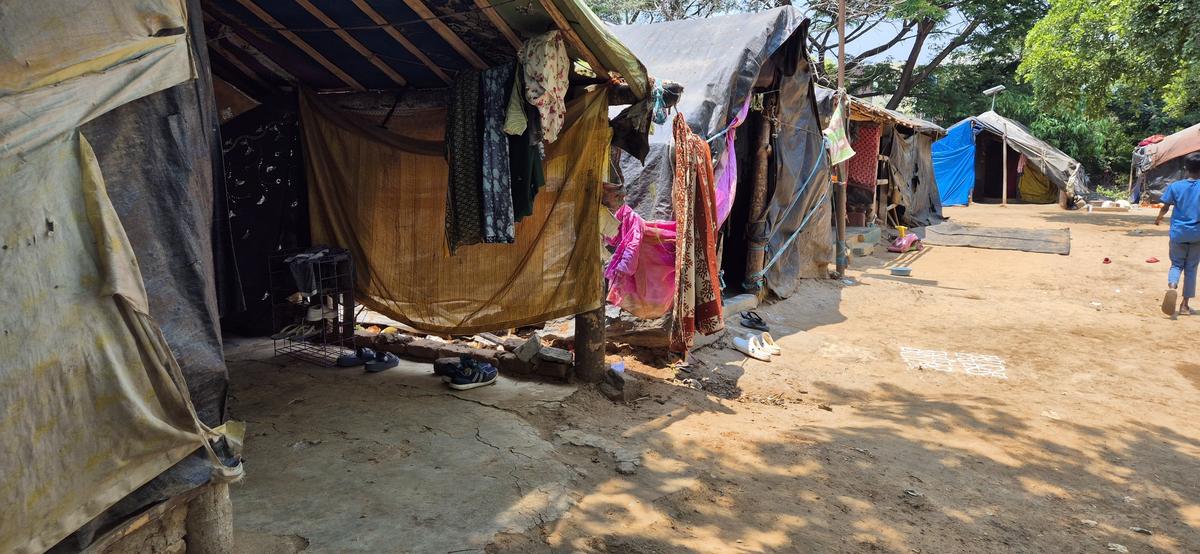
A view of the migrant camp on the outskirts of Shivamogga. | Photo Credit: SPECIAL ARRANGEMENT
Recently, four camp residents traveled to Bengaluru to participate in protests organized by nomadic communities, challenging the government’s approach to internal reservation. There’s deep disappointment among residents, who feel their severe hardships were overlooked when authorities finalized decisions based on the Justice H.N. Nagamohan Das commission’s recommendations for internal reservation.
The Justice Nagamohan Das commission report highlights a stark reality: the State’s population includes 36,431 Sudagadu Sidda, 45,989 Shillekyathas, and 5,337 Sindhollu (Chindollu) individuals. Government representation from these communities is minimal. The Sindhollu Chindollu community has no members in government offices, while only 246 Sudagadu Sidda and 291 Shillekyathas hold government positions, almost exclusively in Group C or D roles. This data underscores the profound lack of opportunities and upward mobility for these groups.
The Plight of 59 Most-Backward Communities
The commission identified 59 such communities, totaling 5.22 lakh people, as ‘most-backward’ and categorized them under Category A, recommending a 1% reservation. Members of these communities had held strong hopes that the government would adopt and implement these crucial recommendations.
However, the government’s decision to merge these 59 microscopic communities with ‘less backward’ groups—such as Bhovis, Lambanis, Korama, and Koracha—and allocate a combined 5% reservation has caused significant distress. This policy forces the truly ‘most backward’ communities to compete with more established ‘less backward’ groups for reservation benefits, a situation they describe as deeply unjust.
Hussainappa, a camp resident, eloquently summarized the perceived unfairness: “It’s like pitting newly literate individuals against university professors.” He elaborated, noting that many from the Lambani, Bhovi, Korama, and Koracha communities have achieved senior official positions and even university professorships. In stark contrast, our children are only just starting school, often studying under the glow of streetlights. “How can we possibly compete with them? This decision represents a profound injustice to our community,” he asserted.
Ongoing Protests for Justice
In response to these perceived injustices, the Karnataka Asprushya Alemari Samudayagala Maha Okkoota, a powerful federation of nomadic communities, has declared an indefinite dharna in New Delhi, commencing Monday. This protest aims to challenge the contentious implementation of internal reservation policies. Meanwhile, demonstrations continue in Bengaluru, with recent actions including activists attempting to lay siege to the residence of Social Welfare Minister H.C. Mahadevappa on Friday, signaling their unwavering resolve for equitable treatment.