
Step inside Hyderabad’s venerable Mahbubia Town Hall, also known as the old Telangana Assembly building, and you’ll find a hive of meticulous activity. Here, skilled artisans, armed with one-inch brushes and tiny trowels, are painstakingly restoring the intricate lime stucco work on its pillars. Hanging from scaffolding, their keen eyes trace and re-carve forgotten vegetal and geometric patterns, revealing designs that have been obscured for decades. What were once rows of offices, filled with furniture, books, and air conditioning units for legislators, are now vibrant workspaces where history is being meticulously brought back to life.
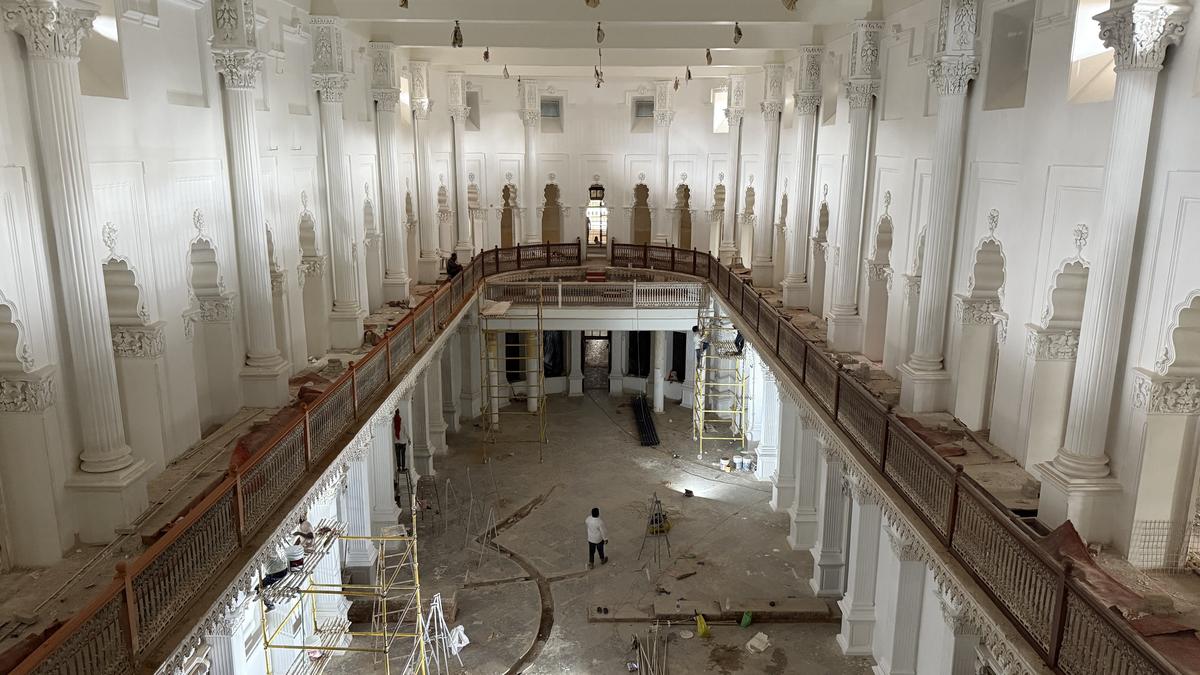
Restoration work underway in the inner hall of the old Assembly building. (Photo: Serish Nanisetti)
“When we began this project, the roof was in such a state that it felt like there was no roof at all. They had even installed tin sheets to prevent rainwater from pouring in,” explains Ratish Nanda, CEO of the Aga Khan Trust for Culture, the organization leading this impressive conservation effort. “Layers of 20th-century additions had compromised the roof’s drainage, leading to significant seepage issues.”
The conservation team undertook a monumental task, removing tonnes of debris, restoring the original slopes, and relocating water tanks from the terrace. Nanda proudly states, “The building has truly gained a new lease on life. Conservation, in many ways, proves to be more cost-effective than constructing something entirely new.”
Almost 120 years after its initial commission in 1905, and completed before 1913, this Indo-Saracenic marvel is a breathtaking sight. Its principal facade gleams with a fresh coat of paint as scaffolding is gradually dismantled, unveiling a transformation that is nothing short of spectacular, despite the occasional modern wire tangle.

The distinctive “MTH” initial, symbolizing Mahbubia Town Hall. (Photo: Serish Nanisetti)
Originally envisioned as a town hall to manage Hyderabad’s civic affairs, the building’s construction was a public effort, crowdfunded to commemorate Nizam Mahbub Ali Khan’s silver jubilee. Leading businessman Seth Dewan Bahadur Ramgopal spearheaded the fundraising. By the 1920s, the structure took on a new role as a museum, with Nizam Osman Ali Khan’s approval. A state document from that era notes, “His Highness has been graciously pleased to command that a portion of the Mahbubia Town Hall be reserved for an economic, industrial and archaeological museum. The absence of an institution of such great educational value for the public of Hyderabad had long been felt. It is hoped that at any rate a modest beginning will soon be made. One of the special features of this museum will be to exhibit the archaeological remains and the arts and crafts of the State.”
Following the completion of the dedicated State Archaeological Museum in the 1930s, the Mahbubia Town Hall fell into disuse until it later became the Andhra Pradesh Assembly building. This served as its function until an adjacent, newer hall was constructed in the 1980s.
“This building truly represents the pinnacle of Indo-Saracenic architectural style,” says Sajjad Shahid of the Indian National Trust for Art and Cultural Heritage. “With its ornate domes, distinctive cusped arches, and rich embellishments, it beautifully reflects the grandeur and character of Nizam Mahbub Ali Khan. This contrasts sharply with later Indo-Saracenic structures, such as the Kacheguda Railway Station, which embody the more reserved and austere sensibilities of Nizam Osman Ali Khan.”
The opulence of the Mahbubia Town Hall is further highlighted by its construction cost of ₹19 lakh, especially when compared to other significant projects of its time: the City High School at just over ₹7 lakh, the Osmania General Hospital at approximately ₹20 lakh, and the High Court at ₹21 lakh.
The careful conservation and restoration of this building signify a crucial step in preserving Hyderabad’s invaluable heritage. It’s a structure that has gracefully transitioned from a town hall, to a museum, and ultimately to a state legislature. As Niyati Jigyasu, an expert from ICOMOS and an architecture and planning professional, aptly puts it, “This building is intrinsically linked to the city’s identity. It embodies urban memory – a collective historical and social recollection that simply cannot be replicated by building anew.”