
The scientific community is buzzing with excitement as the Royal Swedish Academy of Sciences proudly announces the recipients of the 2025 Nobel Prize in Chemistry. This prestigious award is jointly bestowed upon Susumu Kitagawa of Kyoto University, Japan; Richard Robson of the University of Melbourne, Australia; and Omar M. Yaghi of the University of California, Berkeley, USA. These three brilliant scientists are recognized for their pioneering contributions to the field of Metal-Organic Frameworks (MOFs), a class of crystalline materials boasting extraordinary porous structures that are reshaping chemistry, environmental science, and advanced materials engineering.
What Earned Them the Nobel Prize?
The laureates’ groundbreaking achievement lies in their development of Metal-Organic Frameworks—intricate molecular architectures where metal ions are precisely linked by long organic molecules. What makes MOFs truly revolutionary are their spacious internal cavities, which can be custom-designed to selectively capture, store, or catalyze specific substances.
These versatile materials are already being deployed in a variety of critical applications. They enable the efficient harvesting of water from arid desert air, offer advanced solutions for capturing carbon dioxide from the atmosphere, and are capable of separating toxic gases. Furthermore, MOFs show promise in conducting electricity and facilitating complex chemical reactions. Their collective work has established a powerful and adaptable platform for creating tailor-made materials with far-reaching implications for addressing some of the most pressing global challenges facing humanity today.
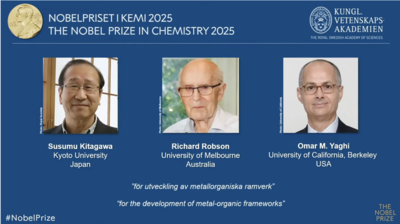
Susumu Kitagawa: The Visionary from Kyoto
Born in Kyoto, Japan, in 1951, Susumu Kitagawa completed his PhD at Kyoto University in 1979. As a distinguished professor at his esteemed alma mater, Kitagawa meticulously demonstrated the remarkable flexibility and gas permeability inherent in MOFs. His research vividly illustrated how these intricate porous structures could be precisely manipulated to selectively trap and release various gases. Kitagawa’s crucial work was instrumental in solidifying MOFs’ standing as highly functional and adaptable materials, paving the way for their diverse real-world applications.
Richard Robson: Laying the Foundations in Melbourne
Richard Robson, a native of Glusburn, UK, born in 1937, obtained his PhD from the University of Oxford in 1962. During his tenure as a professor at the University of Melbourne, Robson initiated the foundational concept of MOFs. He achieved this by skillfully combining positively charged copper ions with multi-armed organic molecules, leading to the formation of unique, diamond-like crystals characterized by their expansive internal cavities. While his early frameworks faced challenges with stability, Robson’s pioneering insights provided the essential groundwork upon which Kitagawa and Yaghi built their later, transformative breakthroughs.
Omar M. Yaghi: Master of Rational Design at Berkeley
Omar M. Yaghi, born in Amman, Jordan, in 1965, earned his PhD from the University of Illinois Urbana-Champaign in 1990. As a professor at the University of California, Berkeley, Yaghi revolutionized the field by developing highly stable MOFs and, more importantly, by introducing comprehensive rational design principles. These principles empower scientists to create MOF frameworks with precisely customizable properties, tailored for specific functions. His profound contributions have led to the synthesis of tens of thousands of MOF variants, each holding significant promise across chemistry, advanced energy storage solutions, and critical environmental applications.
The 2025 Nobel Prize in Chemistry stands as a testament to the immense and collaborative contributions of these three extraordinary scientists. Their collective work underscores the transformative power of molecular design and crystal engineering in modern science, promising a profound global impact on solving pressing environmental and technological challenges that will benefit humanity for generations to come.