
What could be one of the largest single-day demonstrations in U.S. history is currently unfolding as millions of Americans rally under a powerful, yet simple, slogan: “No Kings.” This iconic phrase, deeply rooted in the nation’s foundational principles, has evolved into a widespread movement directly challenging what many perceive as a troubling slide toward authoritarianism under the leadership of President Donald Trump.
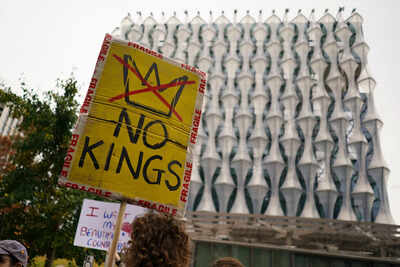
Reports from The Guardian indicate that over 2,500 events are scheduled nationwide, spanning all 50 states. From bustling metropolitan centers like Washington, D.C., and New York City, to smaller communities across the Midwest, these coordinated demonstrations emerge after months of heightened friction between the White House and various opposition factions, and notably, during a government shutdown that has frozen billions in federal funds.
The Roots of the ‘No Kings’ Movement
The “No Kings” coalition first captured national attention during a widespread protest in June, where millions gathered to condemn the administration’s deployment of federal forces in American cities. This current wave of activism, orchestrated once more by a diverse network of progressive organizations, labor unions, and civil rights advocates, significantly amplifies that earlier display of collective defiance.
As detailed by The Guardian, organizers characterize this movement as staunchly “pro-democracy and pro-worker,” underscoring the fundamental belief that true American power resides with its citizens, not with any perceived “kings.” The demonstrations aim to draw attention to what they identify as “authoritarian excesses,” such as harsh deportation policies, reductions in healthcare, and attempts to bypass established judicial and legislative checks on executive authority.
A Massive Nationwide Demonstration
From Honolulu to Boston, events are meticulously planned, with each local community hosting its own rally instead of converging on a single central location. This decentralized approach is designed to powerfully convey that dissent is not limited to major cities but is deeply woven into the fabric of the entire nation.
The “No Kings” coalition’s platform urges participants to wear yellow, a color globally recognized for its association with pro-democracy movements in places like Ukraine, Hong Kong, and South Korea, thereby forging a clear and unified symbol of resistance.
According to crowd estimates from Harvard University’s Crowd Counting Consortium, the initial “No Kings” protests in June attracted between two and almost five million participants, positioning them among the largest demonstrations since the historic 2017 Women’s March. Organizers are now anticipating even greater numbers, with the potential to exceed that previous record.
The 3.5% Rule: Harnessing the Power of Participation
The coalition’s strategic approach is heavily influenced by the “3.5% rule,” a concept pioneered by political scientists Erica Chenoweth and Maria Stephan. Their extensive research into global civil resistance movements revealed that when approximately 3.5% of a population consistently participates in non-violent protest, there’s a near-certain chance that regimes will either significantly alter their policies or face collapse.
While the U.S. population has not yet reached this critical proportion—equivalent to roughly 11 million people—The Guardian reports that movement organizers view this principle as a source of inspiration, not a strict directive. Their core objective is to cultivate sustained civic engagement, moving beyond mere fleeting outrage.
Washington’s Reaction
The Trump administration has, so far, refrained from direct commentary on the October 18th protests. Nevertheless, prominent Republican figures have voiced criticism, branding the demonstrations as partisan acts designed to disrupt and potentially extend the ongoing budget stalemate.
Some cabinet members have even suggested, without offering concrete evidence, that protesters are financially incentivized or that Democrats are exploiting these rallies for political gain. However, movement organizers have vehemently rejected these assertions, maintaining that the protests constitute a “visible, lawful rejection” of what they perceive as authoritarian impulses, as reported by The Guardian.
Prioritizing Security and Non-Violence
In an environment of intense political polarization, safety and security remain paramount. Governors in various states, notably Texas, have dispatched National Guard troops, and federal authorities have committed to maintaining a strong law enforcement presence around protest locations.
The “No Kings” coalition steadfastly promotes non-violence as its core guiding principle. Local organizers have taken extensive measures, including training marshals and distributing “know your rights” information to participants. The Guardian also highlights that tens of thousands have participated in online safety briefings in preparation for these events.
A Critical Test for Democratic Foundations
More than just policy debates, the “No Kings” protests delve into the very essence of America’s political culture. They pose a fundamental question: can American democracy, a system built upon the powerful rejection of monarchy, endure the significant pressures now challenging its core institutions and established norms?
By rallying under the banner of “No Kings,” the movement transcends partisan divides, appealing to a profound constitutional ideal: the unwavering principle of accountable power. Regardless of whether these protests yield immediate policy changes, they undeniably represent a pivotal moment in civic expression, revealing the extent to which a nation is prepared to safeguard its democratic bedrock.