
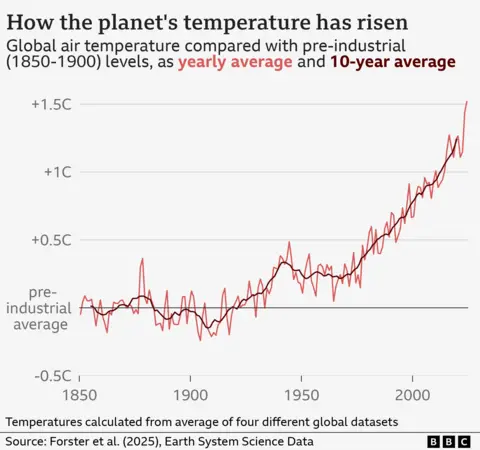
World leaders are preparing to gather for their annual summit dedicated to addressing climate change. COP30, the 30th iteration of the UN Climate Change Conference, marks a significant milestone, occurring ten years after the landmark Paris Agreement. This pivotal accord saw nations commit to limiting the rise in global temperatures to 1.5 degrees Celsius above pre-industrial levels.
What is COP30 and What Does it Signify?
COP, which stands for Conference of the Parties, represents the nearly 200 countries that originally signed the UN climate agreement in 1992. COP30 is the 30th such annual meeting, a forum where governments convene to strategize on limiting and preparing for the impacts of climate change.
When and Where is COP30?
The official dates for COP30 are from Monday, 10 November to Friday, 21 November. World leaders are expected to arrive for preliminary discussions on Thursday, 6 November, and Friday, 7 November, preceding the official opening. It’s common for these conferences to extend beyond their scheduled end dates as participants work towards a consensus on a final agreement.
For the first time, Brazil will host the conference in Belém, located within the Amazon rainforest. The selection of a host nation typically rotates among regions, similar to major international sporting events. However, Belém’s remote location and limited transport infrastructure have presented considerable logistical challenges, including a shortage of affordable accommodation. This situation has raised concerns about potential barriers for delegates from less affluent nations.
The decision to clear a portion of the Amazon rainforest for road construction to support the summit has also drawn criticism. Furthermore, Brazil’s continued issuance of new oil and gas licenses leading up to COP30 has sparked controversy, given that these fossil fuels are primary drivers of global warming.
Who’s Attending COP30 and Who Isn’t?
While participation is anticipated from countries worldwide, many national leaders have yet to confirm their attendance. UK Prime Minister Sir Keir Starmer and Prince William (representing King Charles) are expected to be present. The United States’ delegation status remains uncertain, especially considering the previous administration’s withdrawal from the Paris Agreement and the current administration’s focus on boosting fossil fuel production.
China, the world’s largest emitter of greenhouse gases, is expected to send representatives, though President Xi Jinping’s attendance is unlikely. Alongside government officials, diplomats, journalists, and campaigners will also be present. Previous COPs have faced criticism for including a significant number of individuals linked to the fossil fuel industry, which some argue highlights the continued influence of these lobbies.
The Importance of COP30
COP30 arrives at a critical juncture, with global efforts to meet climate targets facing considerable pressure. The 2015 Paris Agreement aimed to limit global temperature rises to 1.5°C above pre-industrial levels, a goal that is increasingly difficult to achieve. While renewable energy adoption, particularly solar power, is rapidly expanding, countries’ emission reduction plans have consistently fallen short. The UN’s secretary-general has acknowledged that exceeding the 1.5°C threshold is now inevitable, but expressed hope that temperatures could eventually be brought back down to this level by the end of the century. COP30 is seen as an opportunity to reinforce the commitment to the Paris Agreement’s framework.
Key Discussion Points at COP30
Brazil aims for COP30 to be a venue for agreeing on concrete steps to fulfill commitments made at prior conferences. Several key areas are expected to be central to discussions:
- Fossil Fuels: Following the agreement at COP28 to “transition away from fossil fuels,” further discussions are expected to solidify this commitment.
- Finance: Richer nations pledged at COP29 to provide developing countries with at least $300 billion annually by 2035 to aid in climate adaptation. However, this falls short of the needs identified by many developing nations. The aspiration to mobilize $1.3 trillion from both public and private sources remains a significant topic, with details on its realization eagerly awaited.
- Renewables: The commitment made at COP28 to triple global renewable energy capacity by 2030 is a key focus. Despite rapid growth forecasts for renewables, the International Energy Agency indicates that current trajectories are not sufficient to meet this target.
- Nature: A potential development could be the launch of the “Tropical Forests Forever Facility,” a fund aimed at preventing the destruction of tropical forests.
Will COP30 Make a Difference?
Achieving significant breakthroughs at COP30 may prove challenging, partly due to shifts in global political landscapes, such as the US administration’s stance on climate change. Past environmental negotiations have faced difficulties in reaching consensus, and the future of international climate commitments remains a subject of debate.
Some critics, like environmental activist Greta Thunberg, have accused previous COPs of “greenwashing,” allowing entities to enhance their environmental image without enacting substantial change. Nevertheless, past COP sessions have facilitated crucial global agreements, enabling progress that individual national policies might not achieve alone. Despite the difficulties in adhering to the 1.5°C warming limit set in Paris, the commitment has spurred widespread climate action, contributing to a reduction in projected warming, although the current pace of action remains insufficient to meet the Paris goals.

Sign up for our Future Earth newsletter to keep up with the latest climate and environment stories with the BBC’s Justin Rowlatt. Outside the UK? Sign up to our international newsletter here.