
The stage recently came alive at the Museum Theatre with Enchantment, a poignant play chronicling the incredible life of Pt. Ravi Shankar, a musical giant who single-handedly brought the sitar to global prominence. His unparalleled creativity and profound musical insight continue to inspire countless musicians today. This special production, penned and directed by Gowri Ramnarayan and brought to life by JustUs Repertory, served as a fundraiser for REACH, an organization dedicated to tuberculosis care and prevention.
Capturing the essence of such a monumental figure – whose aura and music remain etched in public consciousness – within a concise theatrical piece is an ambitious undertaking. Director Gowri Ramnarayan opted for a linear narrative, focusing on key milestones in Pt. Ravi Shankar’s extraordinary journey.
Right from the start, Gowri Ramnarayan clarified the play’s intent: ‘Artistes are here to enact his life story, not recreate his persona,’ she stated, preempting any concerns about the portrayal. Yohan Chacko, donned in a kurta-pyjama and jacket, brought the sitar maestro to life, while Aarabi Veeraraghavan expertly guided the audience as the sutradhaar (narrator).
The production of Enchantment skillfully navigated through Ravi Shankar’s formative years, starting with his childhood in Benaras, followed by his travels to Paris. It vividly depicted his time with his elder brother, the acclaimed dancer Uday Shankar’s company, where he honed his diverse artistic talents, including music, dance, and acting. A pivotal segment showcased his rigorous gurukul parampara training under the legendary Ustad Allaudin Khan in Maihar, alongside his marriage to Khan’s daughter, Annapurna Devi, and their complex relationship. The play also explored his connection with dancer Kamala Shastri and his later marriage to Sukanya, weaving these personal threads into the broader narrative. As the play progressed, it highlighted his meteoric rise in the West – a period during which he reportedly expressed discomfort with the ‘world musician’ label – featuring his iconic performance at the Woodstock Festival and his groundbreaking collaborations with figures like George Harrison of The Beatles and violin maestro Yehudi Menuhin. His storied rivalry with Vilayat Khan and his venture into film scoring, notably for Anuradha, were also key elements. These life events were primarily conveyed through engaging dialogues between the protagonist and the narrator, enriched by evocative projected images, dynamic dance sequences, and soul-stirring musical renditions.
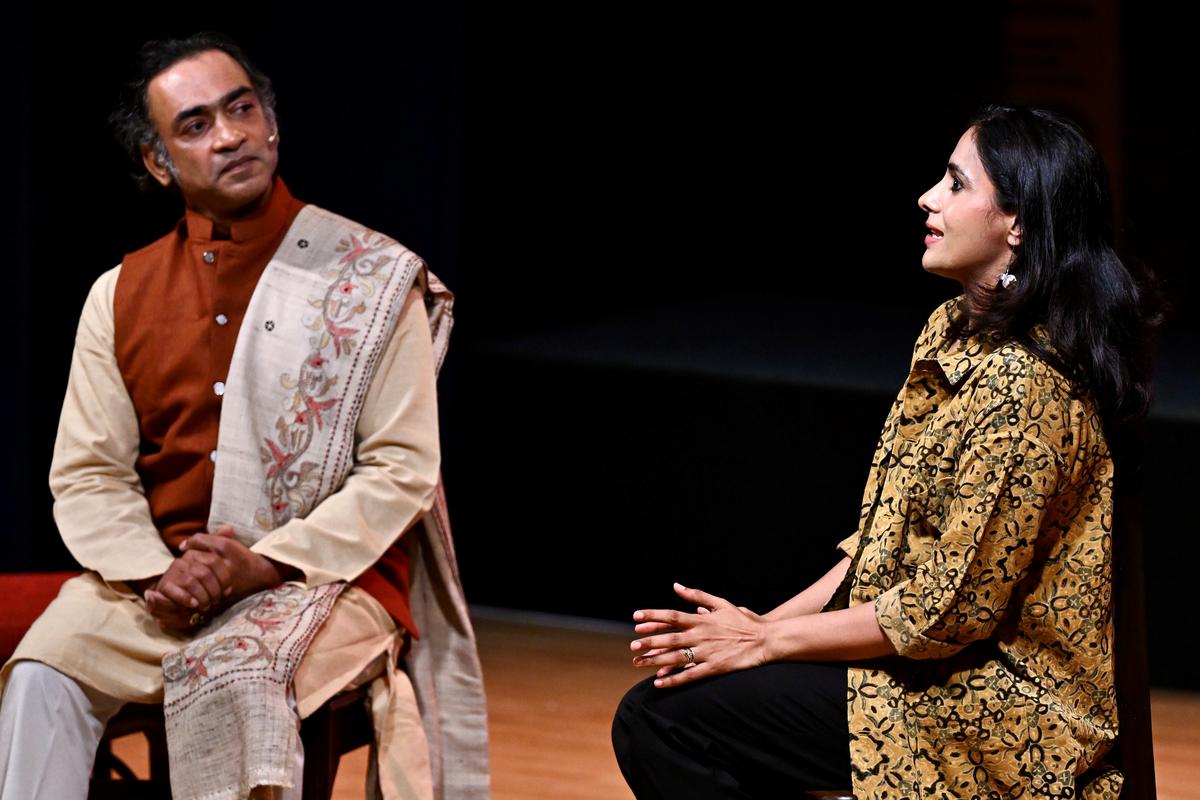
While Yohan Chacko delivered an impressive performance, lending significant weight to the maestro’s journey, a recurring criticism among the audience was the arguably excessive emphasis on Ravi Shankar’s personal relationships. Even if intentional, this aspect often felt superficial, prompting a broader discussion on the boundaries of creative license in biographical theatre. Furthermore, some of the dialogue exploring his romantic life could have benefited from a more subtle and dignified approach, and certain humorous moments occasionally veered into caricature. The portrayal of the legendary guru Allauddin Khan was also perceived as underwhelming, especially during a brief scene where Aarabi, as the narrator, represented the Ustad simply by donning a shawl.
A particularly contentious point was Enchantment‘s depiction of Annapurna Devi. The play largely highlighted her as insecure and jealous of her husband’s romantic interests, and even tyrannical towards their son, Shubhendra. This interpretation notably overshadowed her immense stature as a musician; Annapurna Devi was not only the sole female surbahar player of her era but was widely considered to possess musical genius on par with, if not surpassing, that of Pt. Ravi Shankar. These crucial aspects of her legacy were regrettably glossed over.
The dance segments, featuring Bharatanatyam artistes Renjith and Vijna, felt somewhat detached, running parallel to the main narrative rather than seamlessly integrating with it. These included a portrayal of Ganga arathi in Benaras and a rendition of Balasaraswati’s ‘Krishna nee begane,’ leading up to Pt. Ravi Shankar’s memorable composition from the film Anuradha. The musical tapestry, while featuring the renowned vocalist Bombay Jayashri Ramnath, noticeably relegated the sitar – arguably the true soul of the evening – to a minimal presence.
The cast included Vidhya Subramaniam in a cameo, alongside students of Renjith and Vijna. The recorded musical pieces showcased the talents of singers Aditya Prakash, Chaitra Sairam, and Vignesh Ishwar.