

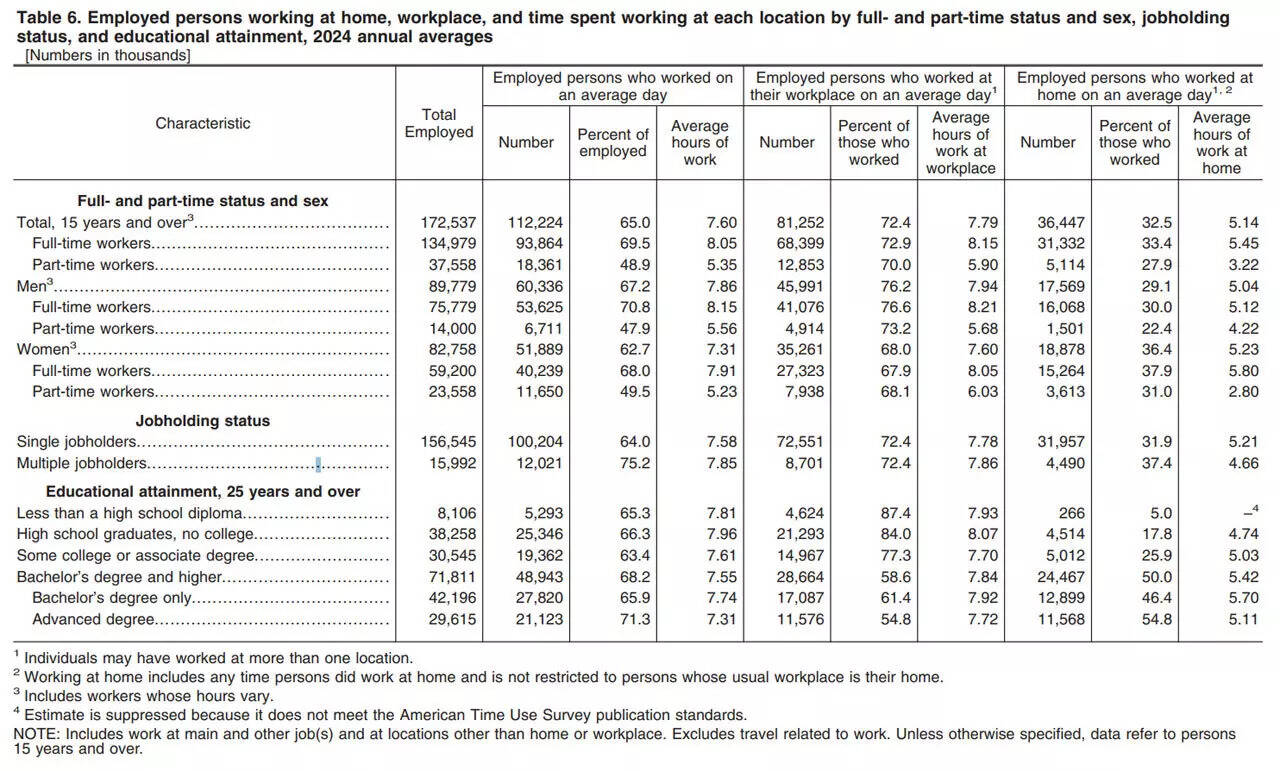
New data from the U.S. Bureau of Labor Statistics (BLS) has unveiled a notable disparity: employees working remotely are logging considerably fewer hours than their office-based counterparts. The 2024 American Time Use Survey (ATUS) reveals that remote workers averaged 5.14 hours of work per day, a substantial 2.65 hours less than the 7.79 hours recorded by those in traditional office settings.
This amounts to more than a full working day lost each week, underscoring a clear difference in productivity between the two work models. For numerous companies that embraced remote or hybrid structures post-pandemic, these BLS findings offer the most comprehensive evidence yet on how various working arrangements impact actual job task engagement.
The Time Gap: Home vs. Office Work Hours
The BLS report indicated that in 2024, approximately 87 percent of full-time employed individuals worked on an average weekday, dedicating about 8.4 hours to their jobs. Conversely, only 29 percent of full-time workers were on duty during weekends, averaging 5.6 hours. Across the board, remote workers consistently reported fewer logged hours compared to those in office environments.
The 2024 ATUS results also showed that about 33 percent of employed individuals spent time working from home on their working days. While this figure remained largely consistent with 35 percent in 2023, the percentage of men working remotely decreased from 34 percent in 2023 to 29 percent in 2024. The proportion of women working from home, however, remained stable at 36 percent.
Key Insights from the BLS ATUS 2024 Report
| Category | Details / Data | Category | Details / Data |
|---|---|---|---|
| Average daily work hours (in-office workers) | 7.79 hours | Average daily work hours (remote workers) | 5.14 hours |
| Difference between office and remote workers | 2.65 hours fewer for remote staff | Equivalent weekly time gap | More than one full workday lost per week |
| Share of employed people working at home (2023) | 35 percent | Share of employed people working at home (2024) | 33 percent |
| Share of men working at home (2023) | 34 percent | Share of men working at home (2024) | 29 percent |
| Share of women working at home (2023–2024) | 36 percent (unchanged) | Average weekday work hours (full-time employees) | 8.4 hours |
| Average weekend work hours (full-time employees) | 5.6 hours | Percentage of full-time employees working weekdays | 87 percent |
| Percentage of full-time employees working weekends | 29 percent | Remote work hours (construction sector) | 2.17 hours |
| Gender difference (remote work) | Men worked 12 minutes less than women | Gender difference (office work) | Men worked 18 minutes more than women |
| Workers aged 25+ with bachelor’s degree or higher working at home | 50 percent | Workers aged 25+ with only high school diploma working at home | 18 percent |
Gender and Industry Variations
The survey also highlighted gender-based differences in work patterns. Men working remotely reported 12 fewer minutes of work per day compared to women, while in office environments, men worked 18 minutes longer. These variations suggest that domestic and environmental factors might continue to influence work-from-home habits.
Furthermore, the BLS identified significant differences across various industries. Sectors like construction, transportation, and personal services showed sharp declines in logged hours among remote workers, primarily due to the inherent nature of their work. For instance, remote construction employees reported only 2.17 hours of labor per day, a stark contrast to the significantly higher averages observed among those working on-site.
Education Levels and Workplace Trends
Among workers aged 25 and older, a clear correlation emerged between higher education levels and the likelihood of working from home. The BLS reported that 50 percent of employees with a bachelor’s degree or higher performed some work at home on working days, compared to just 18 percent of those with only a high school diploma.
The ATUS report clarified that “time spent working” specifically refers to active, job-related tasks and does not include time merely connected to workplace systems. These survey results offer a detailed statistical overview of how American employees managed their working hours in 2024, providing valuable insights into the ongoing evolution of the modern workforce.