
The spectacular theft of priceless jewelry from the Louvre Museum in Paris has left many bewildered: how could such a brazen act occur in broad daylight? And more importantly, what will become of these stolen masterpieces?
In a matter of minutes, four thieves executed their plan with chilling precision. They gained entry through a first-floor window, shattered secure glass displays, and swiftly grabbed nine jewelry pieces of immeasurable value.
Despite alarms blaring and museum guards being close by, the thieves made a rapid escape on motorbikes. Interestingly, they dropped one of the stolen items – a magnificent diamond and emerald-encrusted royal crown, once belonging to Empress Eugenie, wife of Napoleon III.
Their haul consisted of exquisite jewelry from French imperial history, including brooches, necklaces, earrings, and a tiara. French prosecutors estimate the monetary value of these jewels at approximately 88 million euros (about 157 million Australian dollars), a figure that doesn’t even begin to capture their immense historical significance.
The sheer speed and professionalism of this heist point to a meticulously planned operation executed by highly skilled individuals, strongly suggesting connections to organized criminal syndicates.
While recent weeks have seen reports of other smaller thefts from French museums, such as gold nuggets from the Paris Natural History Museum, there is currently no indication that these incidents are linked to the Louvre heist.
What Awaits the Stolen Treasures?
The stolen jewelry comprises pieces so renowned and recognizable that selling them on the black market, even to the most discerning and wealthy collectors, would be incredibly challenging, if not entirely impossible.
This dilemma is a familiar one in the world of high-profile museum robberies. Consider the 2017 theft of the Canadian ‘Big Maple Leaf’ gold coin from Berlin’s Bode Museum, or the infamous 1990 heist of 13 masterpieces by artists like Degas, Manet, and Rembrandt from Boston’s Isabella Stewart Gardner Museum. In both cases, the stolen items have never been recovered.
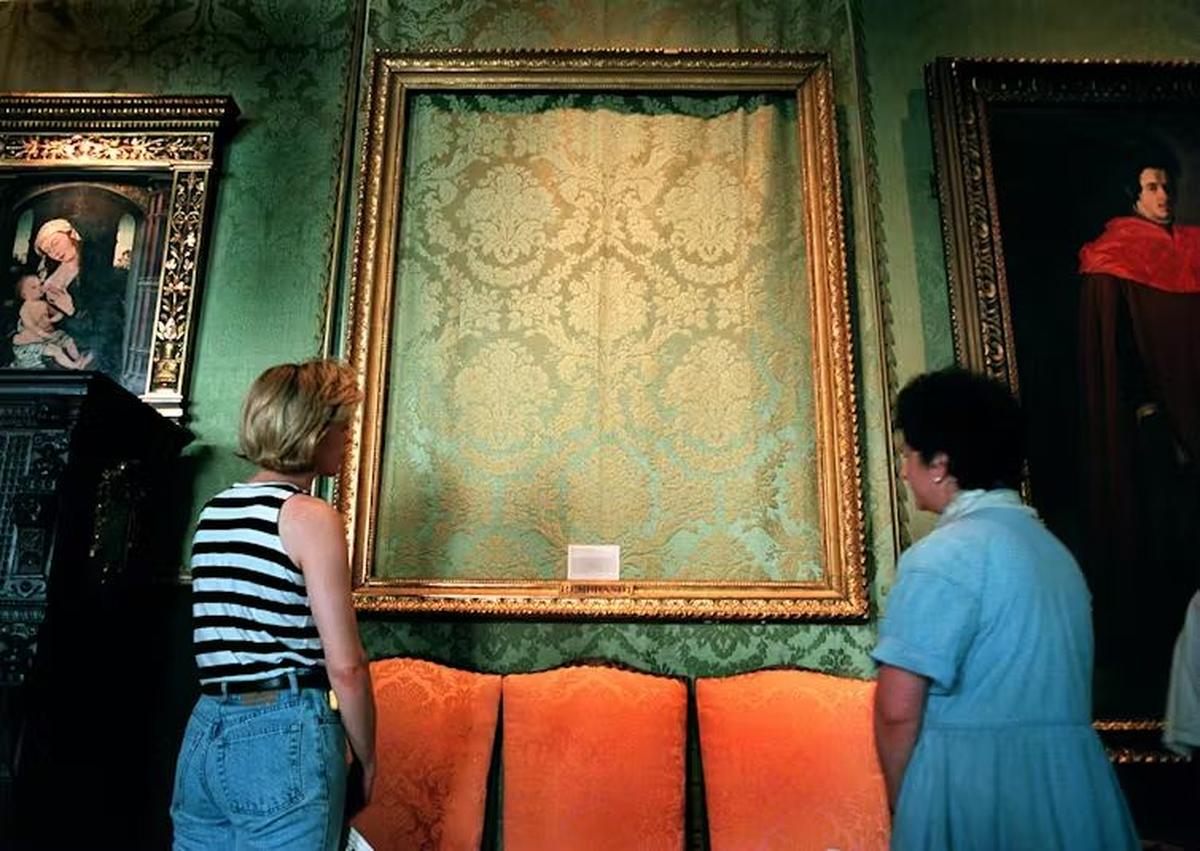
Visitors at the Isabella Stewart Gardner Museum, Boston, observe the empty space where a stolen Rembrandt painting once hung.
Instead, most experts widely agree that two primary scenarios are far more probable.
In the first scenario, the stolen jewelry would be dismantled. Individual diamonds and other precious gemstones could be removed, recut, or altered before being offered for sale. The precious metals like silver and gold might be melted down and repurposed to create new items or sold as raw materials.
This method offers an easy way to obscure the origin of the pieces, allowing them to be sold more openly, perhaps even online. However, the cumulative value derived from selling components would be considerably less than their value as intact historical artifacts. Therefore, it’s questionable whether the thieves chose these specific, iconic pieces with this intention.
The second, more likely scenario, involves the thieves—or more plausibly, the criminal masterminds orchestrating them—attempting to ransom the pieces back to the Louvre or extort money from the French government in exchange for their safe return.
This process could involve intermediaries and might not unfold immediately. It’s probable that the perpetrators will wait until public and media attention subsides, feeling secure enough to make direct or indirect contact with museum or state authorities.
Considering the immense historical significance of these artifacts and the international embarrassment caused by the heist, both the Louvre and the French government would undoubtedly be eager to secure their swift return, potentially willing to engage in covert negotiations.
However, much of this remains speculative. Only a short time has passed since the heist, leaving many questions about the incident, the culprits, and their true motivations unanswered. The identity of those behind this spectacular theft from France’s most prestigious museum continues to be a subject of intense speculation.
Echoes of the Dresden Green Vault Heist
The audacious Louvre theft immediately calls to mind the jewelry heist that struck the Green Vault at the Zwinger Palace in Dresden, Germany, in 2019.
In that incident, the thieves meticulously studied the museum’s security systems for days, successfully entering the building unseen by surveillance cameras. They gained access through a first-floor window and, in mere minutes, stole 21 jewelry pieces from various displays.
A key difference from the Paris heist was that the Dresden thieves struck under the cover of night, resorting to brute force to smash open the displays and seize their loot.

The Jewel Room of the historical Green Vault at the Zwinger Palace in Dresden, Germany, which was robbed in 2019.
Years after the Dresden robbery, German authorities successfully identified and apprehended the perpetrators—all five were members of a well-known Berlin-based crime family.
The culprits have since faced trial, been convicted, and are now serving lengthy prison sentences. Remarkably, most of the stolen jewelry was recovered and returned, completely unaltered, to its historic home.
There is strong hope that French authorities will achieve a similar success in recovering the Louvre’s lost treasures.
This analysis was provided by Andreas Schloenhardt, a Professor of Criminal Law at The University of Queensland.