
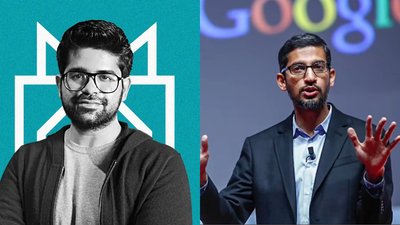
India has gifted the global tech stage with unparalleled talent, and two figures currently dominating the headlines are Aravind Srinivas, the visionary founder of Perplexity AI, and Sundar Pichai, the influential CEO steering Google and Alphabet Inc. Hailing from Tamil Nadu and graduates of the prestigious Indian Institutes of Technology, both individuals exemplify how academic prowess, combined with bold ambition, can reshape the world. While their brilliance is undeniable, their paths to global tech leadership diverge significantly. This raises an intriguing question: whose educational journey makes the more profound statement?
The Foundation: IIT Madras vs. IIT Kharagpur
Both Aravind Srinivas and Sundar Pichai launched their academic careers at India’s elite engineering institutions, albeit across different eras. Born in Chennai in 1994, Srinivas earned his B.Tech and M.Tech in Electrical Engineering from IIT Madras, where he first cultivated his burgeoning interest in artificial intelligence. Sundar Pichai, born in Madurai in 1972, pursued Metallurgical Engineering at IIT Kharagpur, graduating with distinction and securing a scholarship that paved his way to international studies. Pichai’s early achievements underscore the focused dedication characteristic of pre-digital India’s academic landscape. In contrast, Srinivas’s dual-degree approach highlights a modern emphasis on interdisciplinary education, blending electronics, computation, and cutting-edge AI. While both built formidable academic bases, their formative experiences unfolded in vastly different intellectual environments.
The Global Leap: Stanford and Wharton vs. Berkeley
Having achieved excellence in India, both visionaries ventured across continents to pursue their grander ambitions in the United States. Sundar Pichai enrolled at Stanford University for his Master’s in Materials Science and Engineering, quickly integrating into Silicon Valley’s vibrant innovation ecosystem. Further honing his leadership prowess, he then earned an MBA from the Wharton School at the University of Pennsylvania, graduating with the esteemed titles of both a Siebel Scholar and a Palmer Scholar – honors reserved for the institution’s brightest minds. Aravind Srinivas, on the other hand, opted for the University of California, Berkeley, where he pursued a PhD in Computer Science. His doctoral research delved deep into machine learning, positioning him at the vanguard of AI’s most revolutionary advancements. Pichai’s academic trajectory demonstrates a harmonious blend of technological insight and astute business acumen, whereas Srinivas’s education is characterized by profound technical mastery and an insatiable intellectual curiosity. One evolved into an executive powerhouse, the other into a groundbreaking technical pioneer.
Corporate Leadership vs. AI Entrepreneurship
Following his extensive education, Pichai embarked on a professional odyssey that would ultimately reshape the contours of global technology leadership. He joined Google in 2004, quickly ascending through the ranks by expertly managing pivotal products such as Google Toolbar and Google Chrome. His consistent success culminated in his appointment as CEO of Google in 2015, and subsequently, CEO of Alphabet Inc. His leadership style is widely lauded as composed, collaborative, and quietly transformative. Aravind Srinivas, however, charted a distinctly entrepreneurial course. In 2022, he co-founded Perplexity AI alongside Denis Yarats, Johnny Ho, and Andy Konwinski. Leveraging his invaluable experience gained at industry giants like OpenAI, DeepMind, and Google Brain, he conceptualized and launched an innovative AI-powered search engine. This platform delivers precise, cited, and conversational answers to user queries. Under Srinivas’s dynamic leadership, Perplexity AI rapidly garnered significant investments from influential figures such as Jeff Bezos, Elad Gil, Nat Friedman, and Nvidia, even forging a strategic partnership with Deutsche Telekom to integrate AI capabilities into smartphones. While Pichai masterfully navigated and rose within an established tech empire, Srinivas courageously built his own from the ground up.
Values and Vision
Undeniably, both Aravind Srinivas and Sundar Pichai stand as powerful testaments to the impact of education, yet their narratives resonate with audiences in distinct ways. For individuals who came of age in the 1990s, Sundar Pichai’s ascent encapsulated the quintessential Indian dream. His journey from humble beginnings in Chennai to the apex of Silicon Valley leadership vividly illustrates how unwavering dedication, diligent study, and profound humility can profoundly alter a life’s trajectory. Conversely, Aravind Srinivas’s story delivers a more contemporary, disruptive message to the younger generation. He personifies daring innovation, remarkable adaptability, and the sheer bravery required to challenge norms and experiment. Srinivas frequently implores young people to actively “master AI tools rather than merely consuming social media passively,” emphasizing that the future truly belongs to those who create and innovate, not just those who observe. Ultimately, both leaders powerfully demonstrate that the pursuit of knowledge is a continuous, evolving journey, constantly adapting to a changing world.
Whose Journey Wins?
Pitting Aravind Srinivas against Sundar Pichai is akin to contrasting two distinct epochs of technological evolution itself. Sundar Pichai emerges as an enduring emblem of tenacious perseverance and sustained leadership at the highest echelons. His educational trajectory highlights a harmonious blend of strategic balance, prescient foresight, and an unparalleled ability to convert profound knowledge into widespread global influence. Aravind Srinivas, conversely, embodies agility, radical technical innovation, and the dynamic ethos of contemporary entrepreneurship. His path illustrates how an intense, focused academic pursuit can serve as the bedrock for pioneering and disruptive startups. If Pichai’s narrative underscores education’s power to foster and maintain enduring success, Srinivas’s journey illuminates its capacity to fundamentally transform and revolutionize the future. Collectively, they magnificently showcase the vast potential of Indian education: producing both a visionary CEO who has profoundly shaped the internet age and a audacious founder who is now empowering it with intelligence.