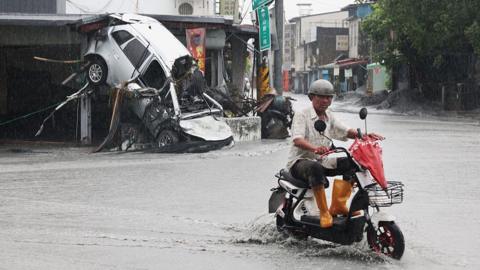
Residents in Taiwan are grappling with shock and grief after a catastrophic event triggered by Super Typhoon Ragasa. A barrier lake, formed by earlier landslides, burst its banks without warning, unleashing a torrent of water that devastated communities, particularly in the eastern county of Hualien.
Awa, a bookstore owner from Guangfu township, described the terrifying experience: “It was like a river outside and cars were floating. Everything started drifting.” She and her husband were forced to take refuge on the second floor of their shop, desperately trying to save their books. “I’m still in shock. I just can’t imagine how this could have happened,” she added, expressing the disbelief felt by many who were caught unaware by the sudden, destructive floodwaters.
While Taiwan was not directly in the path of the typhoon’s strongest winds, the bursting of the Matai’an Creek barrier lake, which held an estimated 91 million tonnes of water, proved to be the primary cause of the widespread destruction. The deluge swept away a bridge, uprooted trees, and submerged vehicles, leading to at least 14 fatalities and leaving 32 injured, with 46 people still unaccounted for.
Experts suggest that the force of the water released was comparable to a tsunami, with flow speeds potentially exceeding 100km/h. Despite the evident danger, survivors reported receiving no immediate warnings from authorities. This lack of timely communication has led to profound distress, especially for the elderly population, many of whom are more vulnerable and have limited access to alert systems.
While academic communities had been monitoring the barrier lake’s water levels and had alerted authorities to potential risks, the effectiveness of the evacuation efforts is now under scrutiny. The rapid rise of the water, which inundated homes up to the second floor in some areas, highlights the devastating impact of such natural phenomena when preparedness measures are not fully realized.
The impact on communities like Hualien, which has faced significant natural disasters in recent years, is profound. The destruction not only threatens lives but also livelihoods, as seen with Awa’s bookshop, which had only recently relocated and is now facing significant damage, including the potential loss of irreplaceable books.
The event serves as a stark reminder of the power of nature and the critical importance of effective early warning systems and comprehensive disaster preparedness, particularly for vulnerable populations.