
For many young Americans, the decision of whether and where to pursue higher education has become a complex financial dilemma. Faced with spiraling tuition fees, a mountain of student debt, and an unpredictable job market, students and their families are increasingly asking a crucial question: Does a U.S. university degree still offer enough value to justify its hefty price tag?
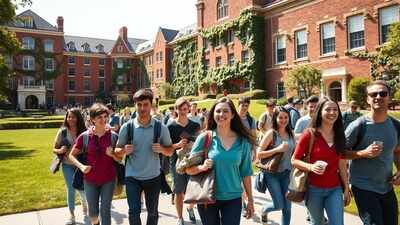
Public confidence in the value of higher education has steadily eroded in recent years. This decline isn’t solely due to economic pressures; ideological concerns, particularly among conservative demographics, also play a significant role. In response, universities nationwide are intensifying their efforts to clearly demonstrate a compelling ‘return on investment’ (ROI) for their students – a business-world term that now frequently permeates university recruitment and communication strategies.
Students are questioning costs versus long-term financial returns
A recent analysis by the Strada Education Foundation revealed that approximately 70% of public university graduates can anticipate a positive financial return on their education within a decade. A ‘positive ROI’ generally means a graduate’s earnings over that period surpass those of a typical high school graduate, accounting for the cost of their degree. However, these outcomes vary dramatically by geographic region. For instance, in Washington, D.C., 82% of graduates see a positive ROI, while in North Dakota, this figure drops to just 53%.
“Students are becoming acutely aware of situations where college simply doesn’t pay off,” remarked Preston Cooper of the American Enterprise Institute, in a statement to the Associated Press. He emphasized that the concept of ROI now dominates discussions within university administrations in a way it hadn’t 15 or 20 years prior.
Examining tuition fees, job placement, and policy shifts
To bolster their ROI, many universities have opted to freeze or even reduce tuition fees. Some private institutions have proactively lowered their advertised prices to provide a more accurate reflection of what students truly pay after financial aid and scholarships are applied.
Concerns persist regarding the broader job market. Research by the Burning Glass Institute, in collaboration with Strada, indicates that a significant 52% of recent graduates are employed in roles that do not actually require a college degree. This trend of underemployment is observed even in historically stable career fields such as nursing and education.
Matt Sigelman, president of the Burning Glass Institute, informed the Associated Press that this disconnect between degrees and employment suitability affects virtually all degree programs and institutions.
Calls for greater accountability and transparency in policy
In response to these issues, several U.S. states are now mandated to publish annual reports detailing university ROI. Texas, for example, integrates ROI data directly into its public funding allocation decisions for community colleges. In North Carolina, a 2023 state-commissioned study confirmed that 93% of public university degrees indeed yielded a positive ROI for graduates.
Federal policy has also evolved. A recent Republican-backed legislative proposal aims to link a majority of federal university funding directly to graduate earnings outcomes, building upon initiatives first introduced during the Obama administration. The core objective is to ensure that graduates consistently earn more than individuals without a college degree.
Universities are adapting to workforce demands
Universities are actively restructuring their academic programs to better align with contemporary job market requirements. Kevin Guskiewicz, president of Michigan State University, shared with the Associated Press that he has collaborated extensively with local business leaders to pinpoint essential graduate skills, subsequently adjusting curricula to meet these identified needs.
Chancellor Lee Roberts of the University of North Carolina at Chapel Hill noted that universities now fully grasp the critical importance of earnings data for prospective students and their families. He stated, as reported by the Associated Press, that “In uncertain times, students are even more focused – and rightly so – on what their job prospects are going to be.”