
Our planet’s majestic glaciers are shrinking at an alarming rate, a stark visual testament to the intensifying impact of global warming. Matthias Huss, director of Glacier Monitoring in Switzerland (GLAMOS), shares a deeply personal perspective, recalling how the Rhône Glacier, once a short walk from his childhood parking spot, is now a half-hour trek away. His sentiment echoes the experiences of many as they revisit familiar frozen landscapes, now dramatically altered.
The numbers are staggering: in 2024 alone, glaciers outside of Greenland and Antarctica shed approximately 450 billion tonnes of ice. This colossal loss is equivalent to a block of ice 7km on each side, enough to fill 180 million Olympic swimming pools. Professor Ben Marzeion from the University of Bremen highlights that these ice bodies are “sitting in a climate that is very hostile to them now because of global warming.” Switzerland’s glaciers are particularly affected, having lost a quarter of their ice in just the last decade.
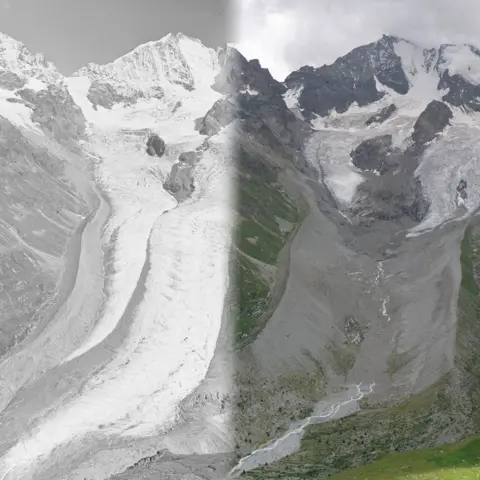
Historically, a 2% annual ice loss was considered extreme for Alpine glaciers. However, 2022 saw an unprecedented loss of nearly 6% of Switzerland’s ice, a trend that has continued with significant melting in subsequent years. Glaciologist Regine Hock notes the changes are “really stunning,” with current shifts happening at a “massive” pace.
Even smaller glaciers, like the Pizol Glacier, have completely disappeared, a development that deeply saddens researchers like Dr. Huss. Historical photos further illustrate this dramatic transformation. The Gries Glacier, for instance, has retreated by 2.2km in the last century, leaving behind a substantial glacial lake. Similarly, the Pers Glacier no longer connects with the larger Morteratsch Glacier, and the Great Aletsch Glacier has shrunk by 2.3km in 75 years, with trees now growing where ice once dominated.
While glaciers naturally fluctuate, the rapid retreat observed over the last 40 years is unequivocally linked to human-induced global warming. Professor Marzeion confirms that current melt rates can only be explained by the rise in CO2 emissions. A sobering reality is that glaciers respond with a delay to climate change; even if temperatures were to stabilize immediately, continued retreat is inevitable.
However, there is hope. Limiting global warming to 1.5°C could preserve half of the world’s mountain glaciers. Our current trajectory, however, points towards a 2.7°C rise, which would result in the loss of three-quarters of glacial ice. This melting not only contributes to rising sea levels but critically impacts mountain communities reliant on glaciers for essential water resources for agriculture, drinking water, and hydropower.
The loss of this vital water source has far-reaching consequences, particularly for the “Third Pole” – the high mountains of Asia – where approximately 800 million people depend on glacial meltwater. Professor Hock emphasizes that while the situation is concerning, “If you decarbonise and reduce the [carbon] footprint, you can preserve glaciers. We have it in our hands.”