
The India Mobile Congress (IMC) 2025, held from October 8 to 11 at Yashobhoomi in New Delhi, was a bustling hub for the country’s telecom industry, drawing hundreds of exhibitors and government officials. Among the standout participants, Ericsson captivated attendees with a media tour of its exhibition booth, spotlighting a range of pioneering 5G and Artificial Intelligence (AI) innovations. A particular highlight was the unveiling of an AI-powered robotic dog, engineered to meticulously inspect automated railcars for any mechanical or systemic flaws.
Revolutionizing Rail Safety with AI: Ericsson’s Robotic Dog
With a keen focus on enhancing safety within the mobility sector, Ericsson is developing cutting-edge technology for driverless trains. Central to this initiative is an ingenious AI-powered robot, cleverly designed to resemble a canine. This advanced ‘robot dog’ is equipped with an array of sophisticated sensors and high-definition cameras, allowing it to navigate seamlessly through automated railcars and conduct thorough inspections for any hardware or software anomalies.
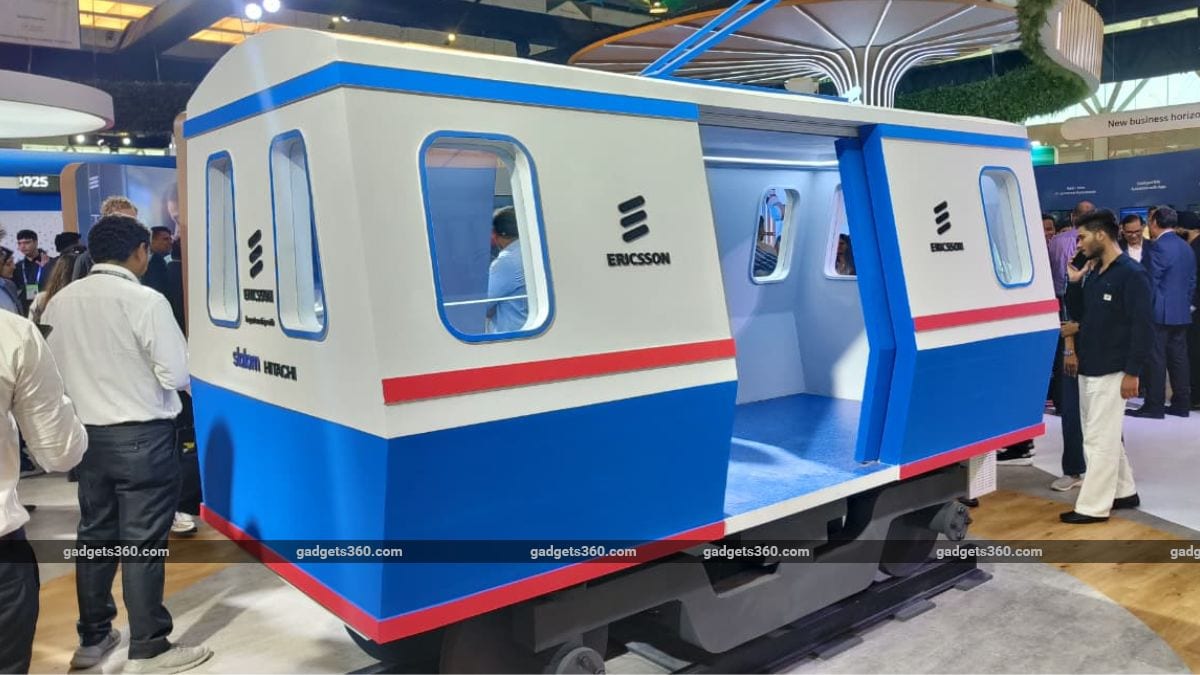
This innovative robot boasts the ability to stream real-time data over a private 5G network. This data is then rigorously analyzed by AI systems to pinpoint any potential defects. Ericsson emphasizes that by integrating these advanced robotic safeguards with autonomous mobility solutions, significant improvements in operational efficiency can be achieved.
Andres Vincente, Ericsson’s Head of Market Area for Southeast Asia, Oceania, and India, further highlighted ‘Annapurti,’ a remarkable 5G-enabled grain ATM. Developed in collaboration with the World Food Programme, this indigenous Indian innovation ensures precise dispensing of various food grains. Ericsson proudly states that Annapurti can distribute between 25 to 30 kilograms of grains in a mere 30 seconds.
To guarantee equitable and transparent distribution, Annapurti incorporates Aadhaar-based biometric scanning. Currently operational in cities like Bhopal, Gorakhpur, Lucknow, Shillong, and Varanasi, Ericsson plans to expand its presence to 23 additional cities by the close of 2026.
Vincente also underscored the success of Ericsson’s fixed wireless access (FWA) solutions, which have garnered 8.4 million subscribers across India. Notably, these solutions have achieved a 40 percent penetration rate in rural areas, offering fiber-like internet speeds wirelessly, a significant boost for connectivity in remote regions.
Rounding out the impressive demonstrations was ‘StethoECG,’ a cutting-edge handheld wireless digital stethoscope featuring an integrated ECG system, all powered by mobile communication. Its compact and portable design makes it ideal for extending critical heart monitoring capabilities to remote areas lacking specialized medical infrastructure. The device connects to the network via a 5G SIM card, enabling instant data transmission and analysis. StethoECG is the product of a collaborative research and development effort between IIT Madras and Ericsson Research.