
Deep within the serene Sussex countryside of southern England, an extraordinary vault stands guard, preserving millions of seeds against any conceivable disaster, be it fire or flood. This is the Millennium Seed Bank at the Royal Botanic Gardens Kew, a beacon of hope celebrating its 25th anniversary.
Housing an incredible collection of over 2.5 billion wild plant seeds from approximately 40,000 species, this facility is a veritable ark for the world’s flora. These precious seeds are meticulously stored in sealed glass jars and foil packets, maintained at a frigid minus 20 degrees Celsius (minus 4 Fahrenheit), a temperature crucial for preventing their extinction.
Scientists hail the Millennium Seed Bank as one of Earth’s most biodiverse locations—a secure, living archive designed to protect its invaluable contents for centuries to come. King Charles III, who inaugurated the facility in 2000 when he was the Prince of Wales, has remained a dedicated advocate for Kew’s conservation initiatives. His continued involvement was highlighted in a recent anniversary podcast, where he joined actor Cate Blanchett and Kew scientist Elinor Breman to discuss the seed bank’s origins and its immense potential for restoring ecosystems worldwide.
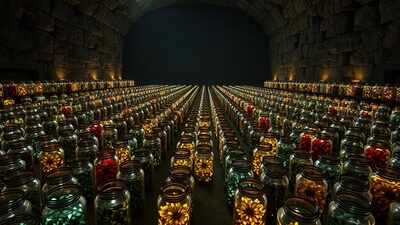
The intricate preservation journey begins far from the subterranean vault. Field collectors venture into diverse environments, from the lush landscapes of Madagascar and Thailand to the rugged terrains of Greece and Arctic Sweden, gathering wild plant seeds. A portion of these vital samples is then dispatched to Kew.
Elinor Breman, Kew’s senior research leader in seed conservation, explains that “Drying is the first step in increasing the longevity of those seeds.” In a specially controlled drying room, air is maintained at 15 degrees Celsius (59 Fahrenheit) with a mere 15% humidity for approximately three months. This slow and steady process allows the seeds to gradually lose moisture, a critical step that extends their lifespan by halting the natural decay processes.
Following drying, the seeds proceed to the cleaning room. Here, dedicated technicians, including David Hickmott, Kew’s Seed Curator, meticulously separate seeds from dust and debris using various tools like sieves, brushes, and an aspirator that employs air pressure. This largely manual and time-intensive work ensures only the purest seeds move forward.
Before storage, the seeds undergo crucial viability tests in the germination laboratory. Here, petri dishes and incubators replicate the specific light and temperature conditions of each seed’s native habitat, confirming whether they are still alive. Rachael Davies, a germination specialist at Kew, emphasizes, “The germination test is our last and most important process. It gives us an indication that the seeds are alive.”
Only seeds confirmed as viable are hermetically sealed and transferred to the vault, where the consistent cold and dry conditions further extend their longevity. Scientists have found that a mere 1% reduction in moisture and a 5-degree Celsius drop in temperature can effectively double a seed’s lifespan.
For certain tropical plants with high water content, conventional freezing is not an option. In response, researchers are pioneering advanced cryopreservation methods, utilizing liquid nitrogen to maintain tissue viability at even lower temperatures, pushing the boundaries of what’s possible in plant conservation.
Dale Sanders, a distinguished biologist and former director of the John Innes Centre in Norwich, highlights the profound importance of seed banks in safeguarding global biodiversity. As the world population is projected to increase by 2 billion by 2050, putting immense pressure on agricultural land, the demand for genetic resources like those preserved at Kew will only intensify.
Sanders asserts, “Within species there is incredible genetic diversity, which protects against disease, climate change and other threats. Maintaining that diversity is essential if we want to preserve the diversity of life itself.”
Since its inception, the Millennium Seed Bank has fostered a vast global network, collaborating with 279 organizations across more than 100 countries. Its extensive collections have already played a pivotal role in projects aimed at reintroducing native species and rehabilitating damaged habitats, both within the United Kingdom and internationally.
Elinor Breman notes, “We have managed to conserve 40,000 species here. But the seed bank is not meant to be the end resting place for those seeds. The next 25 years will focus on using them to restore natural habitats and help combat biodiversity loss and climate change.”
Beyond storage, Kew actively empowers global partners by training over 3,000 scientists from 70 countries in expert seed collection and storage techniques, building essential conservation capacity worldwide. To further fuel its ambitious work, Kew has launched a £30 million ($40 million) Seeds Future Fund, dedicated to supporting new research and expanding global partnerships.
With nearly half of all flowering plant species facing the threat of extinction, researchers underscore that safeguarding these seeds provides crucial insurance for the planet’s biodiversity. From microscopic orchids to palm seeds the size of a fist, every single jar in the Millennium Seed Bank represents a potential lifeline—a species that could one day play a critical role in restoring ecosystems on our rapidly changing planet.