
The Massachusetts Institute of Technology (MIT) has officially turned down the Trump administration’s controversial “Compact for Academic Excellence in Higher Education.” This makes MIT the first institution to publicly reject the deal, which aims to link federal funding to strict rules on university admissions, hiring practices, tuition fees, and free speech policies. This decision has sent ripples through the academic community.
Now, Brown University, one of nine institutions presented with the compact, finds itself under immense pressure from both its students and faculty to follow MIT’s lead and reject the proposal. A surge of protests and organized opposition has swept across Brown’s campus, with many urging the administration to resist aligning with these federal education reforms.
Students and Faculty Rally for Academic Freedom
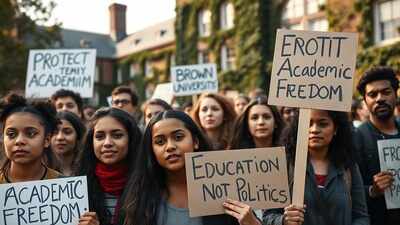
Approximately 120 students, faculty members, and graduate students convened at Brown University’s Van Wickle Gates for a protest, as chronicled by the Brown Daily Herald. The event was orchestrated by “Brown Rise Up,” a recently formed student organization collaborating with faculty and graduate groups to “resist authoritarianism in higher education.”
At the heart of the rally, participants displayed signs proclaiming “students over politics” and “don’t be an accomplice.” Their chants resonated with the message: “reject, rise up, Brown does not belong to Trump.” Later, a joint statement, endorsed by various campus groups including Brown Rise Up, Stand Strong Brown, the Brown Dream Team, Brown Democrats, and the Graduate Labor Organization, was presented to University President Christina Paxson’s office.
The joint statement specifically criticized two key provisions within the compact: a requirement for faculty to uphold political neutrality in official roles, and a prohibition against undermining conservative viewpoints. These stipulations were deemed “incompatible with the values of Brown University” by the signatories, as reported by The Herald.
Understanding the Compact’s Demands and National Implications
Inside Higher Ed reported that MIT President Sally Kornbluth officially informed Education Secretary Linda McMahon of the university’s decision not to sign the compact. In her letter, Kornbluth affirmed that while MIT already adheres to many of the compact’s principles, such as merit-based admissions and free expression, the agreement itself was “inconsistent with MIT’s belief that funding should be based on merit.”
The compact, structured around ten specific points, includes contentious demands such as a five-year tuition freeze, a reduction of international undergraduate enrollment to 15%, and the elimination of race and sex as factors in admissions and hiring decisions. The Trump administration asserts that these measures are designed to enhance fairness and ensure adherence to Supreme Court directives.
Alongside Brown, other prominent institutions like Dartmouth College, the University of Pennsylvania, the University of Texas at Austin, the University of Arizona, the University of Southern California, the University of Virginia, and Vanderbilt University also received invitations to sign. While most have yet to declare their stance publicly, MIT’s decisive rejection has undoubtedly established a significant precedent.
Heightened Concerns for Academic Freedom and Student Well-being
At the Brown protests, speakers articulated deep concerns regarding free speech, the autonomy of academic institutions, and the safety of students. Student speaker Garrett Brand passionately declared, “We’re here today because Donald Trump is once again attempting to control our university,” as quoted by The Herald. He further highlighted the anxieties of international students, who reportedly feared potential immigration repercussions if they spoke out.
Faculty members echoed these worries. Associate Professor Laurel Bestock described the compact as “a chilling instance of surveillance and telling us what to think and what to do,” according to The Herald. Professor Holly Case emphasized her sense of responsibility “to preserve your rights as students to free speech.”
Broader Implications and Institutional Reactions Nationwide
This compact emerges in the wake of the Trump administration’s decision to cut $350 million in federal grants previously allocated to minority-serving colleges. These grants supported institutions catering to Hispanic, Black, Asian American, Pacific Islander, and Native American communities. Inside Higher Ed reported that Education Secretary Linda McMahon defended this policy, asserting that the funds were reallocated to “underprepared or under-resourced” students instead of being tied to “racial quotas.”
Student organizers, such as Simon Aron from Brown Rise Up, underscored the national importance of Brown’s upcoming decision. “The nation is looking to Brown to see what we do,” he conveyed in a statement to The Herald. Caitlyn Carpenter, another student advocate, also noted that similar organized demonstrations had taken place at other universities that received the compact, including Vanderbilt and Dartmouth.
As of the current moment, Brown University’s administration has yet to release a public statement or announce a decision regarding the compact.
Ready to navigate global policies? Secure your overseas future. Get expert guidance now!