
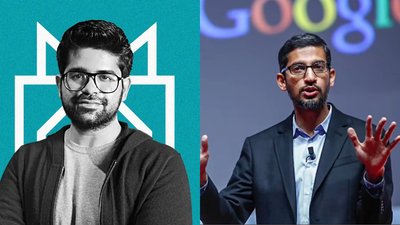
In the vibrant tapestry of global technology, two exceptional Indian minds illuminate distinct pathways to success: Aravind Srinivas, the brilliant young innovator behind Perplexity AI, and Sundar Pichai, the accomplished leader steering Google and Alphabet Inc. Both are proud alumni of the Indian Institutes of Technology, both trace their roots to Tamil Nadu, and both have profoundly reshaped the tech landscape, demonstrating the immense power of academic excellence fused with ambition. Their journeys, however, diverge dramatically. This raises a compelling question: whose educational ascent is truly more remarkable?
Laying the Groundwork: IIT Madras vs. IIT Kharagpur
Aravind Srinivas and Sundar Pichai both commenced their academic voyages at India’s highly esteemed engineering institutes, albeit in different eras. Srinivas, a Chennai native born in 1994, earned his B.Tech and M.Tech in Electrical Engineering from IIT Madras, where his fascination with artificial intelligence first blossomed. Pichai, born in Madurai in 1972, pursued Metallurgical Engineering at IIT Kharagpur, distinguishing himself with a silver medal and securing a coveted scholarship for overseas studies.
Pichai’s early achievements embody the perseverance and academic rigor characteristic of pre-digital India. In contrast, Srinivas’s dual degree signifies a modern approach to interdisciplinary education, seamlessly blending electronics, computation, and cutting-edge AI. While both established formidable academic foundations, they did so within vastly different global and technological landscapes.
The Global Ascent: Stanford & Wharton vs. Berkeley
Having distinguished themselves in India, both leaders ventured across continents to pursue grander aspirations in the United States. Sundar Pichai enrolled at Stanford University for his Master’s in Materials Science and Engineering, deeply engaging with Silicon Valley’s dynamic innovation culture. To further sharpen his leadership acumen, he later pursued an MBA at the Wharton School of the University of Pennsylvania, graduating with the prestigious titles of Siebel Scholar and Palmer Scholar, honors reserved for truly exceptional students.
Aravind Srinivas opted for a different path, choosing the University of California, Berkeley, for his PhD in Computer Science. His doctoral research delved into machine learning, positioning him at the vanguard of AI’s most groundbreaking advancements.
Pichai’s trajectory beautifully illustrates a harmonious blend of technological prowess and business strategy. Srinivas’s academic pursuits, conversely, highlight a profound technical mastery coupled with an insatiable intellectual curiosity. One evolved into an executive visionary, the other a trailblazing technical pioneer.
Corporate Giant vs. AI Trailblazer: Leadership Paths Diverge
Upon the completion of his advanced studies, Pichai embarked on a professional odyssey that would fundamentally reshape global tech leadership. Joining Google in 2004, he spearheaded crucial products like Google Toolbar and Google Chrome. His undeniable success culminated in his appointment as CEO of Google in 2015, and subsequently, CEO of Alphabet Inc. His leadership style is frequently characterized by its calm demeanor, collaborative spirit, and a quietly revolutionary impact.
Aravind Srinivas, on the other hand, chose a decidedly more entrepreneurial trajectory. In 2022, he co-founded Perplexity AI alongside Denis Yarats, Johnny Ho, and Andy Konwinski. Leveraging his invaluable experience gained at OpenAI, DeepMind, and Google Brain, Srinivas conceived an AI-powered search engine engineered to provide clear, cited, and conversational answers. Under his astute guidance, Perplexity AI rapidly garnered significant investments from prominent figures like Jeff Bezos, Elad Gil, Nat Friedman, and Nvidia. The company even forged a strategic partnership with Deutsche Telekom to integrate AI capabilities into smartphones.
While Pichai meticulously ascended the hierarchical ladder of an established tech empire, Srinivas audaciously constructed an innovative one from its very foundations.
Values and Enduring Vision
Both these remarkable individuals unequivocally underscore the transformative power of education, yet their personal narratives offer distinct forms of inspiration.
For those who came of age in the 1990s, Sundar Pichai’s journey epitomized the quintessential Indian dream. His ascent from humble beginnings in Chennai to the pinnacle of Silicon Valley demonstrated how unwavering dedication, disciplined effort, and profound humility can profoundly reshape one’s life.
Conversely, Aravind Srinivas’s narrative resonates with a more audacious and disruptive spirit, particularly among the younger generation. He embodies daring, remarkable adaptability, and the courage to relentlessly experiment. Srinivas has consistently exhorted young individuals to “master AI tools instead of being passive consumers of social media,” serving as a potent reminder that the future unequivocally belongs to the creators, not merely the observers.
Ultimately, both men stand as living testaments to the timeless truth that learning is not a finite destination, but rather an ongoing, dynamic process that continuously evolves with the world around us.
The Verdict: Two Paths, Equal Impact?
Drawing a direct comparison between Aravind Srinivas and Sundar Pichai is akin to evaluating two distinct epochs of technological evolution itself.
Sundar Pichai stands as an enduring emblem of unwavering perseverance and sustained leadership excellence. His educational trajectory embodies balance, strategic foresight, and an unparalleled ability to translate profound knowledge into a tangible global impact.
Aravind Srinivas, by contrast, personifies agility, radical technical innovation, and the audacious spirit of contemporary entrepreneurship. His academic journey strikingly illustrates how intense academic dedication can directly ignite and propel groundbreaking startups.
If Pichai’s narrative eloquently speaks to how education can cultivate and perpetuate monumental success, Srinivas’s journey compellingly demonstrates how it can fundamentally disrupt and redefine the future. Together, they brilliantly showcase the multifaceted potential of Indian education: producing a visionary CEO who meticulously shaped the digital world, and a daring founder who is now teaching artificial intelligence to truly think.