
Bringing real historical events to the stage is always a delicate balancing act. It demands unwavering accuracy without sacrificing dramatic flair, a challenge that becomes even more pronounced when the subject is as intense as war. Yet, Theatrekaran, in collaboration with NCC-UDAAN, bravely tackled the complex narrative of the 1971 Indo-Pak War. To their immense credit, directors Raghavendr and Sabarivas navigated this sensitive theme with remarkable skill.
Their production, titled 1971 war: Oru Vetri Thorkkadikkapattadhu (meaning ‘A Victory Defeated’), based on a concept and curated by retired Major General Indrabalan, unfolded at the Narada Gana Sabha. It vividly depicted the horrific brutalities inflicted upon East Pakistanis by Tikka Khan, highlighted Chief of Army Staff Manekshaw’s strategic counsel to Prime Minister Indira Gandhi to postpone war until optimal conditions prevailed, showcased India’s multi-front assault by air, sea, and land, and ultimately, Pakistan’s surrender to the Indian forces.
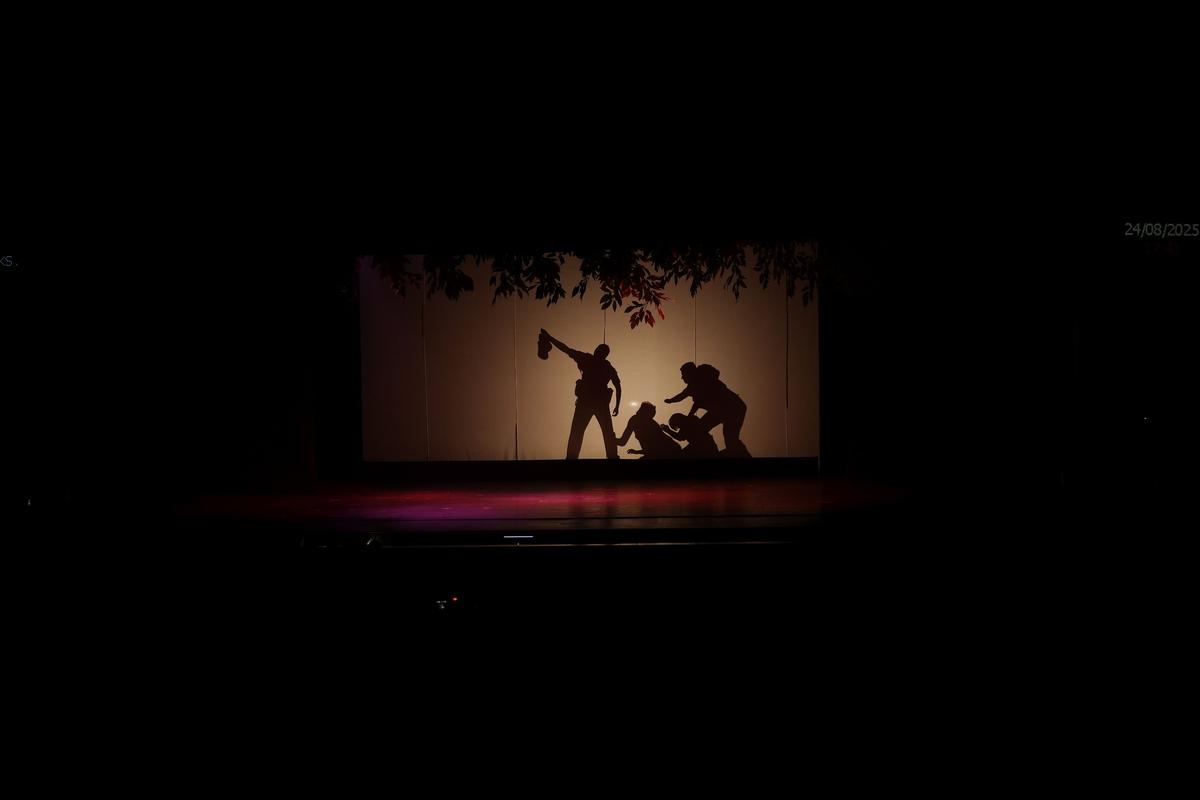
The actors portrayed battle scenes effectively, sometimes resorting to shadow play. | Photo Credit: Special Arrangement
The production skillfully brought to life harrowing battle scenes, intense guerrilla warfare, and the atrocities endured by the East Pakistanis, occasionally employing poignant shadow play for dramatic effect. A particularly powerful moment arose when Pakistan’s Lt. General Niazi asserted India as a Hindu nation. In response, Major General J.F.R. Jacob delivered a stirring retort, highlighting the Indian military as a true testament to the nation’s diverse fabric – Jacob himself a Jew, with Air Force’s Idris Hasan Latif a Muslim, Manekshaw a Parsi, and Lieutenant General Aurora a Sikh. While the historical accuracy of this specific exchange might be debated, its inclusion on stage resonated deeply, delivering a vital message of unity and pluralism.
However, the impact of some key dialogues, such as Mujibur Rahman’s impassioned address, was unfortunately diminished by overly loud background music. Many scenes featuring crucial lines would have benefited from greater silence, allowing the words to carry their full emotional weight. Director Sabarivas clarified that the title Oru Vetri Thorkadikkapattadhu, translating to ‘A Victory Defeated,’ was chosen to underscore the younger generation’s apparent lack of awareness regarding India’s triumph in 1971. One might, however, ponder if Oru Vetri Marakkapattadhu (‘A Victory Forgotten’) would have been an even more fitting title.
Adding a powerful touch to the evening, 87-year-old Major Krishnaswamy (who later became a Colonel), a veteran who had bravely led his forces deep into enemy territory during the war, shared his experiences with the audience after the performance. He recounted a memorable exchange with Sheikh Hasina, then Prime Minister of Bangladesh, during a visit to Dhaka years prior. When asked, “When did you last visit Dhaka?” his poignant reply was, “Last time, I didn’t visit. I entered Dhaka.” He then drew a humorous contrast: in 1971, he held a gun, but now, he holds his wife’s hand. Hasina, with a witty remark, quipped, “What you are now holding is a more potent weapon than a gun,” bringing a touch of warmth and humanity to the weighty historical context.