
As the curtain gracefully ascended at Narada Gana Sabha’s Main Hall, the audience was met with an awe-inspiring spectacle: more than a hundred veena artists, spanning generations from spirited 10-year-olds to revered septuagenarians, were seated in perfect, harmonious rows. The gentle, anticipatory shimmer of tuning plucks filled the air, setting a delicate prelude to the grand event – 108 Veena Nadanjali. At the heart of this magnificent gathering, veena exponent Kannan Balakrishnan presided with quiet intensity, ready to usher in an evening of impeccable musical artistry.
This remarkable ensemble seamlessly brought together some of the fraternity’s most esteemed figures, including Prof. R.S. Jayalakshmi, Mudicondan Ramesh, S. Sundar, Jayalakshmi Sekar, Shobana Swaminathan, GRS Murthy, Karukurichi Ravi, T.T. Narendran, Emani Lalitha Krishna, and Baradwaj Raman. Alongside these stalwarts, promising young talents like Veena Venkatramani, Charulatha Chandrasekar, B. Sai Harini, and N. Haripriya showcased their skill. Providing vibrant rhythmic support were Aswini Srinivasan on mridangam and Shrisainath on ghatam, adding depth and dynamism to the performance.
108 Veena Nadanjali served as the glorious culmination of the 13-day Veena Mahotsavam, an extensive festival that featured an impressive 77 concerts, highlighting 100 main artists and 36 accompanists. This grand celebration, meticulously curated by Kannan Balakrishnan, was a collaborative effort organized by the Bharata Ilango Foundation, Narada Gana Sabha Trust, and Kalakendra.com.
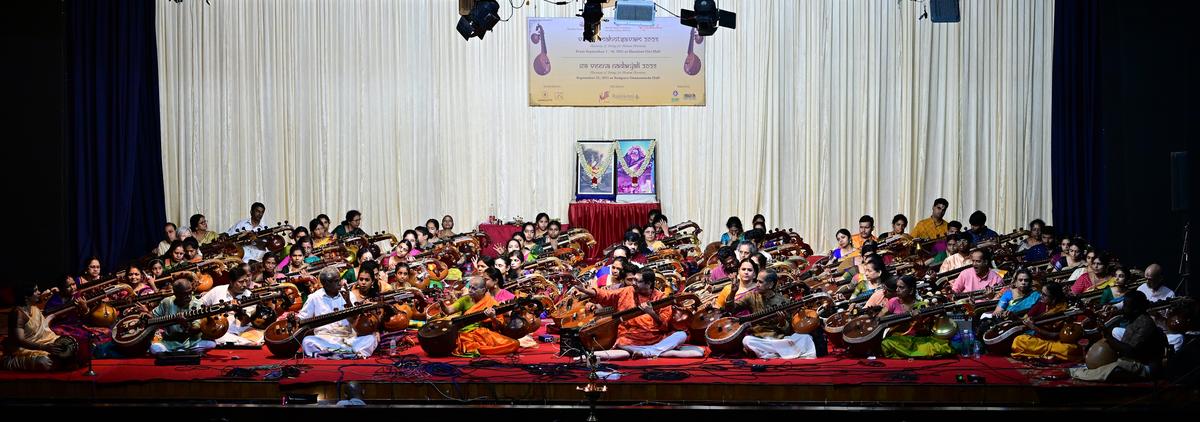
The soft shimmer of tuning plucks hung in the air like a delicate prelude to the event. | Photo Credit: VELANKANNI RAJ B.
The evening commenced on a truly auspicious note with the ensemble’s soul-stirring rendition of ‘Saraswathi Ashtottara Sata Namavali,’ a beautiful intertwining of veenas and voices guided by Kannan’s chanting. The program featured a rich selection of kritis: ‘Gam ganapathe’ (Hamsadhwani, Adi – tisra nadai, Muthiah Bhagavatar), ‘Sri saraswathi’ (Arabhi, Rupakam, Dikshitar), ‘Akhilandeswari’ (Dwijavanti, Adi, Dikshitar), ‘Paratpara’ (Vachaspathi, Adi, Papanasam Sivan), ‘Darini telusukonti’ (Suddhasaveri, Adi, Tyagaraja), ‘Raghuvamsa sudhambudhi’ (Kathanakuthuhalam, Adi, Patnam Subramania Iyer), ‘Kanchadalayatakshi’ (Kamalamanohari, Adi, Dikshitar), and ‘Brahmam okate’ (Bowli, Eka, Annamacharya). The renditions of ‘Vande mataram’ and ‘Maithreem bhajata’ concluded the list, enveloping the hall in a profound and prayerful glow. The collective resonance of a hundred veenas playing in unison created an overwhelmingly powerful and moving experience.
To prevent any trace of monotony and to infuse each piece with unique character, a leading artist delivered a concise raga essay before each kriti. The most remarkable aspect of this offering was the flawless integration of diverse schools, styles, and patantarams into a single, cohesive, and nearly perfect sonic tapestry. Every ‘meettu’ (pluck) and every note was executed in precise synchrony, creating a vivid manifestation of musical harmony. ‘Darini telusukonti’ proved to be a particularly intriguing choice for such a massive instrumental ensemble, as the complexity of its ‘sangatis’ (melodic phrases) in the pallavi section posed a significant challenge to maintain perfect concordance. Yet, the artists rose to the occasion, gracefully navigating this ‘tight-string’ walk with impressive skill. The lively energy of ‘Gam ganapathe,’ the serene beauty of ‘Akhilandeswari,’ and the enchanting ‘chittaswaram’ of ‘Raghuvamsa sudhambudhi’ also captivated the audience’s attention.
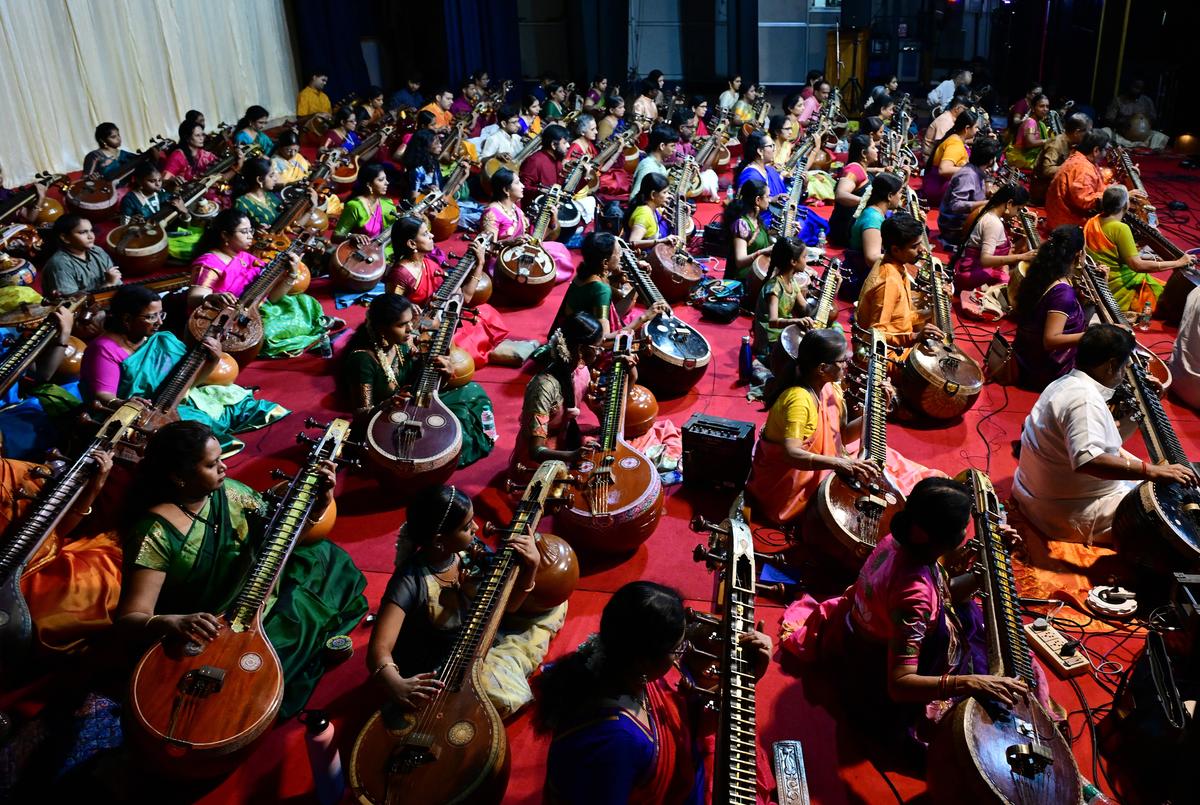
The evening began on an auspicious note with the rendering of ‘Saraswathi Ashtottara Sata Namavali’. | Photo Credit: VELANKANNI RAJ B.
While the selection of songs thoughtfully embraced a wide array of composers within the event’s framework, the absence of a Syama Sastri kriti was noticeable. Although a typical ‘chowka kalam’ (slow-paced) composition of his might not have been suitable for a large ensemble, a moderately paced piece could have fit perfectly. The inclusion of three compositions by Dikshitar, a celebrated vainika-gayaka (veena player and vocalist), subtly highlighted the year’s significance—the ongoing 250th birth anniversary celebrations of the illustrious Nadajyoti.
What began modestly in 2009 as ‘Veena Utsav,’ featuring just 30 concerts, has since blossomed into an eagerly anticipated annual carnival, deeply cherished by both practitioners and ‘rasikas’ (connoisseurs) alike. Kannan Balakrishnan fondly recalled how, at that time, veena playing was often unfortunately perceived as a dying art with a bleak future. Today, 17 years later, he takes immense pride in the instrument’s remarkable revival, a resurgence clearly evidenced by the growing number of students and the increasing sales of veenas, as consistently corroborated by both teachers and instrument makers/dealers.
Kannan Balakrishnan concluded the event by dedicating this profound musical offering to global peace, aspiring for a war-free future, and honoring the selfless service of our armed forces. In that poignant moment, the veena transcended its role as a mere instrument of sound, becoming a powerful vessel for a collective prayer for harmony across the world.