
Google Pixel 10 Pro and Pixel 10: The New Kings of Smartphone Displays
Google’s Pixel 10 Pro XL and Pixel 10 have ascended to the pinnacle of DxOMark’s comprehensive display rankings. The esteemed benchmark platform lauded both handsets for their remarkably balanced performance across all evaluation metrics. These new Google devices have successfully dethroned previous contenders, including the Samsung Galaxy S25 Ultra, which now occupies the third position in the display hierarchy. DxOMark’s rigorous assessments highlighted several standout features, such as stellar color reproduction, impressive peak brightness, highly responsive touch interactions, and thoughtful eye comfort enhancements.
DxOMark Benchmarks Unveil Outstanding Performance
In DxOMark’s testing, the Google Pixel 10 Pro XL achieved an astonishing peak brightness of 3013 nits, with the Pixel 10 trailing closely behind at 2983 nits in High Brightness Mode. These figures place both models among the elite for outdoor visibility, ensuring a comfortable viewing experience even under bright sunlight.
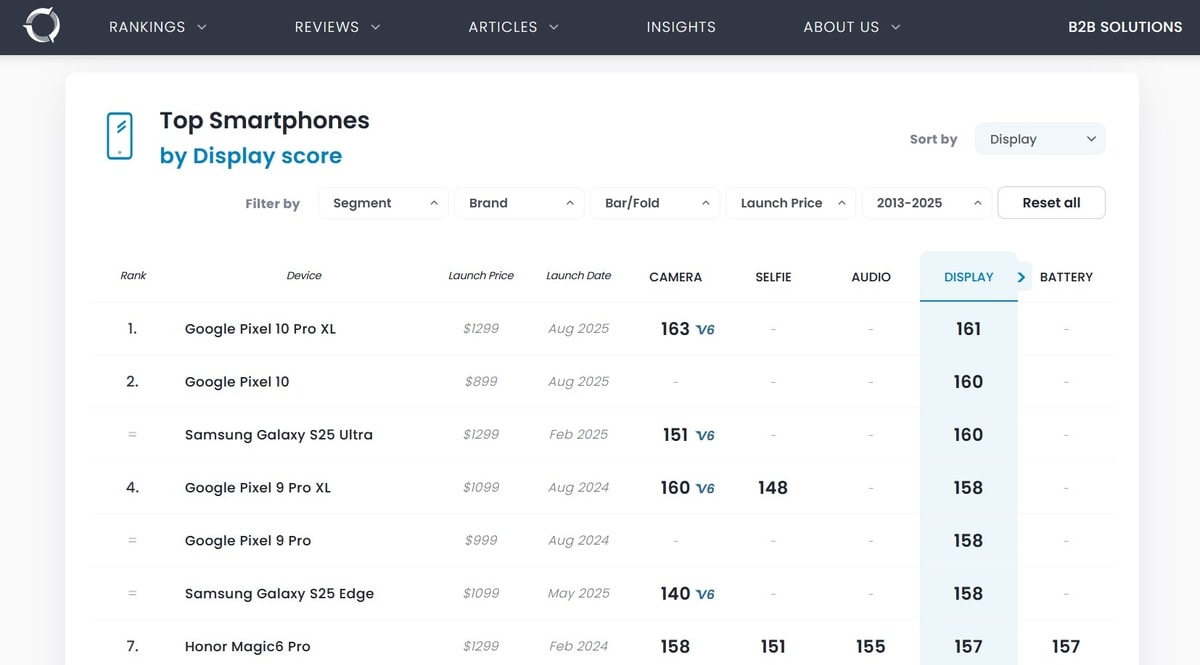
A screenshot showing DxOMark’s most recent smartphone display rankings.
Color rendering proved to be another area where both Pixel phones truly excelled. With options for Default, Natural, or Faithful color modes, DxOMark confirmed that these devices deliver consistently accurate colors across diverse lighting conditions. A noteworthy innovation this year is Google’s new Adaptive Tone feature, which intelligently adjusts the white point to harmonize with ambient lighting, mirroring Apple’s well-known True Tone technology.
Furthermore, the handsets demonstrated impressive performance in HDR video playback, particularly in terms of brightness, contrast, and color fidelity. However, DxOMark’s evaluation did note that SDR (Standard Dynamic Range) video playback on the Pixel 10 Pro XL was observed to be slightly dimmer.
Both the Pixel 10 and Pixel 10 Pro offer reliably responsive touch, with the Pixel 10 Pro XL providing an even faster feedback experience. It’s important to mention that on the standard Pixel 10, the 120 Hz refresh rate requires manual activation, a distinction from its more premium sibling.
For enhanced eye comfort in low-light environments, the Pixel 10 Pro XL incorporates support for 480 Hz pulse-width modulation (PWM), which also needs to be enabled manually. DxOMark also awarded both models an Eye Comfort Label, acknowledging their effective blue-light filter capabilities.
As of this report’s publication, the Pixel 10 Pro led DxOMark’s display rankings with an impressive 161 points. The Pixel 10 secured the second spot with 160 points, sharing its score with the Samsung Galaxy S25 Ultra, which now sits in third place after its launch earlier this year. Close behind were last year’s Pixel 9 Pro XL and Pixel 9 Pro, both scoring 158 points.