
Apple’s recent ‘Awe Dropping’ event on September 9 saw the grand unveiling of the iPhone 17 series, featuring Pro models that boast significant redesigns. Following its launch, the renowned gadget-repair experts at iFixit swiftly released a comprehensive teardown video of the iPhone 17 Pro. This video offers an exclusive look into its internal architecture, highlighting an innovative vapor chamber designed for superior thermal management, and assesses its overall repairability. While battery replacements appear more straightforward than in previous models, the absence of a dual-entry design and the proliferation of various screw types present a notable challenge for self-repair enthusiasts.
Dissecting the iPhone 17 Pro: A Detailed Teardown
The process of repairing the iPhone 17 Pro shares similarities with the iPhone Air, as recently detailed by iFixit. However, a closer inspection reveals several key distinctions. The iFixit team initiates their nearly 11-minute teardown by carefully removing two Torx screws located at the base of the iPhone.
Accessing the phone’s interior still necessitates the familiar prying tools and suction cups to remove the back glass, which in turn showcases Apple’s new unibody construction. Unlike earlier iPhone iterations where the entire back panel was detachable, the iPhone 17 Pro now features a smaller, removable glass panel that grants partial access to the battery. It’s important to note, however, that a direct battery replacement isn’t possible through this small opening alone.
A single ribbon connector links to the back plate, accommodating the MagSafe coil. For any significant repairs, the iPhone 17 Pro’s display must first be carefully detached. Beneath it, a new protective plate emerges, with the battery securely affixed. Intriguingly, Apple has opted for an increased number of screws to hold the battery in place, making its removal a more involved process.
Although the entire battery tray can be unfastened using a screwdriver, detaching the protective plate from the metal-encased battery demands a specialized approach. Users will need to apply a 12V current to activate the electrically-debonding adhesive. Once this step is complete, the internal components of the iPhone 17 Pro become fully visible for inspection.
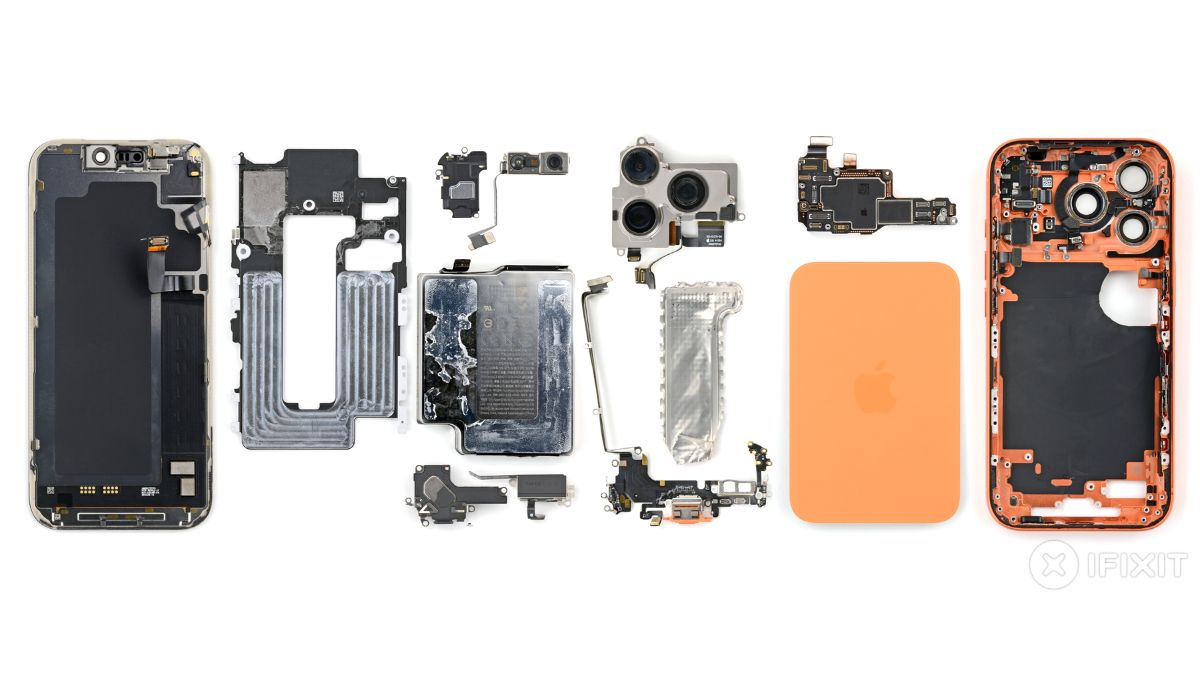
Mirroring the iPhone Air’s design, the logic board is neatly housed in the upper section of the iPhone, secured by press connectors. The expanded camera plateau, however, grants more generous space for these intricate components. Below the battery, other crucial parts reside, including the Taptic Engine and speaker module, all fastened by a mix of tri-point, Phillips, and standoff screws, necessitating a diverse set of screwdrivers for removal.
The teardown video highlights a staggering 22 screws that must be removed to access the USB Type-C port. In contrast, the front sensor array is held by two press connectors, and the rear camera module by three cables – both relatively simple components to replace, offering some relief for repair specialists.
Further insights were provided by iFixit’s 3D X-ray scan, which offered an intricate look at the iPhone 17 Pro’s internal architecture. A significant reveal was the new vapor chamber, featuring a lattice sandwich design, which is directly integrated with the battery plate. This sophisticated cooling system is strategically positioned to dissipate heat from both the A19 Pro chip (at the top) and the battery (at the bottom), promising enhanced thermal performance and a cooler operating temperature compared to its predecessors.
Unraveling the ‘Scratchgate’ Mystery
Recent weeks have seen a proliferation of videos demonstrating the iPhone 17 Pro and iPhone 17 Pro Max’s susceptibility to scratches. This issue, dubbed ‘Scratchgate,’ is particularly noticeable around the device’s redesigned camera plateau, which features sharp, unchamfered edges.
Upon microscopic examination, the iFixit team made a crucial discovery: the anodization around the camera island consists of a secondary anodized layer instead of pure aluminum. This inherent brittleness of the anodized material makes it prone to detaching, a phenomenon scientifically referred to as “spalling,” thereby explaining the ease of scratching.
iPhone 17 Pro Repairability: The Verdict
According to the gadget-repair specialists, the iPhone 17 Pro’s repairability earns a mixed review. While the innovative battery plate design simplifies battery swaps, the removal of the traditional dual-entry access and the sheer number of diverse screws transform the repair process into a painstaking endeavor.
In conclusion, the iPhone 17 Pro was deemed slightly less repairable than the iPhone Air, achieving a score of 7 out of 10 on iFixit’s renowned repairability scale.