
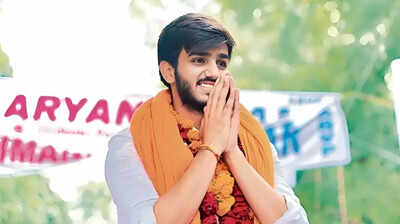
The highly anticipated 2025 Delhi University Students’ Union (DUSU) elections have concluded with a significant win for the Akhil Bharatiya Vidyarthi Parishad (ABVP), who successfully secured three out of the four key central panel positions. Leading the charge for the ABVP was Aryan Maan, who was elected as President. Meanwhile, the National Students’ Union of India (NSUI), backed by the Congress, managed to secure the Vice President’s seat with Rahul Jhansla’s victory.
These elections, held on September 18 across North Campus, saw a total of 60,272 students casting their votes out of 1.53 lakh registered voters. This resulted in a 39.36% turnout, an increase from 35.2% in 2024, although slightly lower than the 42% recorded in 2023. The fiercely contested election, which featured 21 candidates vying for the top four posts, clearly demonstrated the ongoing intensity and ideological split within campus politics.
Counting and Results
After 18 meticulous rounds of tallying under strict surveillance at the Convention Centre in North Campus, the following candidates emerged victorious:
| Position | Winner | Student wing |
| President | Aryan Maan | ABVP |
| Vice President | Rahul Jhansla | NSUI |
| Secretary | Kunal Chaudhary | ABVP |
| Joint Secretary | Deepika Jha | ABVP |
The results reaffirmed ABVP’s continued dominance across Delhi University campuses.
ABVP vs. NSUI: A Clash of Campus Ideologies
The perennial rivalry between the ABVP, the student wing of the Rashtriya Swayamsevak Sangh (RSS), and the NSUI, affiliated with the Indian National Congress, serves as a powerful microcosm of India’s broader national political landscape. The ABVP continues to solidify its influence by advocating for right-leaning politics and cultural nationalism, appealing to a significant segment of the student body. In contrast, the NSUI positions itself as a progressive voice, championing causes related to student welfare, promoting gender representation, and advocating for greater inclusivity on campus.
This year’s presidential race garnered considerable attention, with ABVP’s Aryan Maan campaigning on promises of enhanced student amenities and improved campus infrastructure. Rahul Jhansla, the NSUI’s Vice Presidential candidate, focused his campaign on progressive reforms and student-centric policies. The final tally, which saw a clear ABVP majority but with NSUI securing a vital central panel post, highlights both the established strength of the ABVP and the persistent, competitive spirit of student politics within Delhi University.
Why DUSU Elections Resonate on the National Stage
Historically, DUSU elections have been a crucial stepping stone for aspiring national political leaders. Notable alumni, such as the late finance minister Arun Jaitley and prominent Congress leader Ajay Maken, began their political journeys through these very student body elections. Beyond the university campus, these polls are keenly observed as a significant indicator of youth sentiment across India and serve as a proving ground for various political strategies. The outcomes of the 2025 elections will undoubtedly be analyzed for valuable insights into the evolving preferences and trends among India’s young electorate.
Looking Ahead: The Road for the New DUSU Executive
As the newly elected DUSU executive prepares to take office, Delhi University finds itself at a pivotal moment, with heightened expectations for improved governance, enhanced student engagement, and impactful welfare initiatives. Aryan Maan’s presidential victory further solidifies ABVP’s strong presence and influence, yet it also serves as a potent reminder that campus elections are often a mirror reflecting broader national political currents, where deeply held ideologies, personal ambitions, and student welfare concerns intertwine.
With the stage now set for the 2025–26 academic term, all attention will be on how this new leadership translates its electoral promises into concrete reforms and whether the NSUI, despite securing only one top post, can leverage its presence to build future momentum and challenge the established order.