
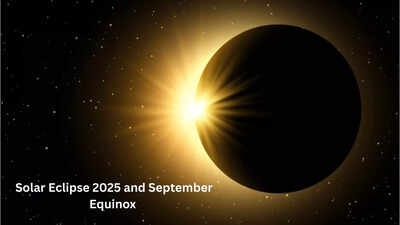
Get ready for a fascinating celestial event on September 21, 2025, as a partial solar eclipse graces our skies. Unfortunately, those in India won’t have a direct view of this “Surya Grahan” and will need to rely on live broadcasts. This particular eclipse is made even more special by its proximity to the September equinox, happening within the same 24-hour window.
Where to Witness This Solar Eclipse?
While a crescent sunrise solar eclipse will occur on Sunday, its visibility will be limited to specific parts of the world. Observers in Antarctica, the South Pacific, and New Zealand will have the extraordinary chance to see the sun rise as a distinct crescent shape.
Understanding the September Equinox
The equinox is scheduled for September 22 at 18:19 UTC. This marks the beginning of autumn in the Northern Hemisphere and spring in the Southern Hemisphere. On this significant day, both hemispheres experience nearly equal periods of daylight and darkness due to Earth’s 23.5-degree axial tilt. Following the equinox, the Northern Hemisphere will transition to longer nights, while the Southern Hemisphere will enjoy longer days.
The “Equinox Eclipse”: A Unique Phenomenon
This astronomical event is particularly noteworthy because it’s dubbed the “equinox eclipse,” happening precisely within the same 24-hour period as the September equinox itself. During this time, the sun appears to cross the celestial equator, ushering in the change of seasons for both hemispheres.
What Exactly is a Partial Solar Eclipse?
Unlike a total solar eclipse, where the Moon entirely obscures the Sun, revealing only its ethereal corona, a partial solar eclipse involves the Moon covering only a portion of the Sun. This creates the visual effect of a crescent moon, as only a segment of the Sun remains visible.
When is the Next Solar Eclipse on the Horizon?
The next anticipated solar eclipse will take place on February 17, 2026. This will be an annular solar eclipse, promising a breathtaking “ring of fire” effect, lasting for up to two minutes and twenty seconds.