
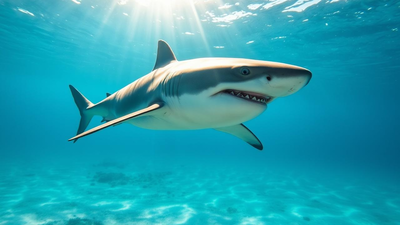
High above Sydney’s stunning beaches, a silent vigil is kept. Drones soar, diligently scanning the azure waters for any sign of the ocean’s apex predators. They search for the tell-tale flick of a tail, the subtle swish of a fin, or a shadowy form gliding through the waves. Australia’s vast oceans are undeniably rich with sharks, with the formidable great white often topping the list of species capable of a fatal encounter with humans.
Despite this ever-present risk, Australians are intrinsically drawn to the sea. A 2024 survey revealed that almost two-thirds of the population embarked on a staggering 650 million coastal visits within a single year. For many beach lovers, the inherent risks are simply part of the allure.
Tragically, when surfer Mercury Psillakis lost his life to a shark off a northern Sydney beach in September, his grieving family described it as a “tragic and unavoidable accident.” Scientists suggest that increasingly crowded waters, coupled with rising ocean temperatures that seem to be altering shark migratory patterns, might be contributing to a rise in attacks, even as overfishing threatens certain shark species.
Since 1791, Australia has recorded over 1,280 shark incidents, with approximately 260 resulting in fatalities, according to a national database. While still relatively rare, fatal attacks do appear to be on an upward trend, with 56 recorded deaths in the 25 years leading up to 2025, a notable increase compared to 27 deaths in the preceding quarter-century.
Guiding Sharks Away
Protecting people from sharks in Australia is a delicate and often debated issue. Authorities have adopted a comprehensive, multi-pronged strategy. This includes deploying drones for aerial surveillance, attaching acoustic trackers to sharks that are then detected by listening buoys near popular beaches, and providing real-time alerts through a mobile app. Additionally, traditional shark nets remain in use.
Drones have proven to be an invaluable asset, identifying over 1,000 sharks patrolling New South Wales coastal waters in the past year alone. “We operate with extreme caution,” explains Oliver Heys, a Surf Life Saving New South Wales drone pilot. “If we spot something, we zoom in to confirm if it’s a potentially dangerous shark. Once identified, a jet ski or inflatable rescue boat carefully guides the shark back out to sea.” Pilots primarily watch for three of the most perilous species: great whites, tiger sharks, and bull sharks. Since 2000, great whites have been responsible for a significant 42 percent of all recorded shark attacks.
The ‘Dinner Bell’ Debate
While shark nets are deployed annually during the summer months in New South Wales and Queensland, their efficacy and ethical implications are hotly contested. Plans by three local councils in New South Wales to remove nets for a trial run this year were regrettably abandoned after the fatal attack in Sydney last September.
Support for these extensive nets, which can stretch wider than a football field and plunge up to six meters deep, has diminished significantly. Critics argue that sharks can easily bypass them, and the mesh indiscriminately ensnares and kills much of the marine life it traps, including endangered turtles, dolphins, fish, and rays. Leonardo Guida, a shark scientist at the Australian Marine Conservation Society, contends that nets are obsolete and can, paradoxically, act as a “dinner bell,” attracting predators with trapped carcasses.
Many scientists champion more advanced and targeted techniques. In New South Wales, smart drumlines—anchored buoys fitted with baited hooks—send immediate alerts when a shark takes the bait, allowing the animals to be tagged. The innovative ‘Shark Smart’ mobile app then provides real-time notifications to swimmers, surfers, divers, and fishers when a tagged shark approaches a listening buoy near their favorite spots. However, this technology’s effectiveness relies on the shark being tagged or swimming within range of a detection buoy. Other Australian states utilize sturdy, wall-like structures that enclose headlands, offering a more contained protective barrier for swimmers.
“There is no magic solution,” says Guida. “We cannot eliminate 100 percent of the risk, but we can certainly mitigate it as much as humanly possible.”
Innovation in Wetsuits and Deterrents
Beyond detection and deterrence, scientists are also exploring ways to reduce the lethality of shark encounters. This includes developing bite-resistant materials for wetsuits and personal electronic deterrents.
Research funded by New South Wales and conducted by Flinders University professor Charlie Huveneers and his team suggests that certain bite-resistant wetsuits can significantly reduce injuries and blood loss—the primary cause of death from shark bites. Furthermore, Huveneers’ previous studies indicated that an effective personal electronic device, designed to repel sharks by disrupting their electro-sensory systems, could reduce bites by approximately 60 percent.
“Australia stands at the forefront of shark bite mitigation measures,” Huveneers asserts, adding, “We truly can save lives.”
Yet, researchers emphasize that the lives of sharks also require protection. Globally, a staggering 37 percent of oceanic shark and ray species are now classified as either endangered or critically endangered by the International Union for Conservation of Nature, a leading global authority on threatened species. While sharks may instill fear in Australia’s waters, official statistics highlight a far greater danger: drowning, which claimed 357 lives in the 12 months leading up to June this year.