
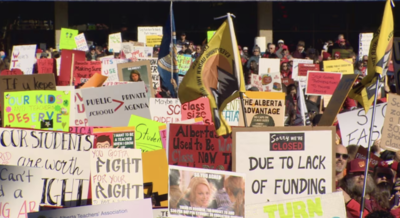
As Alberta’s education crisis enters its fourth week, the passionate debate surrounding classroom conditions, fair funding, and essential teachers’ rights has spilled from the halls of government into the vibrant community streets.
Over the past weekend, concerned citizens and educators from across Alberta converged in Calgary’s West Springs neighborhood. This area falls within the Calgary-Bow constituency, represented by Education Minister Demetrios Nicolaides since 2019. The rally, orchestrated by Public Interest Alberta, united members of the Alberta Teachers’ Association (ATA) and various supporters, all demanding a renewed and steadfast commitment to public education.
A Strike Rooted in Classroom Realities
Approximately 51,000 teachers, representing Alberta’s public, separate, and francophone school systems, have been on strike since October 6th. This prolonged action impacts nearly 750,000 K–12 students, as reported by CBC News.
Bradley Lafortune, executive director of Public Interest Alberta, characterized the protest as a crucial endeavor to "correct the course" of public education, a system he believes is "at risk of sinking." In his comments to CBC, Lafortune directly held Premier Danielle Smith and Minister Nicolaides accountable, asserting that both possessed the power to prevent the strike but "chose not to."
Demonstrators strategically placed yellow signs throughout the constituency, imploring residents to advocate for "sustainable and equitable funding" and to vociferously oppose the province’s contentious proposed Back to School Act (Bill 2), which aims to force teachers back to work.
Lafortune emphasized to CBC that implementing such legislation would "take away the right to strike" and fundamentally undermine any prospects of genuine, good-faith negotiations. Instead, he urged the government to pursue an agreement through open dialogue and to make a substantial, long-term investment in Alberta’s vital public education system.
A Parallel Political Undercurrent
This public demonstration coincided with a recall petition initiated against Minister Nicolaides. The petition, officially approved earlier this month under Alberta’s recently amended Recall Act—the first of its kind since the law’s revision—alleges the minister’s failure to adequately support public education.
Organizers, who were actively collecting signatures at the West Springs event, clarified to CBC that the protest and the recall initiative were distinct but related efforts.
In a statement shared across social media platforms, Nicolaides characterized the recall as a disagreement over "policy and priorities," rather than an issue of personal misconduct. He underscored his 2023 re-election, where he secured nearly 50% of the vote in Calgary-Bow, and reaffirmed his commitment to engaging constituents with "humility."
The petitioners face a deadline of January 21, 2026, to collect 16,006 signatures, which accounts for 60% of voters from the last provincial election. If successful, this process would initiate a referendum and potentially lead to a by-election.
Provincial Response and Legislative Direction
During her weekly radio program, "Your Province, Your Premier," Premier Smith confirmed her government’s intention to table back-to-work legislation on Monday. She acknowledged that teachers have consistently highlighted "complexity" within classrooms as a critical concern, but maintained that not all such challenges could be resolved through collective bargaining.
Smith informed CBC that the province’s latest proposal includes a 12 percent wage increase over four years, alongside funding allocated for 3,000 new teachers. She stressed that the government remains open to collaborative solutions through a proposed education task force, which would meticulously examine classroom needs on a "school-by-school basis."
The premier framed the escalating situation as a delicate balancing act, weighing the rights of teachers, parents, students, and taxpayers. "If they don’t voluntarily agree to return to work and engage in mediation, we will have to ensure classes resume," she stated, as reported by CBC.
Balancing Rights, Reform, and Responsibility
As the province prepares to enact legislation compelling teachers back into classrooms, the broader discourse surrounding Alberta’s education system continues to intensify. For dedicated educators, the strike has transformed into a profound call for respect, adequate resources, and a recognition of their invaluable contributions. For the government, this represents a significant test of both policy resilience and political determination.
With classrooms remaining quiet and negotiations at a standstill, Alberta stands at a pivotal juncture, grappling with the challenge of restoring educational stability while simultaneously reimagining the fundamental structure of its public education system.