
Bengaluru recently hosted the 29th Indian performance by Artie’s, a vibrant ensemble, as part of the International Music and Arts Society’s golden jubilee. Known for their refreshing and contemporary approach to Western classical music, curated by founder Gauthier Herrmann, Artie’s consistently delights Indian audiences with diverse programming. This particular evening was further enhanced by the unexpected and appealing addition of a vocalist.
The concert commenced with Mozart’s early violin and piano sonata K379, where the piano took a notably leading role, with the violin offering accompaniment. While this dynamic isn’t unusual given Mozart’s affinity for the piano in his early compositions (a balance he refined in later works), the piece still demands exceptional artistry. Pianist Nicolas Bourdoncle and violinist Mathilde Borsarello admirably captured Mozart’s intricate structure, tempo variations, and inherent lyricism.
Next was a selection from Handel’s ‘Giulio Cesare in Egitto,’ a Baroque opera seria celebrated for its powerful arias and rich orchestral backing. Gauthier’s transposition of the opulent ‘Overture’ for a trio, however, couldn’t quite replicate the grand scale and magnificence of the original.
Later in the program, soprano Marion Tassou delivered a moving rendition of ‘Piangerò la sorte mia’ (I will lament my fate) from the same opera. This poignant aria perfectly encapsulates Cleopatra’s raw emotions and anxieties as she confronts the potential loss of both her beloved Cesare and her political standing in a tumultuous, male-dominated era. Tassou masterfully conveyed the initial sorrow, then transitioned powerfully into the fiery B-section, expressing Cleopatra’s mounting rage in this da capo aria.
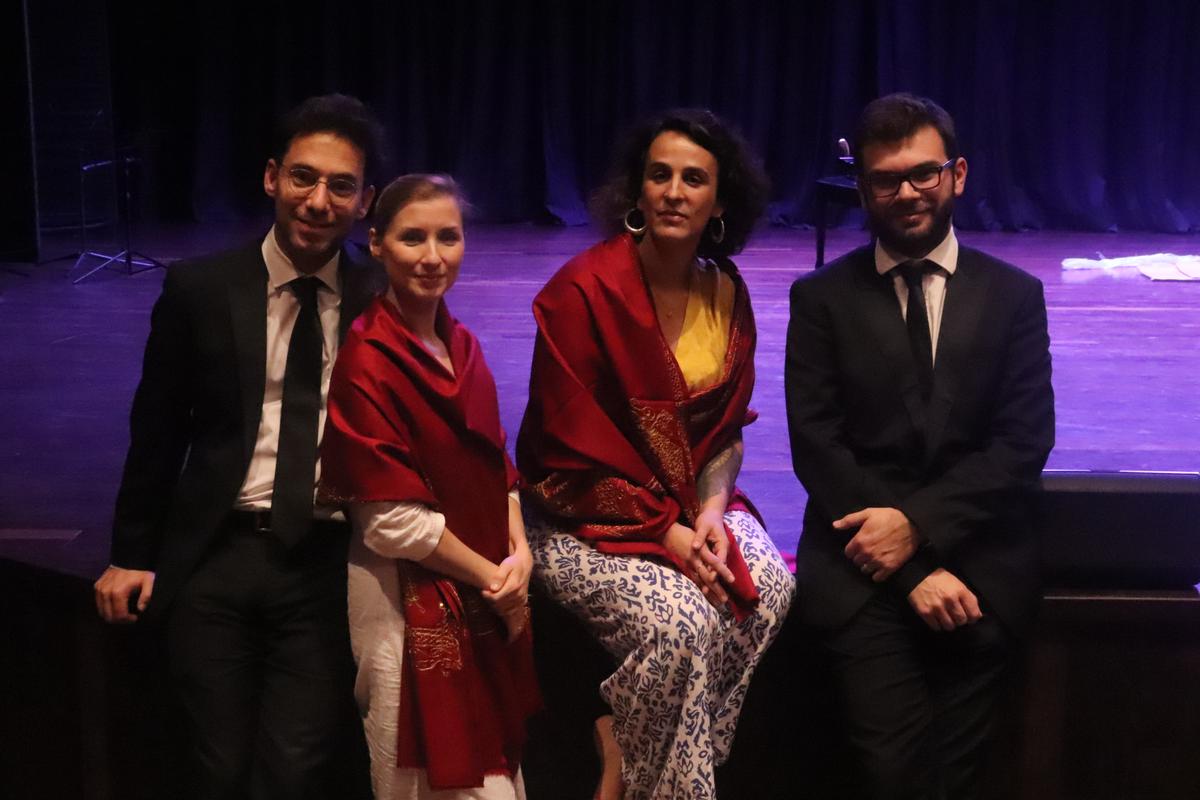
The Artie’s ensemble onstage during their recent captivating performance in Bengaluru. (Photo Credit: Special Arrangement)
A minor drawback of the evening was the lack of available translations for the vocal pieces, and the introductory remarks for the Reynaldo Hahn songs were insufficient. Hahn, a Venezuelan-born composer who made his life in France, might have been new to many in the audience. While not considered a ‘serious’ composer in the academic sense, he was celebrated for his popular ‘melodies’ that perfectly captured the essence of fin de siècle Paris. A well-connected figure in society, Hahn counted luminaries like Sarah Bernhardt among his close friends and was famously Marcel Proust’s only romantic interest. The program featured three of his songs, including ‘Descret Indolens au asard’ performed as a captivating solo piano piece. This was followed by the tender ‘L’heure Exquise,’ inspired by Verlaine’s poetry, and finally, the delightful ‘La Derniere Valse,’ which showcased Soprano Tassou’s versatility.
Following the intermission, the highlight of the program was Schubert’s ‘Piano Trio Op. 99,’ a remarkably expansive work for chamber music. Schubert, a profound admirer of Beethoven, had yet to compose a major work that he felt would impress his idol; perhaps this Trio served as his ambitious answer. The piece began with a joyous burst, as the violin and cello gracefully wove the melody over the piano’s energetic triplet runs. The Andante un poco mosso featured the cello gently swaying through a lilting, rhythmic melody. In the Scherzo, all three instruments engaged in a spirited, almost imitative dialogue. The classical Minuet section, initially sharp and staccato, eventually softened into a graceful waltz. The musicians, demonstrating exceptional skill and an impressive ensemble synergy, beautifully articulated Schubert’s signature blend of elegance and profound emotion.
The evening concluded on a delightful and humorous note with two arias from Offenbach’s operettas. Soprano Tassou perfectly captured the lighthearted charm of the ‘Grand Duchess Geroldstein,’ a character smitten with military men, showcasing her versatile, lighter vocal style in the joyous ‘Ah! How I love soldiers!’ She then delivered a captivatingly droll performance of ‘Tu n’es pas riche, tu n’es pas beau’ (You are neither rich, nor handsome) from the operetta ‘La Périchole,’ performed with both flair and technical polish. Tassou’s expressive hand gestures further enriched the storytelling in both comedic selections.
This charming and skillfully performed program ended with a perfectly light-hearted finale, leaving the audience thoroughly entertained and appreciative of the musicians’ artistry.