
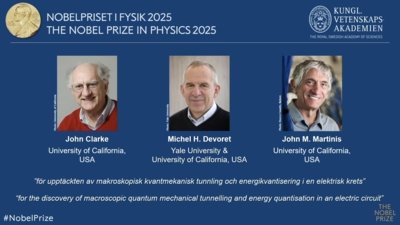
The scientific community is buzzing with excitement as the Royal Swedish Academy of Sciences proudly announced the recipients of the 2025 Nobel Prize in Physics: John Clarke, Michel H. Devoret, and John M. Martinis. These brilliant minds are being honored for their revolutionary work that revealed macroscopic quantum phenomena within superconducting circuits. Their pioneering experiments made it possible for us to observe quantum mechanical effects, like tunneling and energy quantization, in systems large enough to be held in one’s hand, effectively bridging the vast gap between the microscopic and macroscopic realms of physics.
What Earned Them the Nobel Prize?
The esteemed trio received this recognition for their “discovery of macroscopic quantum mechanical tunneling and energy quantization in an electric circuit.” Through a series of incredibly precise and groundbreaking experiments, they proved that superconducting circuits can indeed display quantum behaviors, which were previously believed to be exclusive to atoms and subatomic particles. Their work definitively demonstrated that such systems could ‘tunnel’ between different states and absorb or emit energy in distinct, discrete amounts. This not only confirmed long-standing predictions of quantum mechanics but also established the critical groundwork for the burgeoning field of modern quantum computing.
Meet the Laureates:
John Clarke
John Clarke embarked on his academic journey at the University of Cambridge, earning his BA, MA, and PhD in Physics between 1964 and 1968, affiliated with Christ’s College and Darwin College. His doctoral research delved deep into the complexities of superconductivity and quantum interference devices, quickly positioning him as a leading pioneer in superconducting electronics. Clarke’s comprehensive education provided him with an unparalleled understanding of quantum theory and experimental techniques, which proved indispensable for his later work in demonstrating macroscopic quantum tunneling.
Michel H. Devoret
Michel Devoret’s impressive academic path began with his graduation from the École Nationale Supérieure des Télécommunications in Paris in 1975. He then pursued an MSc in Quantum Optics from the University of Paris-Sud (Orsay) in 1976, followed by a PhD in Solid State Physics from the same prestigious institution in 1982. Devoret further refined his research prowess during a crucial postdoctoral period in John Clarke’s laboratory at UC Berkeley, where he was instrumental in conducting pivotal experiments on macroscopic quantum tunneling. His diverse international academic background uniquely prepared him to expertly blend theoretical physics with innovative practical experiments.
John M. Martinis
John Martinis completed both his BS (1980) and PhD (1987) in Physics at the renowned University of California, Berkeley. His doctoral research was foundational, pioneering the study of quantum-bit states in superconductors – work that would later become a cornerstone in quantum computing and superconducting qubits. Martinis’ education at Berkeley, coupled with extensive hands-on laboratory experience, enabled him to make essential contributions to the experiments that ultimately garnered this prestigious Nobel Prize.
Education: The Bedrock of Discovery
The remarkable educational journeys of Clarke, Devoret, and Martinis underscore the profound importance of rigorous academic training, dedicated mentorship, and access to state-of-the-art research facilities. Their university experiences were the fertile ground upon which groundbreaking experiments flourished, not only advancing fundamental physics but also enabling transformative technologies like quantum computers and the exciting field of circuit quantum electrodynamics (circuit QED).
Through their brilliant fusion of theoretical insight and experimental mastery, the 2025 Physics laureates have vividly demonstrated how a robust academic foundation can unlock discoveries that profoundly redefine our understanding of the physical universe.