
On Thursday, October 2, 2025, a wave of protests swept across France, with demonstrators in over 200 cities and towns vociferously condemning proposed spending cuts and demanding higher taxes for the wealthy.
The capital, Paris, saw thousands—including workers, retirees, and students—begin their march from Place d’Italie in the afternoon. A notable impact of these demonstrations was the closure of the iconic Eiffel Tower, as announced to visitors.
This nationwide strike, orchestrated by France’s prominent labor unions, marks another significant event in a series of ongoing protests that began last month, fueled by political unrest and intense debates over the national budget.
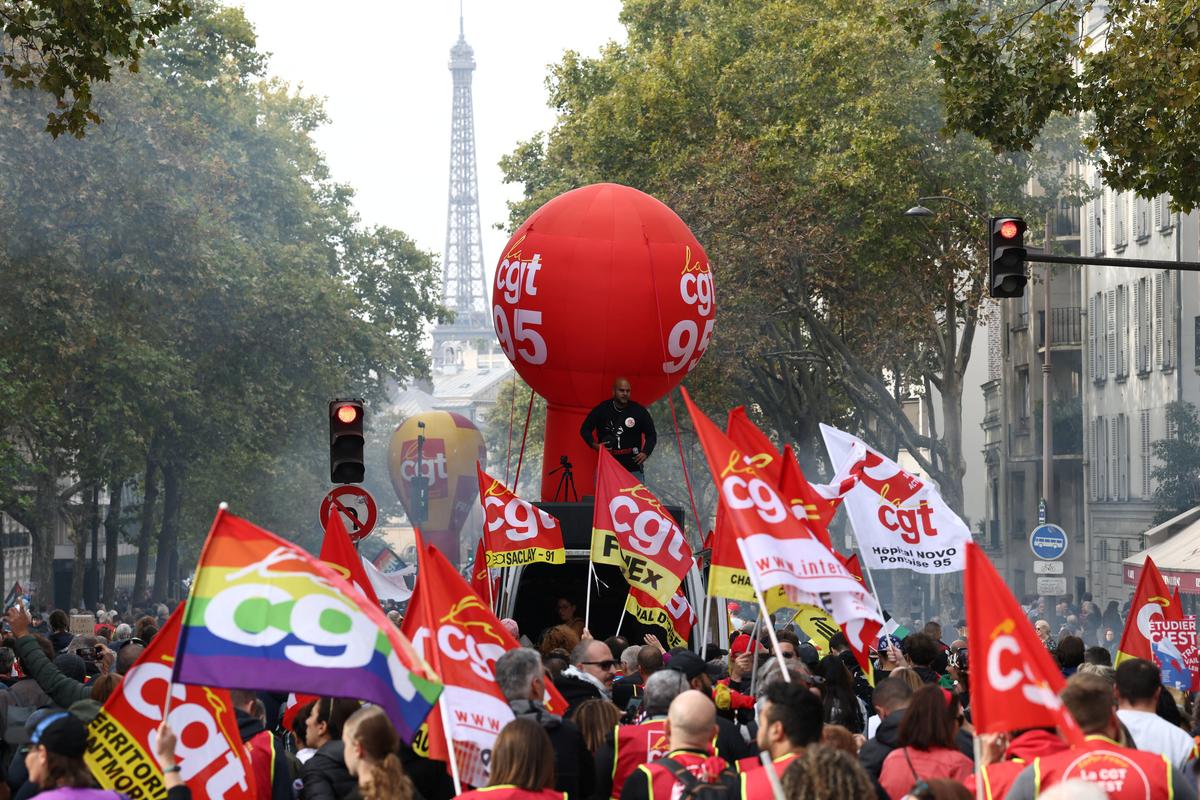
A striking visual from the Paris protests on October 2, 2025: demonstrators, many carrying CGT labor union flags, march past a large CGT balloon with the Eiffel Tower looming in the distance. This scene captures the essence of the nationwide outrage against government policies and potential austerity measures.
Unions are exerting considerable pressure on Prime Minister Sébastien Lecornu to scrap the preliminary budget proposals from his predecessor. These contentious measures include freezes on social welfare and other austerity policies, which critics argue will disproportionately harm the financial stability of low- and middle-income families. Furthermore, unions are pushing for increased taxation on the affluent.
Prime Minister Lecornu, who assumed office just last month, has yet to disclose the specifics of his own budget agenda or finalize his cabinet appointments, both anticipated soon. The proposed budget bill is slated for parliamentary debate later this year, amidst a visibly fractured political landscape.
Sophie Binet, leader of the influential CGT union, commented on Thursday, October 2, 2025, that the current situation—three days of strikes and protests within a month, even without a fully formed government or finalized budget—is unprecedented and a stark indicator of profound public discontent.
When questioned on BFM TV about the timing of these latest actions, Binet explained, “We are protesting now because we believe crucial decisions are being made, and we demand our voices be heard.” The French Interior Ministry reported that by midday, approximately 85,000 protestors had mobilized across France, excluding Paris.
Regarding public services, the national rail operator, SNCF, confirmed that high-speed train services operated as usual on Thursday, October 2, 2025, though some regional routes experienced minor interruptions. Within Paris, the metro system largely maintained normal operations, but several commuter train lines ran at reduced capacity.
While some educators and healthcare professionals participated, initial estimations suggest that overall participation in this latest strike was lower compared to last month’s turnout.
Previously, on September 18, over 500,000 individuals marched across France’s towns and cities, including Paris, as confirmed by police and interior ministry data. Union figures, however, claimed more than one million strikers and protestors nationwide.
Just a week prior, the ‘Block Everything’ campaign resulted in widespread anti-government actions across France, transforming streets into scenes of smoke, burning barricades, and tear gas volleys.