
In the emotionally charged final scenes of Sanju Surendran’s film, If on a Winter’s Night (also known as Khidki Gaav), a profound silence settles over the audience. Protagonists Abhi and Sarah, brought to life by Roshan Abdul Rahoof and Bhanu Priyamvada, find themselves in an indefinite wait at a bus stop. The biting Delhi winter night, depicted with chilling realism through cold tones and powerful acting, culminates in an unexpected downpour, painting a stark, poignant portrait of a young Malayali couple navigating the migrant experience.
For director Sanju Surendran, however, Khidki Gaav marks the triumphant conclusion of a deeply personal and prolonged journey. Filming in Delhi had been hampered for several winters by a severe lack of resources. Now, with the film securing the prestigious Hylife Vision Award at the recently concluded Busan International Film Festival 2025, Surendran feels his labor of love is finally receiving the recognition it deserves. The movie proudly competed in the festival’s esteemed Asia Vision category.
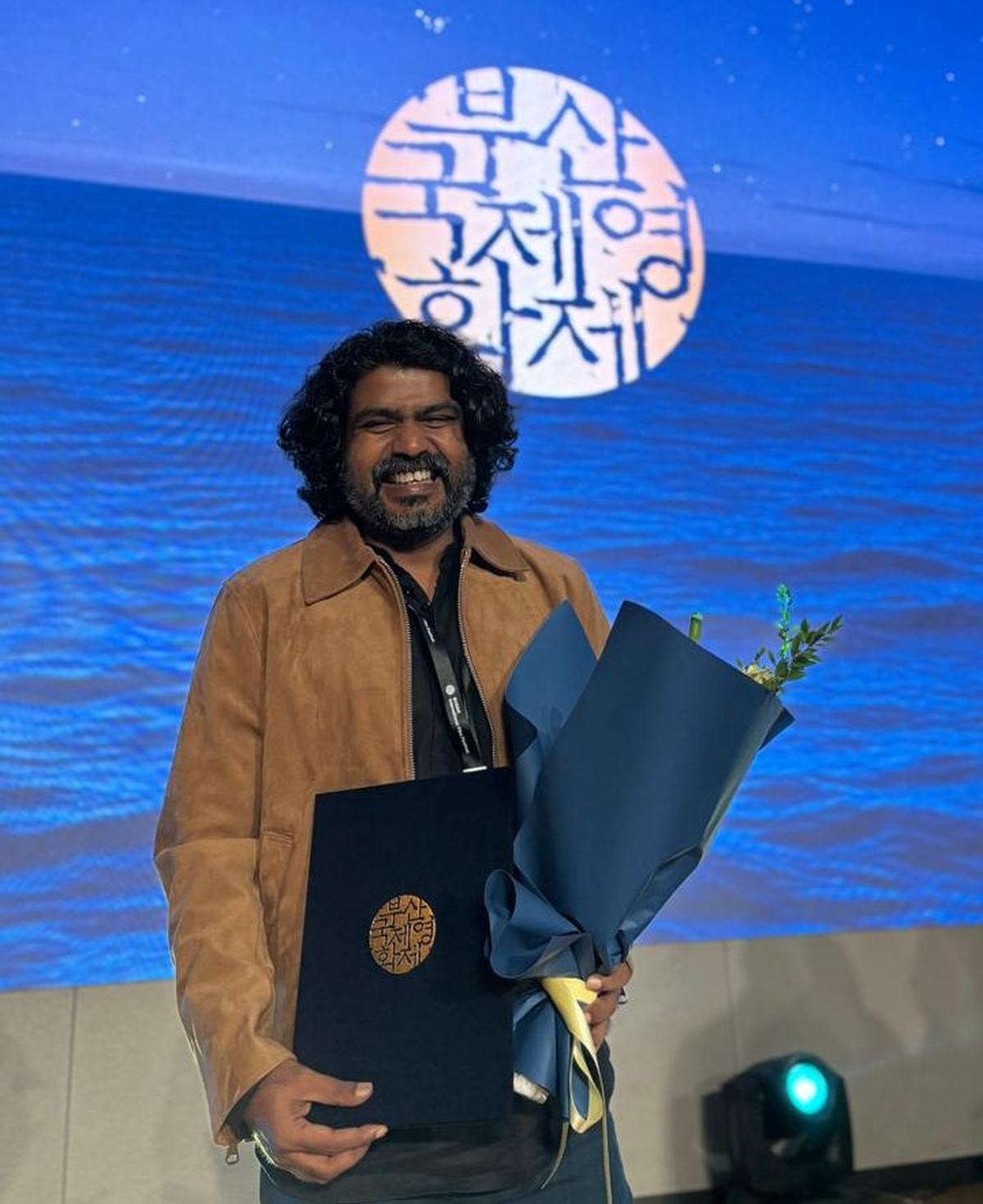
Sanju Surendran proudly accepts the Hylife Vision Award at the Busan International Film Festival 2025. (Photo Credit: SPECIAL ARRANGEMENT)
Filmed during the first half of 2024, the movie intimately portrays the lives of a young Malayali couple navigating a live-in relationship in the bustling city of Delhi. As they struggle to make ends meet, Abhi grapples with a formidable language barrier, while Sarah bravely confronts the pressures of her controlling family.
“Our aim was to delve into the nuances of modern relationships within an urban setting, exploring their inherent complexities, triumphs, and struggles,” Sanju explains. He credits scriptwriter Rekha Raj for her exceptional work in crafting the contrasting yet compelling characterizations of the film’s lead couple.
“This film draws inspiration from the personal experiences of several of my friends,” Sanju reveals. He recounts that the initial discussions for Khidki Gaav sparked when Rahul Pratap Singh, the movie’s Hindi dialogue writer, brought up Ritwik Ghatak’s 1957 film Musafir, a story centered around a rented house and three individuals at various junctures of their lives.
Initially funded by generous financial contributions from Sanju’s friends within the film industry, Khidki Gaav soon garnered significant attention. It was recognized as a Top Selects film at the Waves Bazaar project market in Mumbai earlier this year, subsequently securing the crucial Asian Cinema Fund grant for post-production. The film also participated in the CineV-CHD project market in Chandigarh. A delightful surprise for Sanju was the involvement of acclaimed director Payal Kapadiya, who joined the project as an executive producer.
Delhi and the Winter’s Embrace
“The film’s Hindi title, Khidki Gaav, directly references its setting—a village in Delhi renowned for providing affordable student housing,” Sanju clarifies. “Meanwhile, the English title, If on a Winter’s Night, speaks to the specific time and season in which our story unfolds.”
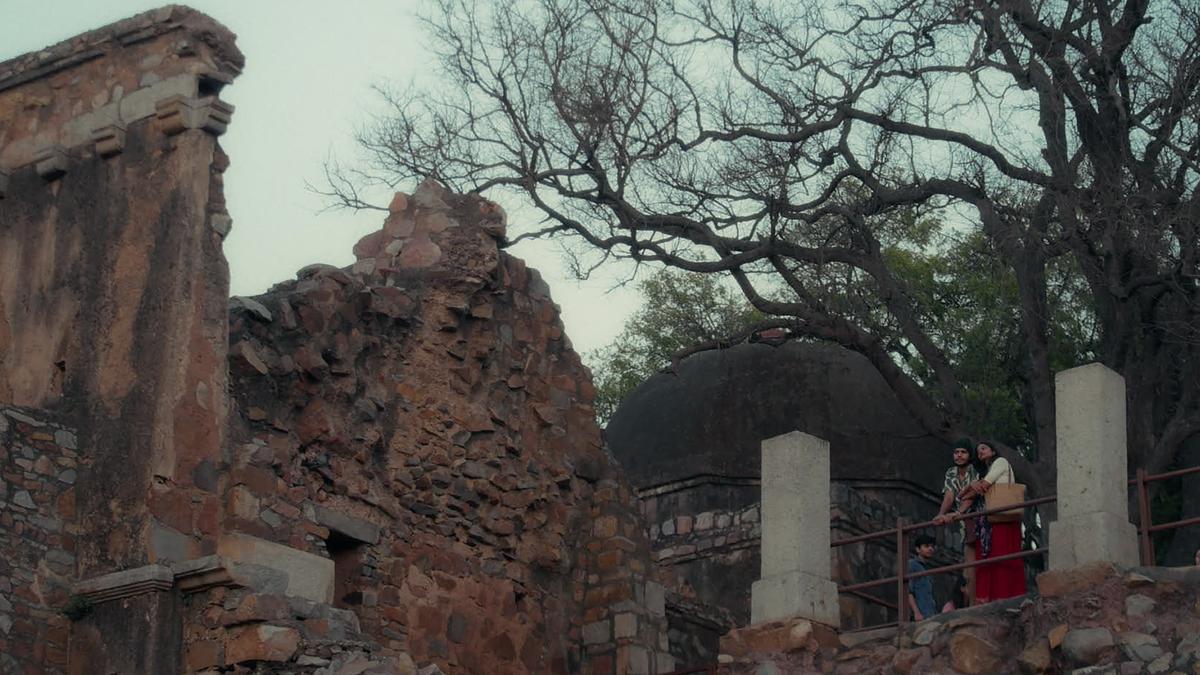
A captivating still from the film ‘Khidki Gaav.’ (Photo Credit: SPECIAL ARRANGEMENT)
“Even a week into our shoot, we were still desperately searching for a suitable house for our protagonists,” Sanju recounts. “Several individuals who initially agreed had withdrawn their offers. Eventually, we managed to secure a student’s apartment, minimally furnished with just a bench, a desk, and beds.”
He emphasizes the pervasive challenge: “Finding accommodation as a bachelor is tough everywhere, and this difficulty is compounded by the North-South divide. We even encountered places that exclusively rented to vegetarians. The film serves as a poignant distillation of these very real experiences.”
Sanju also notes that Delhi presents significant challenges for filmmakers. “When I filmed my first movie, Aedan: Garden of Desire (2017), in Kerala, the process was seamless,” he states. In Khidki Gaav, Delhi itself becomes a character, particularly through Abhi’s struggle with the Hindi language.
Sanju, a former student of the late Mani Kaul, the legendary filmmaker and professor at the Film and Television Institute of India, Pune, shares an amusing anecdote. He recalls how their landlord—a vibrant character known for his Hawaii shirts, gold bracelets, and Royal Enfield rides reminiscent of Fahadh Faasil’s role in Aavesham—celebrated his birthday on set by creating Instagram reels with art director Fyodor Sam Brook and production designer Dileep Das. Sanju humorously recounts asking about this, to which Dileep replied, ‘If we don’t keep him entertained, he might just disrupt our climax shoot!’
A keen admirer of French filmmaker Robert Bresson, Sanju embraced Bresson’s concept of ‘grace’ – the notion of a fortunate accident occurring during filming. This approach, coupled with guerrilla shooting techniques, significantly benefited the production, according to the director.
“I truly appreciate the power of improvisation,” Sanju states. “Even with a carefully crafted script and talented actors, we strive to push boundaries. We were working within incredibly confined spaces, and if those environments weren’t portrayed creatively, the film could easily have felt repetitive.”
He offers an example: during a pivotal scene where the protagonists are overwhelmed by sadness and frustration, the camera spontaneously cuts to a passerby wearing a t-shirt emblazoned with the word ‘miserable.’ “Many of these elements simply unfolded during filming,” Sanju notes. “Even the rain that occurs during the climax was an unexpected, yet perfect, addition.”
Crafting the Ensemble
“Roshan reached out to me via social media after I posted a casting call,” Sanju recounts. “I immediately sensed in him a genuine spark of innocence that I knew would perfectly embody the character.” Roshan had previously risen to fame with his debut in Omar Lulu’s Oru Adaar Love, notably alongside Priya Prakash Warrier, particularly for his role in the viral song ‘Manikyamalaraya’.
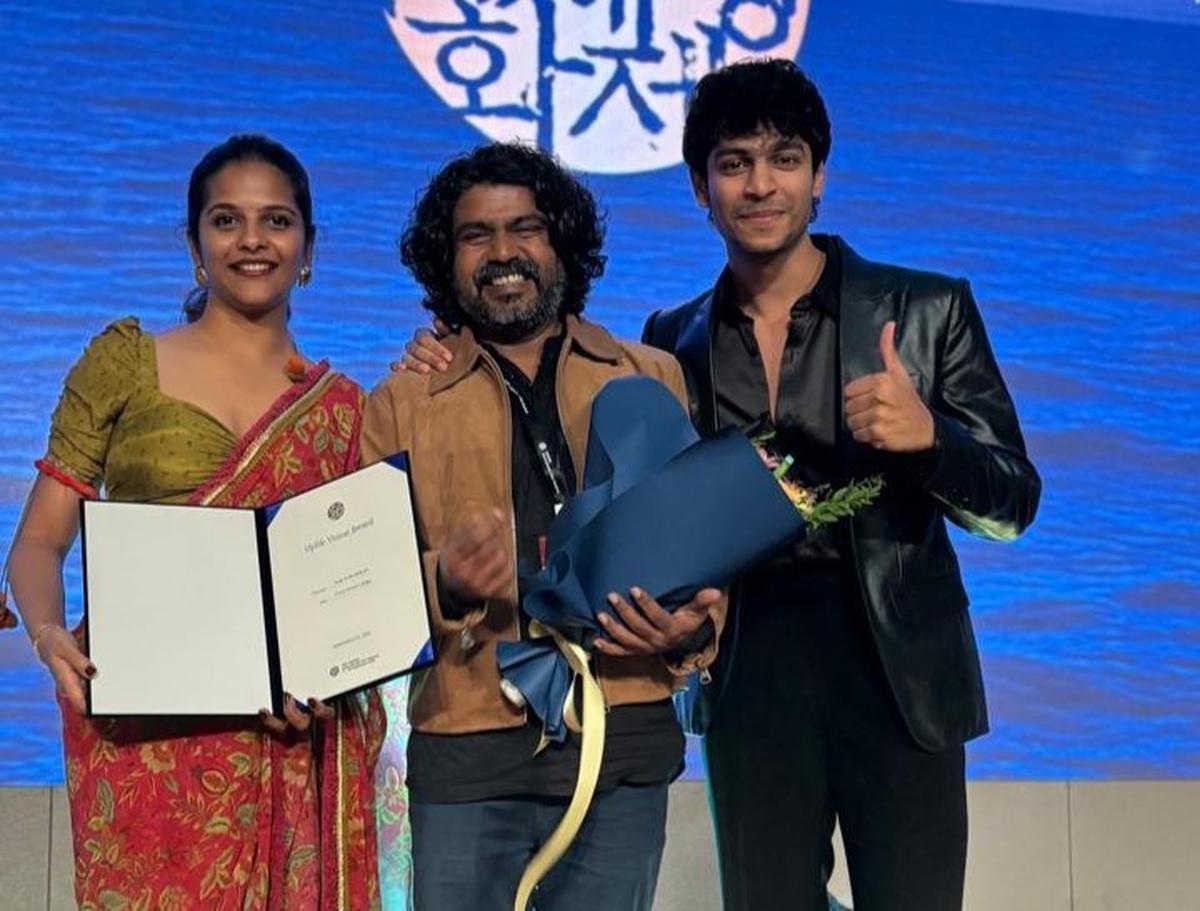
Bhanu Priyamvada, director Sanju Surendran, and Roshan Abdul Rahoof celebrate their Hylife Vision Award win. (Photo Credit: SPECIAL ARRANGEMENT)
“Bhanu, an actress with roles in Madras Matinee (2025) and Daveed (2025), joined the project at the eleventh hour after several others had withdrawn,” Sanju explains. “She delivered a truly authentic performance as Sarah. Jitheesh Raichel Samuel also provided a strong portrayal as Simon.”
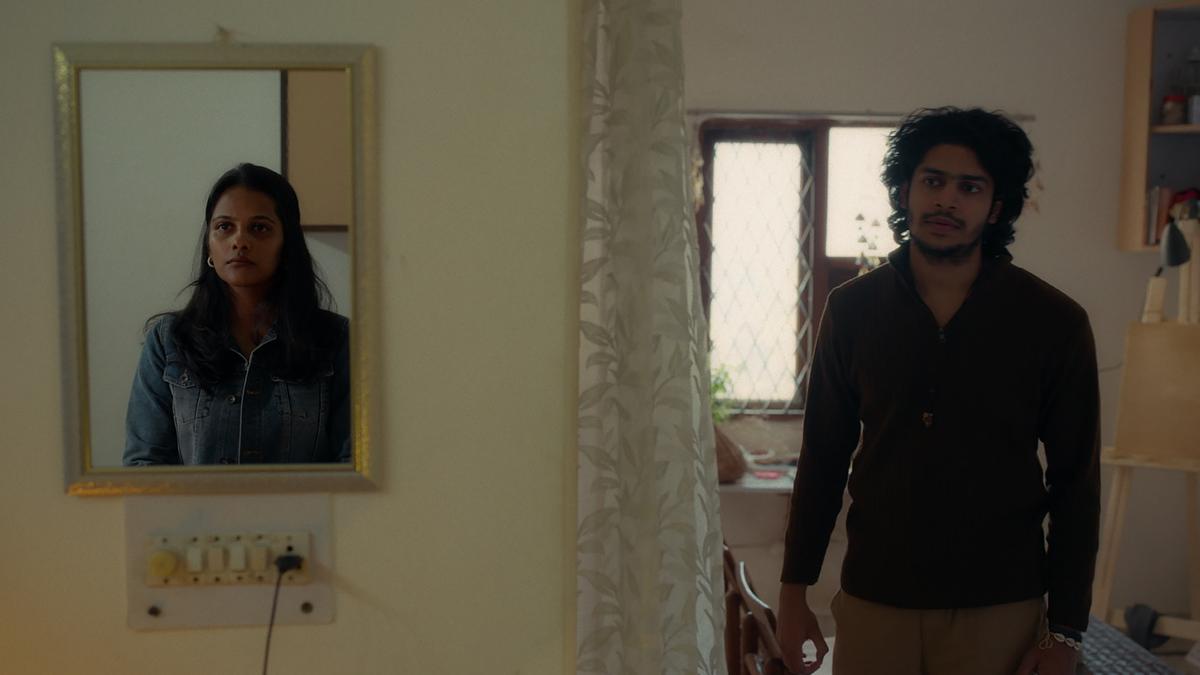
More captivating stills from ‘Khidki Gaav.’ (Photo Credit: SPECIAL ARRANGEMENT)
Both Roshan and Arathy KB, who portrays Gopika, participated in intensive acting workshops. “Crucially,” Sanju emphasizes, “we filmed for 42 days, allowing the cast to spend significant quality time together. This immersive experience enabled them to truly embody their characters and perform with remarkable confidence.”
“Color grading is absolutely vital to the film’s impact,” Sanju explains. “I’m incredibly thankful to our colorist, Ethan Park, who joined us once we secured the Asian Cinema Fund. His unique ability to perceive the world through textures and colors was instrumental in creating the powerful wintery atmosphere for the audience.” He also commends Leena Thushara for her costume design and veteran Manesh Madhavan for his stunning cinematography.
Looking Ahead: Future Projects
Sanju, acclaimed for directing the national award-winning documentary Kapila, expresses his artistic philosophy: “I approach each film as a distinct journey, consciously avoiding self-repetition or adherence to a specific success formula. The creative process for Khidki Gaav diverged significantly from that of Aedan; every film truly feels like a fresh adventure.” He is currently preparing for his next directorial venture, Fishers of Men/Kothiyan, penned by S. Harish. This upcoming project earned recognition as the second-best film at last year’s National Film Development Corporation’s Film Bazaar co-production market.
He concludes by acknowledging the road ahead: “For Khidki Gaav, we are eagerly awaiting responses from several more film festivals and are making plans for a limited theatrical release. We understand it’s a challenging path, but we are ready for the journey.”